

Last Updated: November 4, 2026
Quick Summary
Propane heating offers measurable environmental advantages: propane contains no sulfur and produces no sulfur dioxide, emits minimal particulate matter compared with heating oil, and dissipates as vapor if released rather than pooling in soil or water. High-AFUE propane furnaces also convert most fuel energy into usable heat, improving efficiency.
- Propane contains no sulfur, so combustion produces no sulfur dioxide.
- Propane spills dissipate as vapor, while heating oil pools and persists.
- AFUE expresses the share of fuel energy that becomes usable heat over a season.
- An oversized furnace short-cycles, never reaches steady-state efficiency, and wears out faster.
- Renewable propane is chemically identical to conventional propane and compatible with existing furnaces.
Table of Contents
- How Propane Heating Systems Stack Up on Emissions
- Propane vs Heating Oil Environmental Impact: The Side-by-Side
- Propane Heating Efficiency Ratings That Change the Math
- Air Quality, Particulate Matter, and What Comes Out of the Flue
- Storage, Leaks, and Soil and Water Safety on Your Property
- What Propane Critics Get Right, and Where the Case Still Holds
- Check Propane Prices Before You Commit to a Fuel Switch
- Frequently Asked Questions
How Propane Heating Systems Stack Up on Emissions
Propane heating is often marketed as a cleaner fossil fuel, and the environmental benefits of propane heating systems come down to three measurable factors: combustion efficiency, greenhouse gas output per unit of heat delivered, and how the fuel behaves if it escapes. This guide from Discount Propane examines each factor with the available research, including where the claims hold and where critics have a point.
The stakes are practical. Homeowners weighing a conversion from oil, and contractors specifying heat for a job site, both need numbers rather than slogans.
What Clean-Burning Actually Means at the Burner
Clean-burning is a combustion property, not a marketing label. Propane burns with a high combustion efficiency, meaning most of the fuel converts to heat, water vapor, and carbon dioxide rather than unburned residue.
The National Institute of Standards and Technology study on heating fuel sustainability examined energy, environmental, and economic tradeoffs across residential heating designs, a useful frame for comparing fuels on more than one axis.
Greenhouse Gas Numbers Beyond the Hype
Every fuel claim deserves scrutiny, including this one. Propane is a fossil fuel, and combustion produces carbon dioxide.
What the available industry figures do support is a relative advantage over oil and electric resistance heating in many applications. The U.S. Energy Information Administration’s Winter Fuels Outlook confirms propane remains a primary space heating fuel in the Northeast and upper Midwest, which keeps the comparison relevant for most of this region’s housing stock.
Propane vs Heating Oil Environmental Impact: The Side-by-Side
Propane vs heating oil environmental impact comes down to what leaves the flue and what stays in the tank. Propane contains no sulfur, so it produces no sulfur dioxide from combustion.
| Factor | Propane | Heating Oil |
|---|---|---|
| Sulfur dioxide | None | Present in combustion |
| Particulate matter | Minimal | Higher |
| Spill risk | Vapor dissipates | Liquid pools and persists |
| Storage life | Indefinite in a sealed tank | Degrades over time |
| Retrofit path | Often a burner or appliance swap | Full system replacement |
For a broader breakdown of tradeoffs, see our comparison of propane vs electric heating pros and cons.
Propane Heating Efficiency Ratings That Change the Math
Efficiency ratings decide whether the emissions advantage survives contact with a real house, and the rating that matters most is annual fuel utilization efficiency (AFUE). AFUE expresses the share of fuel energy that becomes usable heat over a full heating season, so a furnace rated at 90 AFUE converts roughly 90 percent of the fuel’s energy into heat and loses the rest, mostly up the flue. Older atmospheric propane furnaces and modern condensing units differ in AFUE rating, and the rating shows how much of the fuel becomes usable heat over a season.
The comparison that changes the math is against electric resistance. A baseboard heater converts electricity to heat at essentially 100 percent at the point of use, which is why resistance heating is sometimes described as perfectly efficient. That description stops at the meter. Once you account for generation losses at the power plant and transmission and distribution losses on the grid, the effective efficiency of resistance heating per unit of primary energy is far lower, and the gap versus a high-AFUE propane furnace widens further in regions with carbon-intensive generation. Heat pumps are the exception worth naming: in mild climates a properly sized heat pump can deliver more heat per unit of electricity than resistance heating, and an honest efficiency comparison should treat heat pumps as a real competitor rather than ignore them. The same attention to energy inputs applies beyond space heating, since energy efficient water heaters can also reduce the electricity or fuel needed to meet a household’s hot-water demand.
Sizing and commissioning matter as much as the nameplate. An oversized furnace short-cycles, never reaches steady-state efficiency, and wears out faster; an undersized one runs continuously and never satisfies the thermostat. A room-by-room load calculation is generally a more reliable basis for sizing than a rule of thumb based on square footage. Duct leakage is the other silent tax, conditioned air lost to an attic or crawlspace is heat you paid for and never felt.
Once the equipment is right, the next lever is the building. See our guide to improving home heating efficiency with propane.
Here is the forward-looking angle most efficiency content misses: efficiency gains are not the only way propane’s carbon profile improves. Read how renewable propane works with existing equipment in our article on renewable propane compatibility with existing furnaces.
Air Quality, Particulate Matter, and What Comes Out of the Flue
Particulate matter is the pollutant most directly tied to what a neighbor breathes. Nitrogen oxides are still produced during propane combustion, so propane is not clean in absolute terms.
Carbon monoxide is the one output that demands respect. It is a product of incomplete combustion, and it appears when equipment is poorly maintained or improperly vented (the EPA). Annual servicing and working carbon monoxide alarms are not optional.
Storage, Leaks, and Soil and Water Safety on Your Property
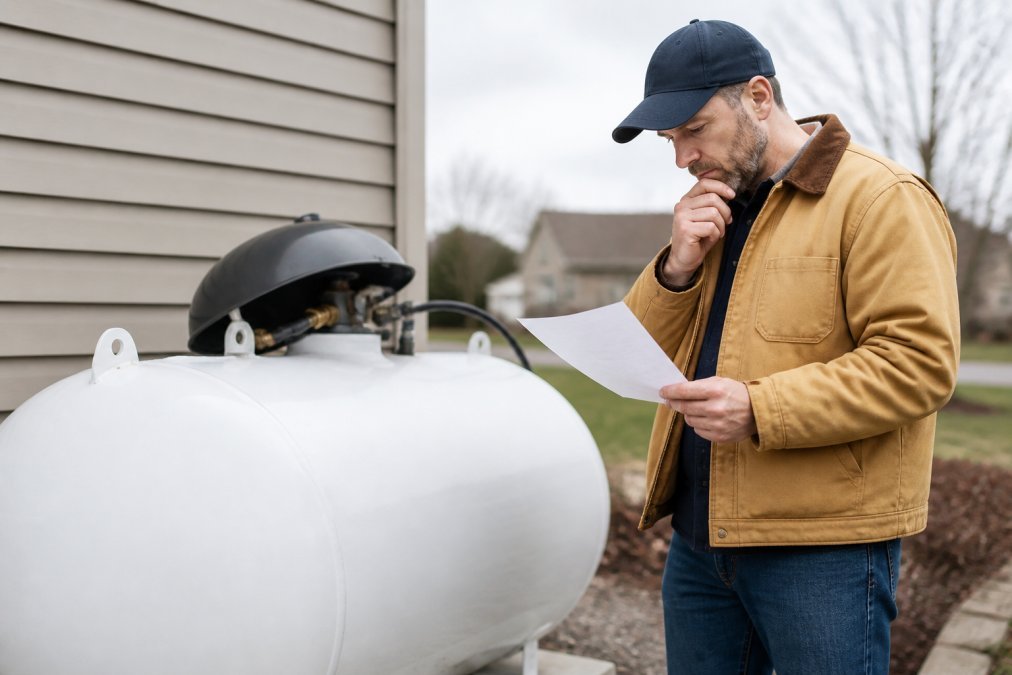
Fuel leakage is where fuel type matters most for local soil and water. Propane is stored as a liquid under pressure and returns to vapor if released.
That does not make propane risk-free. A leak is still a serious event, and every tank needs functioning safety valves and sensible clearance from structures. Know the response steps in advance with our guide to what to do during a propane gas leak.
What Propane Critics Get Right, and Where the Case Still Holds
Propane is a fossil fuel, not a zero-emissions heating source, and combustion produces carbon dioxide and other byproducts.
Where the case still holds is on relative emissions, air quality, and spill behavior, and on the fuel’s forward path. Renewable propane is chemically identical to conventional propane and compatible with existing furnaces, which means today’s equipment is not a dead end. Read how that works in our article on renewable propane compatibility with existing furnaces.
Check Propane Prices Before You Commit to a Fuel Switch
The environmental case only matters if the economics work for your building. Propane pricing varies with volume, delivery timing, and tank arrangement, so a quote from six months ago tells you very little about today.
You can check propane prices on the Discount Propane website before you order, schedule delivery from your phone or PC, and choose from the available payment options, with no commitment required to look.
Frequently Asked Questions
Is propane actually environmentally friendly?
Propane is a fossil fuel, so it is not zero-emissions, and any claim otherwise is wrong. Compared with the fuels it usually replaces, it performs better on several measures. The honest framing: cleaner than oil and resistance electric, not cleaner than a fully renewable system.
How does propane compare to heating oil in terms of emissions?
The bigger practical difference is sulfur. Heating oil contains sulfur, which contributes to sulfur dioxide emissions; propane does not.
What is the 80/20 rule for propane?
Furnace efficiency is rated by annual fuel utilization efficiency (AFUE), which expresses the share of fuel energy that becomes usable heat. A higher-rated unit burns less fuel for the same heat output. Ask for the AFUE rating on any unit before you buy, and match the venting setup to the rating.
Does using propane help reduce a home’s carbon footprint?
It can, depending on what you are replacing. The U.S. Energy Information Administration’s Winter Fuels Outlook reports on propane’s role as a space heating fuel in the Northeast and upper Midwest. If your baseline is a heat pump on a low-carbon grid, the advantage narrows, so compare your actual current system before assuming a gain.
The environmental benefits of propane heating systems are real but conditional: they depend on the equipment, the maintenance, and the fuel you are replacing. If you are ready to compare options, get a propane price from Discount Propane and see the numbers for your property before you decide.
