

Table of Contents
- What to Do If You Smell Propane
- Propane Leak Symptoms and Warning Signs
- How to Detect a Propane Leak Safely
- Immediate Actions: The First 60 Seconds
- Propane Gas Emergency Procedures: Calling for Help
- When It’s Safe to Shut Off the Propane Supply
- Returning to Your Home or Facility After a Leak
- Frequently Asked Questions
Last Updated: October 6, 2026
What to Do If You Smell Propane
A strong rotten-egg smell is the telltale sign of a propane gas leak, an odor added on purpose so you can detect it.
Propane is odorless in its natural state, so any rotten-egg smell means propane is escaping, a fire and explosion risk.
Most propane emergencies can be contained if you act within the first 60 seconds. The smell is your early warning system, trust it.
Propane Leak Symptoms and Warning Signs
Beyond the rotten-egg odor, watch for these additional warning signs of a propane gas leak:
- Hissing or whistling sounds near the tank or supply line
- Dead plants or grass in a concentrated area around the tank
- Frost or ice buildup on a propane cylinder or regulator in warm weather
Small leaks can develop without a strong smell. If your heating system stops working or your grill won’t ignite, check the tank and connections before assuming equipment failure.
Indoor leaks are the highest risk: propane is heavier than air and sinks to low points. If you smell it inside, act immediately.
How to Detect a Propane Leak Safely
To confirm a suspected propane gas leak, use a simple soap solution test.
Steps to test for a leak:
- Mix dish soap with water in a spray bottle
- Apply the solution to all visible connections and fittings on your tank
- Look for bubbles forming at any joint or valve
- Bubbles mean gas is escaping
Never use a lighter, match, or any ignition source near a suspected propane gas leak.
If you find bubbles, stop testing, move away, and follow the emergency procedures below. Do not tighten connections or repair anything yourself.
Inspect outdoor tanks yearly for damage, corrosion, or loose fittings.
Immediate Actions: The First 60 Seconds
Your first move depends on where the propane is coming from. Use the branch that matches your situation, then follow the shared rules.
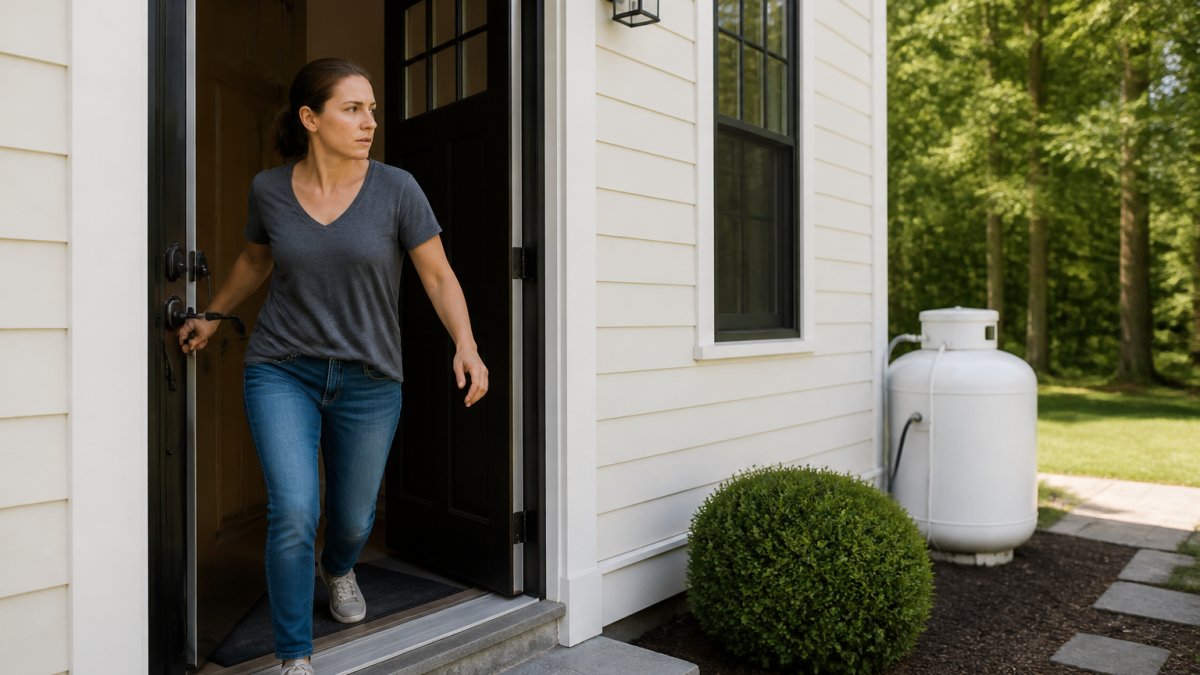
Branch A: You smell propane indoors
- Do not touch light switches, thermostats, garage door openers, or appliance controls. Do not use a landline, doorbell, or start a car in an attached garage.
- Get everyone out through the nearest door or window. Do not stop for belongings or lock doors behind you.
- Help children, older adults, and anyone with limited mobility first, but do not re-enter. Tell responders who may still be inside and where they were last seen.
- Once outside, walk upwind and at least 50 feet from the building and any tank or meter. Keep going until the odor is gone.
- From that safe distance, call 911 or your propane supplier. Do not go back inside until a responder or qualified technician clears the structure.
If you have a pet that will not come when called, leave the door open as you exit and call the animal from outside. Do not go back in after it. Firefighters and animal control are equipped to retrieve pets from a gas-filled structure.
Branch B: You smell or hear a leak at an outdoor tank
- Move upwind, away from the tank. Avoid walking between the tank and the building.
- Warn anyone else outside, neighbors, contractors, children, to move away and not approach.
- Do not start vehicles, mowers, generators, or any engine- or motor-driven equipment within the odor area.
- Do not attempt to shut off the tank valve unless every condition in the shutoff section below is met.
- Call 911 or your propane supplier from at least 50 feet away and upwind. Give the tank size and location if you know it.
Branch C: A small portable cylinder is leaking
- If the cylinder is outdoors and upright, leave it. Do not carry, roll, or load it into a vehicle.
- Move people and pets upwind and at least 50 feet away.
- If the cylinder is indoors, evacuate immediately and call 911. Never move a leaking cylinder through an enclosed space.
- Do not throw water on the cylinder, tape or bag the valve, or submerge it.
- If the cylinder is in a vehicle, park away from buildings and people, shut it off, exit, and move upwind. Call 911 and say the cylinder is in a vehicle.
Shared rules for all three branches
- No flames or sparks. No smoking, lighters, matches, candles, grills, fire pits, or pilot lights. A single spark can ignite propane vapor.
- No switches. Treat every electrical switch, doorbell, garage opener, and appliance control as a potential ignition source until you are outside and clear of the odor.
- Phones are fine once you are clear. A cell phone used outdoors, upwind, and at least 50 feet from the source is not an ignition risk. Do not use a phone inside the odor area.
What to tell the dispatcher
Have these details ready:
- Your exact address or a clear location description
- That you smell propane or suspect a propane leak
- Whether the leak is indoors, at an outdoor tank, or from a portable cylinder
People who may not smell the odor
Propane’s odorant can fade, and some people have a reduced sense of smell. If someone in the household has a medical condition, respiratory illness, or known loss of smell, do not rely on them to detect a leak. Install a propane or combustible gas detector near the floor in rooms with propane appliances and test it per the manufacturer’s instructions.
The first 60 seconds are about distance, not diagnosis. Get out, get upwind, get 50 feet or more away, and call from there. Everything else can wait.
Propane Gas Emergency Procedures: Calling for Help
Once at a safe distance, call for help.
If the leak is at your home or business:
Call your propane supplier first with your account number, address, and a clear description.
If you do not know your supplier’s emergency number, call 911.
If the leak is at a commercial facility or construction site:
What to tell emergency responders:
- Your exact location (address or building name)
- That you smell propane or suspect a propane gas leak
- How many people are in the area and whether anyone is injured
Do not return to the building or get closer to the leak while waiting for help.
When It’s Safe to Shut Off the Propane Supply
Most people assume the first move is to run to the tank and close the valve. Often that instinct is more dangerous than doing nothing. Shutting off the supply depends on whether you can reach the valve without moving toward the leak, and whether the leak is at the tank or a downstream connection.
The default rule: do not approach the tank
If you smell propane strongly, hear gas escaping, or see frost, damage, or a plume near the tank, do not walk toward it.
Do not approach the tank or attempt shutoff if any of these are true:
- You smell propane strongly, or the odor gets stronger as you move toward the tank
- You hear hissing, whistling, or a steady roar near the tank or regulator
- The tank, valve, pigtail, or regulator shows visible damage, frost, or ice in warm weather
In any of those cases, evacuate first. Call 911 or your propane supplier from a safe distance and let them make the shutoff decision.
When a shutoff may be appropriate
A trained or capable adult can safely close a supply valve only when all of the following are true at once:
- The odor is faint and does not intensify as you approach
- The leak is clearly downstream of the tank, at an appliance connection or a flexible connector inside a well-ventilated space
- You can reach the tank valve from upwind, in open air, without passing through the odor
If even one condition is not met, do not attempt it. A closed valve is not worth standing next to an uncontrolled release.
Never use a tool to force a stuck propane valve. A valve that will not turn by hand may be damaged, and forcing it can shear the stem and turn a small leak into a full-bore release. Back away and let the supplier or fire department handle it.
How to close a propane tank valve if it is safe
On a standard ASME or DOT cylinder, the service valve is the round handwheel on top. Turn it clockwise (right to close) until it seats; do not overtighten.
If a remote or excess-flow valve has tripped, you may hear a click and flow may stop on its own. Do not assume the leak is resolved, the system still needs a pressure test before returning to service.
What not to do at the tank
- Do not use a phone, flashlight, or any device with a switch within the odor area
- Do not smoke, vape, or carry any open flame
- Do not start a vehicle or piece of equipment nearby
Cylinder-specific note
For a small portable cylinder (grill, camp, or forklift tank), the same logic applies. If it leaks at the valve or collar, do not carry it outside. Move people away; if it is outdoors and upright, leave it and call for help. If indoors, evacuate and call 911, never move a leaking cylinder through an enclosed space.
After the valve is closed
A closed valve is not a repair. A qualified propane professional must leak-test the system with a manometer or electronic detector before any appliance is relit. Ask the technician to document the leak location and repair, and keep that record with your tank paperwork. If the same fitting leaks again, the cause is usually a worn connector, damaged regulator, or shifted tank, not the valve.
Returning to Your Home or Facility After a Leak
After responders clear the area, do not assume it is safe to return immediately. Follow these steps.
Wait for official clearance:
Before you return:
- Ventilate the building thoroughly by opening all windows and doors
- Leave the space empty for at least 30 minutes after the last odor is detected
- Do not light any flames or use any electrical appliances until cleared
After you return:
Request a full system inspection from your propane supplier. A leak often signals a larger problem.
If the smell returns after a few hours or days, evacuate again and call for help.
For residential customers, Discount Propane offers transparent pricing and easy online ordering.
Frequently Asked Questions
What should I do immediately if I smell propane in my home?
Evacuate the building or area at once. Leave doors and windows open as you exit. Once outside and at a safe distance (at least 300 feet away), call emergency services (911) or your propane supplier from a cell phone or neighbor’s phone. Do not re-enter the building until a qualified technician confirms the propane gas leak has been located and fixed.
Can you have a propane leak and not smell it?
Propane is naturally odorless, but a chemical odorant (mercaptan) is added to make leaks detectable by smell. In rare cases, the odorant can fade or become undetectable due to age or contamination. If you suspect a propane gas leak but don’t smell the rotten-egg odor, listen for a hissing sound near the cylinder or tank, watch for bubbles when you apply a soap solution to connections, or contact your propane supplier for a system inspection and leak test.
Should you turn off the propane tank if you smell gas?
Only shut off the propane supply if you can do so safely without approaching the leak source. If the smell is strong, the leak is clearly visible, or you are unsure where it’s coming from, evacuate immediately and do not attempt to locate or shut off the tank. Let emergency responders and a qualified technician handle it. Turning off the valve is only safe when the leak is minor, well-ventilated, and you can reach the shutoff valve without exposing yourself to the gas.
When is it safe to return to a building after a propane leak?
Do not re-enter until a qualified technician has inspected the entire system, located the source of the leak, completed repairs, and conducted a leak test to confirm the system is secure. Once repairs are complete and the technician confirms the area is safe, ventilate the space thoroughly by opening windows and doors. If the propane odor persists after ventilation, evacuate again and contact your propane supplier or emergency services.
A propane gas leak is a genuine emergency that demands immediate action. Evacuate, avoid ignition sources, do not operate electrical devices, and call for help from a safe distance. Do not attempt repairs yourself. Let trained professionals handle the system inspection and restart. Your life depends on following these steps exactly. When in doubt, leave the area and call for help. There is no penalty for over-caution with propane.