

Table of Contents
- How We Evaluated Long Island Propane Companies
- Feature Comparison: Top Propane Providers
- 1. Discount Propane: Transparent Pricing and Online Ordering
- 2. Propane Depot: Family-Owned Service with High Satisfaction
- 3. Paraco Gas: Full-Service Provider for Residential and Commercial
- 4. Ideal Bottle Gas: Tank Monitoring and Equipment Sales
- Propane Delivery Cost Per Gallon: What to Expect
- Propane Safety Tips for Homeowners
- Frequently Asked Questions
Last Updated: September 5, 2026
The best propane companies Long Island residents can rely on distinguish themselves through transparent pricing, reliable delivery windows, and responsive customer service rather than just low per-gallon rates. This comparison breaks down the top providers on those criteria.
How We Evaluated Long Island Propane Companies
We built this ranking around four criteria: pricing transparency, delivery reliability, service area coverage, and customer support.
Many providers operate on a will-call basis, meaning you track your own tank levels and request refills. Others offer automatic delivery with tank monitoring to prevent run-outs. We also weighed whether each provider handles tank installation, maintenance, and emergency service, since those needs often arise at the worst possible moments.
Feature Comparison: Top Propane Providers
| Provider | Best For | Key Strength | Delivery Model |
|---|---|---|---|
| Discount Propane | Transparent pricing & online ordering | Real-time rates, no commitment | Will-call & scheduled |
| Propane Depot | Family-owned service | High satisfaction ratings | Bulk delivery |
| Paraco Gas | Full residential/commercial service | Tank installation & HVAC | Automatic & will-call |
| Ideal Bottle Gas | Tank monitoring & equipment | Prevents run-outs | Automated monitoring |
| Peconic Propane | East End local expertise | Safety-focused since 1995 | Will-call & scheduled |
| Long Island Propane | Bulk home heating | Efficient scheduling | Bulk delivery |
| Bob’s Propane Delivery | Small tank quick fills | Next-day turnaround | Flat-rate per tank |
1. Discount Propane: Transparent Pricing and Online Ordering
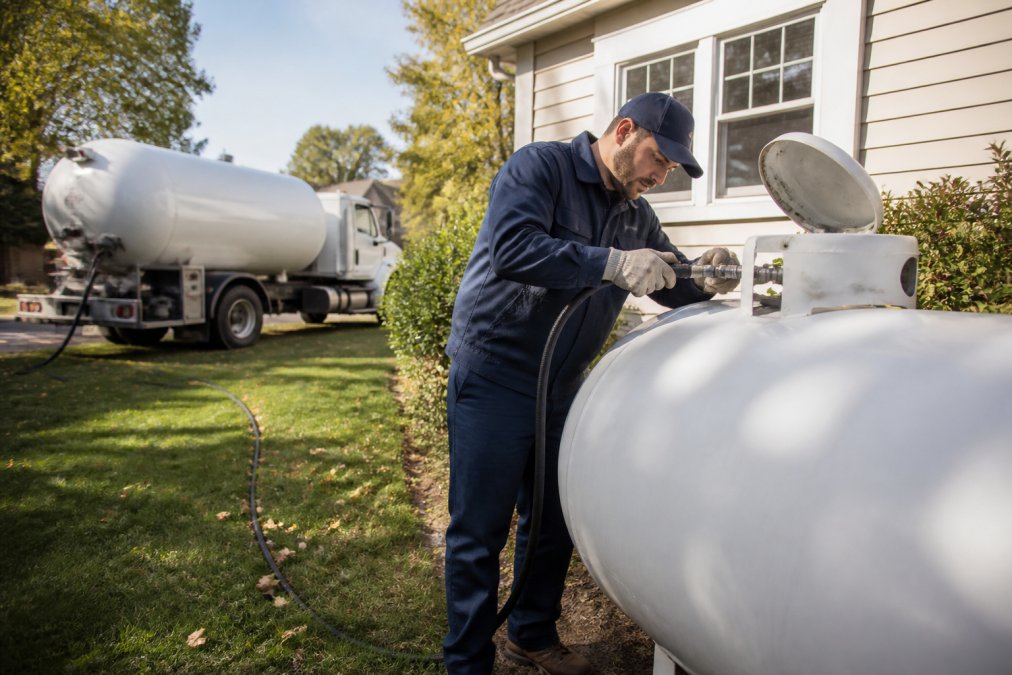
Our top pick for most homeowners is Discount Propane because it solves the industry’s biggest frustration: hidden pricing. You can see real-time rates online before you commit, which is rare among Long Island propane companies. Ordering takes minutes through a secure portal, and delivery scheduling is fast and flexible without a long-term contract.
The company accepts PCI-compliant credit card payments, cash on delivery, or Zelle, so you are not locked into autopay to get a fair price.
Before switching providers, compare the per-gallon rate on your current bill against the posted online price at Discount Propane. Many customers find the difference covers the cost of the switch within one winter fill.
2. Propane Depot: Family-Owned Service with High Satisfaction
Propane Depot earns its reputation through consistent customer service rather than flashy technology. This family-owned operation serves residential and commercial accounts with bulk delivery and maintains strong satisfaction ratings.
The company runs promotional savings programs that claim up to 30% off in certain periods, though pricing still fluctuates with market rates.
3. Paraco Gas: Full-Service Provider for Residential and Commercial
Paraco Gas operates across multiple states, bringing infrastructure advantages for customers needing comprehensive support. Beyond delivery, they handle professional tank installation, maintenance, and heating system service.
If you want one vendor managing your tank, burner, and fuel supply, Paraco simplifies that relationship.
4. Ideal Bottle Gas: Tank Monitoring and Equipment Sales
Ideal Bottle Gas, based in Bellport, brings a useful technical edge through automated tank monitoring. Their system tracks your propane level remotely and schedules refills before you run out.
The service area concentrates in specific zones, so confirm coverage before assuming they reach your address.
5. Peconic Propane: Local Expertise for the East End
Peconic Propane has served the North and South Forks since 1995, giving them deep familiarity with the seasonal demand patterns of the East End. Their safety-focused protocols and long operational history appeal to homeowners who want a provider that understands coastal weather impacts on fuel consumption.
If you live in their coverage area, the local expertise is valuable.
6. Long Island Propane: Bulk Delivery for Home Heating
Long Island Propane specializes in bulk delivery for homes that burn through significant volume during heating season. As a family-owned operation, they emphasize efficient scheduling and personalized care.
You would need a separate contractor for installations or repairs.
7. Bob’s Propane Delivery: Fast Turnaround for Small Tanks
Customers with 100-pound cylinders or small tanks who need a quick fill without committing to a large delivery contract.
Bob’s Propane Delivery operates on a different model entirely, charging a flat rate per tank with next-day service. At $25 per tank, this suits homeowners running a single grill or backup heater rather than whole-house heating.
Propane Delivery Cost Per Gallon: What to Expect
Propane pricing on Long Island is not a single number. The per-gallon rate you see advertised is only the starting point. Most providers quote a base rate per gallon, but the final price depends on several variables that are rarely explained upfront.
How to Read a Propane Bill Like a Pro
Look for these line items:
- Base per-gallon rate: The advertised price, which fluctuates with the wholesale market tracked by NYSERDA.
- Delivery fee: A flat charge (often $15 to $50) applied per visit, regardless of gallons delivered. This is why a small 50-gallon top-off costs disproportionately more per gallon than a 200-gallon fill.
- Tank rental or lease fee: If you do not own your tank, the provider charges an annual rental fee (commonly $75 to $150) or folds it into the per-gallon price.
- Hazardous material or environmental fee: A small surcharge (typically $1 to $5 per delivery) that covers regulatory compliance and disposal.
- Minimum delivery threshold: Many companies require a minimum purchase (e.g., 100 gallons) per delivery. If your tank is small or your usage is low, you may be forced to pay for more fuel than you need or incur a short-fill penalty.
The Real Cost of Will-Call vs. Automatic Delivery
Your delivery model directly affects your per-gallon cost. Will-call customers, who monitor their own gauges and call for a refill, often pay a slightly higher rate because the provider cannot optimize its delivery routes. Automatic delivery customers typically receive a discount of $0.05 to $0.15 per gallon because the provider can plan efficient bulk runs.
Seasonal Pricing and the Summer Fill Strategy
Wholesale propane prices follow a predictable seasonal curve. Demand peaks between November and March, pushing retail prices up by 10% to 20% compared to summer months. A common pattern among cost-conscious Long Island homeowners is to schedule a full tank fill in July or August, when wholesale prices are at their annual low.
Comparing Quotes: The 30-Minute Exercise
Before renewing with your current provider or switching, run this comparison:
- Find your last three delivery invoices. Note the base rate, all fees, and the total gallons delivered.
- Calculate your true cost per gallon. Divide the total invoice amount by the gallons delivered. This number, not the advertised rate, is what you actually pay.
- Call three providers and ask for a delivered price per gallon for your tank size. Do not accept a range; ask for the exact rate they would charge today for a standard fill.
- Ask about fees explicitly. Inquire about delivery fees, minimums, tank rental, and any seasonal surcharges.
- Compare the true cost per gallon, not the headline rate. A provider advertising $0.10 less per gallon may add a $40 delivery fee that erases the savings on a 200-gallon fill.
A provider that posts its current per-gallon rate online, like Discount Propane, saves you the phone call. If a company will not give you a firm price without a sales conversation, that reluctance is a signal about its pricing transparency.
The NYSERDA residential propane price dashboard publishes weekly average retail prices for New York regions. Use it as a benchmark: if a provider quotes you more than 10% above the regional average, ask why. Legitimate reasons include white-glove delivery windows or premium tank monitoring, but you should be able to identify what you are paying for.
Propane Safety Tips for Homeowners
Propane safety is not a one-time checklist; it is a seasonal routine. Most incidents on Long Island stem from a handful of predictable failures: undetected leaks, blocked regulators, and improper tank placement after storms or frost heaves.
The Annual Leak Detection Test (Do This in October)
Before the heating season starts, test every propane connection in your home. Mix a solution of one part dish soap and three parts water in a spray bottle. Apply it generously to all pipe connections, the regulator, and the tank valve. If bubbles form, you have a leak. Tighten the connection and retest. If bubbles persist, shut off the tank valve and call your provider immediately.
Propane’s odorant (ethyl mercaptan) can fade over time or be masked by other household odors, especially in homes with new carpet, paint, or cleaning products. A gas leak detector is a $30 to $50 investment that provides continuous monitoring. Install it near the floor in rooms with propane appliances, as propane is heavier than air and settles at ground level.
Winterizing Your Tank and Regulator
Long Island winters bring freezing temperatures, snow accumulation, and ice dams. Three specific risks affect propane systems:
- Regulator freeze-up: When moisture enters the regulator and freezes, it can restrict gas flow. This often happens after a heavy snowstorm melts and refreezes. Keep the regulator and piping clear of ice and snow at all times.
- Frost heave: Repeated freezing and thawing can shift the ground around an underground tank, stressing the piping connections. After a thaw cycle in late winter, visually inspect the area around the tank for soil movement or exposed piping.
- Snow blockage of the tank gauge: If you have a will-call account, a snow-covered gauge can lead to an unexpected run-out. Clear snow from the gauge face after every storm.
The 30% Rule and the Winter Emergency Refill
Schedule a refill when your tank gauge reads 30%. This is not a conservative guideline; it is a practical buffer. A tank at 30% has roughly 10 to 14 days of typical winter heating demand remaining, depending on your home size and insulation. Waiting until 20% risks a run-out during a cold snap when delivery trucks are stretched thin.
Local Regulations: What You Can and Cannot DIY
New York State Fire Code and local Long Island municipal codes classify propane tank installation and gas line work as regulated activities. A homeowner can legally replace a small grill cylinder (20-pound tank) without a permit. However, installing or replacing a stationary tank (anything above 125 gallons water capacity, which is the standard residential size) requires a permit from your local building department and an inspection by the fire marshal in most townships.
Gas line connections to appliances are not a DIY project. New York State Fire Code regulations on propane storage requires that any work on a propane gas system be performed by a licensed installer who holds the appropriate certifications. The practical reason is not just code compliance; it is insurance. If a DIY connection fails and causes property damage, your homeowners insurance policy will likely deny the claim because the work was performed without a license and permit.
The Post-Storm Inspection
After any significant storm (hurricane, nor’easter, or heavy snow), perform a 10-minute visual inspection:
- Check the tank for visible damage or displacement.
- Look for fallen branches or debris resting against the tank, piping, or regulator.
- Verify that the tank’s shutoff valve is accessible and not buried under snow or debris.
- If you smell gas or suspect damage, shut off the tank valve and call your provider before using any propane appliance.
If you smell gas inside your home, do not operate any electrical switches, do not use your phone inside the house, and do not light any flame. Evacuate immediately, leave the door open behind you, and call your provider or 911 from a safe distance. A propane leak that ignites can cause an explosion within seconds.
For a comprehensive reference, the Propane Education & Research Council safety guidelines publishes a downloadable homeowner checklist that covers appliance ventilation, tank placement clearances, and emergency procedures. Print it, keep it near your tank, and review it with every adult in your household.
Frequently Asked Questions
What are the current propane prices on Long Island?
Propane prices on Long Island fluctuate with market rates, so there is no single fixed price. The NYSERDA Propane Dashboard offers official, unbiased weekly retail price data for New York State, which is a useful benchmark. For actual quotes, companies like Discount Propane publish real-time pricing online, letting you see the current per-gallon rate before you commit. Comparing the state average against a provider’s listed price is the most reliable way to gauge a fair deal.
How do I choose between propane delivery companies?
Start by confirming the company delivers to your specific area of Long Island. Next, compare their pricing model: some offer per-gallon rates, while others use flat fees. Check for online price transparency, delivery scheduling flexibility, and whether they offer automatic delivery or tank monitoring to prevent run-outs. Finally, consider the full scope of services, such as tank installation, maintenance, and appliance service, to see which provider covers your current and future needs.
Is it better to lease or own a propane tank?
Leasing a tank typically means lower upfront costs, and the propane company remains responsible for maintenance, repairs, and inspections, which simplifies compliance. Owning a tank gives you the freedom to shop around for the best per-gallon price from any supplier, but you are responsible for upkeep and replacement costs. For homeowners who value predictable service and minimal hassle, leasing is often simpler. If you want maximum pricing flexibility, owning may be the better long-term choice.
How often should I schedule a propane delivery?
Delivery frequency depends on your tank size, usage, and the season. A typical 500-gallon tank used for home heating may need refills a few times during peak winter months. The best approach is to enroll in automatic delivery, where the company monitors your usage and schedules deliveries before you run out. You can also check your tank gauge monthly and request a will-call delivery when it reaches 30 percent to stay ahead of demand.
This article was written using GrandRanker