

Table of Contents
- Step 1: Request an Itemized Invoice and Review Service Charges
- How to Read a Propane Bill to Spot Hidden Costs
- Step 2: Understand Propane Minimum Usage Fees and Avoid Them
- Step 3: Compare Your Rate Type and Lock in Price Protection
- Step 4: Evaluate Auto-Delivery vs. On-Demand Ordering
- Step 5: Review Your Service Agreement for Hidden Clauses
- Is Propane Cheaper Than Heating Oil? Understanding Your Fuel Options
- Step 6: Negotiate Your Contract Terms and Fees
Last Updated: August 21, 2026
Surprise propane fees catch homeowners and business owners off guard every heating season. One month your bill is manageable, the next it spikes 40% higher with charges you don’t recognize. The good news: most surprise propane fees are avoidable. They stem from unclear billing practices, contract terms you haven’t reviewed, and pricing structures designed to confuse rather than inform.
This guide walks you through seven concrete steps to avoid surprise propane fees. You’ll learn how to read your bill, spot hidden costs, negotiate better terms, and choose a service model that matches your actual usage.
Step 1: Request an Itemized Invoice and Review Service Charges
Your first line of defense against surprise propane fees is transparency. Many providers bundle charges into a single "total due" without breaking down what you’re actually paying for.
Request an itemized invoice that separates every charge: fuel cost (price per gallon × gallons delivered), delivery fee, tank rental or ownership fee, hazmat or environmental fee, administrative or service charge, and any surcharges or seasonal adjustments.
Once you have the itemized version, compare it to previous bills. Look for charges that appear inconsistently or vary without explanation. Many providers resist itemized invoices because they expose pricing inconsistencies. Insist on it anyway. If your current provider won’t provide one, that’s a red flag about their billing transparency.
Ask for a 12-month billing history in itemized format. Patterns emerge when you see the full year, seasonal markups, fee increases, and surcharges become obvious. This history becomes your negotiation foundation.
How to Read a Propane Bill to Spot Hidden Costs
Most propane bills are deliberately difficult to parse. Learning to read one properly takes 10 minutes and saves you hundreds annually.
Start with the delivery section. Your bill should clearly state gallons delivered and the price per gallon. Multiply these numbers yourself. Propane prices fluctuate daily, so the per-gallon rate should reflect current market conditions. If your rate seems frozen while market rates swing, you’re likely paying a premium.
Next, examine service charges. Common hidden charges include minimum usage fees, tank rental, hazmat fees, fuel surcharges, and administrative fees. Each charge is legitimate in some contexts, but frequently inflated or applied unnecessarily. A hazmat fee of $0.15 per gallon is reasonable; $0.45 per gallon is padding (aoga.org). A tank rental of $12 annually is standard; $180 annually needs justification.
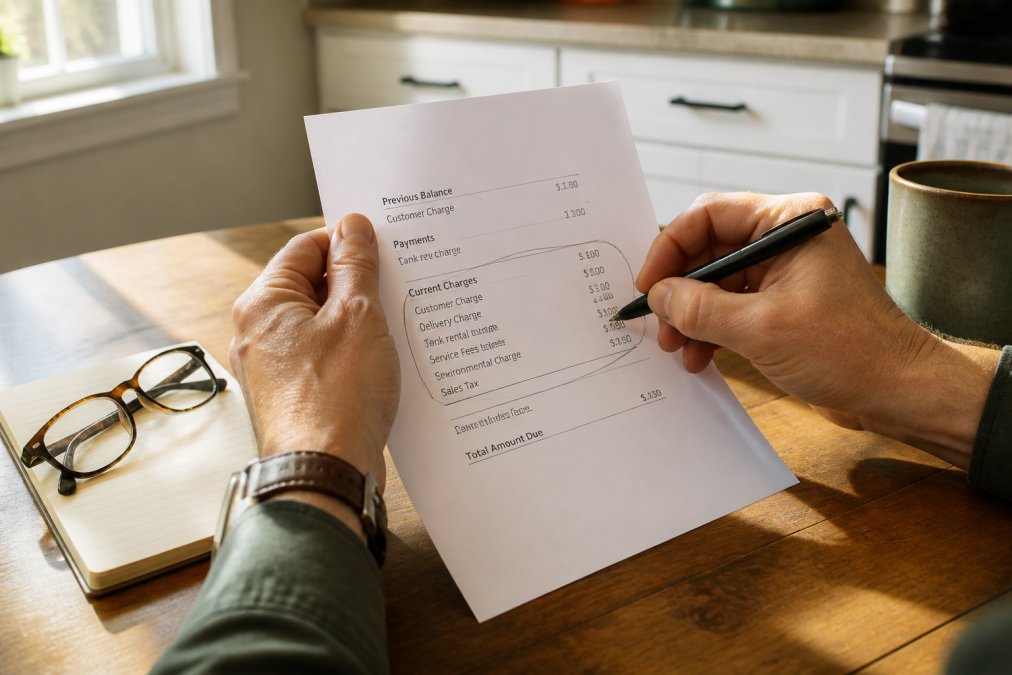
Check the billing cycle dates. Some providers manipulate billing periods to include extra days, increasing charges without increasing consumption. Look for price adjustments or "market rate" notations. These should reference an actual market index with clear calculations. Vague references to "market conditions" without specific numbers indicate the provider is adjusting rates at their discretion.
Finally, review any contract terms printed on the bill. Many providers include updated terms on invoices, often with language that changes your agreement.
If your bill lists charges with no description, demand clarification in writing. Vague charges are often the most inflated ones.
Step 2: Understand Propane Minimum Usage Fees and Avoid Them
Minimum usage fees are among the most deceptive charges in propane billing. They guarantee the provider baseline revenue regardless of your actual consumption. In mild winters when you use less propane, these fees spike your bill unexpectedly.
Here’s how they work: your contract specifies a minimum monthly charge, often expressed as a minimum gallon requirement or flat monthly fee. If you use fewer gallons than the minimum, you’re charged for the difference. Example: A contract with a 50-gallon minimum means you pay for at least 50 gallons every month, even in October when you only used 20 gallons for water heating.
Minimum usage fees are negotiable. To avoid surprise propane fees tied to minimum usage, request a contract without a minimum usage clause. Many providers will agree for reliable customers with consistent heating needs. If they refuse, ask for the minimum to be reduced or negotiate a seasonal minimum, you might accept a 50-gallon minimum November through March but zero minimum April through October.
Track your actual monthly consumption. After one full year, you’ll know your real usage patterns. Use this data to negotiate. Ask about pre-buy or fixed-rate programs, which often eliminate minimum usage fees because you’ve already committed to purchasing a set amount.
Minimum usage fees are the easiest fees to eliminate through negotiation. Most providers will remove them or reduce them for customers who push back with actual consumption data.
Step 3: Compare Your Rate Type and Lock in Price Protection
Propane pricing follows two main models: variable rates that fluctuate with market conditions and fixed rates locked for a specific period.
Variable rates tie your per-gallon price to market indexes like the Henry Hub natural gas price or the EIA weekly propane price. These rates change weekly or monthly. The advantage is transparency tied to actual commodity prices. The disadvantage is unpredictability.
Fixed rates lock your per-gallon price for a set period, typically through a pre-buy program. You pay a premium upfront (usually 10-15% above current market rates) but gain price certainty. The advantage is budget predictability. The disadvantage is that if market prices drop, you’re locked in at the higher rate.
When comparing rates, demand clarity on how they’re calculated. Variable rates should reference a specific, publicly available index. Check your contract for rate adjustment clauses. Some providers include language allowing them to adjust rates with 30 days’ notice, even during locked-rate periods. Demand that locked rates remain locked for the full contract period without adjustment.
Step 4: Evaluate Auto-Delivery vs. On-Demand Ordering
Your delivery method shapes both your propane costs and your exposure to surprise fees.
Auto-delivery means your provider monitors your tank level and delivers propane on a predetermined schedule, usually every 30-60 days. Benefits include consistent, predictable delivery and lower delivery fees. Drawbacks include less control over when you’re charged and potential overdelivery in mild weather.
On-demand ordering means you order propane when you need it. Benefits include complete control over when you’re charged and flexibility to adjust ordering frequency. Drawbacks include higher per-delivery fees and risk of running out during peak demand.
To avoid surprise propane fees, understand what model your current contract specifies and whether it matches your actual needs. If you’re on auto-delivery, request the option to switch to on-demand. Calculate the total annual cost difference including delivery fees and per-gallon rates. For some customers, higher per-delivery fees on on-demand ordering are offset by lower per-gallon rates and eliminated minimum usage fees.
Step 5: Review Your Service Agreement for Hidden Clauses
Your service agreement is a contract, and contracts contain clauses that directly impact your costs. Many customers never read theirs, which means they’ve unknowingly agreed to fees and terms they don’t understand.
Request a copy of your current service agreement in writing. If your provider can’t produce one, that’s a legal red flag.
Focus on these specific clauses: Early termination fees (how much do you pay if you switch providers?), rate adjustment provisions (can the provider adjust rates with notice?), automatic renewal clauses (does your contract automatically renew at new rates?), minimum purchase commitments (are you required to buy a minimum annual amount?), and tank ownership (who owns the propane tank?).
Clauses allowing automatic renewal or unlimited rate adjustments are the most common sources of surprise fee increases. Many customers discover mid-winter that their rates have jumped because they didn’t read renewal language.
Contract clauses allowing automatic renewal or unlimited rate adjustments are the most common sources of surprise fee increases. Many customers discover mid-winter that their rates have jumped because they didn’t read renewal language.
Is Propane Cheaper Than Heating Oil? Understanding Your Fuel Options
Propane is generally 15-25% cheaper per BTU than heating oil, though this varies seasonally (eia.gov). Propane is cleaner burning and can be used for multiple appliances. However, conversion costs are significant, new furnace, tank installation, and line work can cost $3,000-7,000 (energy.gov).
Calculate payback period: annual savings divided by conversion cost. If propane saves you $800 annually and conversion costs $5,000, payback takes 6-7 years. If you plan to stay in your home that long, conversion makes financial sense.
The real cost difference emerges in billing practices. Propane providers vary widely in fee structures. A provider charging transparent rates with minimal fees might deliver propane 20% cheaper than a provider with high administrative charges and minimum usage fees. When evaluating conversion, request itemized quotes from multiple propane providers and compare total annual costs including all fees.
Step 6: Negotiate Your Contract Terms and Fees
Most propane customers accept the terms their provider offers without negotiation. This is a mistake. Nearly every term is negotiable, and providers expect customers to push back.
Start with your usage data. Calculate your actual annual consumption and average monthly usage. Request a meeting or call with your provider’s account manager. Phone conversations create pressure and allow for real-time negotiation. Explain that you’re evaluating whether to stay with your current provider or switch.
Present your data and ask for specific concessions: eliminate minimum usage fees or reduce them based on your actual average usage, remove or reduce early termination fees, lock in rates for 2-3 years, reduce delivery fees by committing to auto-delivery, or eliminate administrative charges.

Providers will resist some requests. That’s normal. The goal isn’t to win every concession but to improve your overall terms. Be prepared to switch. Your strongest negotiation tool is willingness to leave. Document all agreements in writing and request written confirmation from the provider.
Timing matters for negotiation. Call in spring or early summer when demand is low and providers are hungry for customers. Calling in November when everyone’s heating up is far less effective.
Frequently Asked Questions
What are the most common hidden propane fees I should watch for?
The most common hidden charges include hazmat fees, administrative charges, tank rental fees, fuel surcharges, minimum usage fees, and restocking fees. Many providers bury these in their service agreements or itemized invoices. Request a detailed breakdown of every charge on your bill before signing a contract. Always ask your provider to list every possible fee upfront.
How do I know if my propane minimum usage fees are standard?
Propane minimum usage fees vary by provider and region. Some companies charge monthly minimums regardless of consumption, while others only apply them during peak seasons. Review your service agreement to find the specific minimum usage fee terms. Compare what your current provider charges against quotes from other suppliers in your area. Many providers will waive or reduce minimums if you commit to auto-delivery or sign longer contracts. If your minimum is significantly higher than competitors, you have leverage to negotiate.
Is propane cheaper than heating oil for residential heating?
Propane is typically more efficient and often costs less per BTU than heating oil, though prices fluctuate based on market conditions and delivery location. Propane burns cleaner, requires less maintenance, and heating systems have lower upfront installation costs. However, total savings depend on your current equipment, consumption patterns, and local market rates. Request quotes from multiple propane providers and compare the total annual cost, including all service fees and charges, against your current heating oil expenses before deciding to convert.
What should I do if my propane provider won't provide an itemized invoice?
Insist on receiving a detailed itemized invoice that breaks down every charge: fuel cost, delivery fee, hazmat fee, tank rental, administrative charges, and any other fees. This is your right as a customer and essential for spotting unauthorized or inflated charges. If your provider refuses, request the information in writing and escalate to their customer service manager. If they still refuse, this is a red flag indicating poor transparency practices. Consider switching to a provider like Discount Propane that offers upfront, transparent pricing and easy online account management.
This article was written using GrandRanker