

Table of Contents
- Why Winter Propane Preparation Matters
- Create a Propane System Winterization Checklist
- Plan Your Propane Delivery Schedule for Winter
- Propane Tank Snow and Ice Safety
- Schedule a Professional System Inspection
- What to Do If You Smell Propane
- Common Winter Propane Problems and Solutions
- Frequently Asked Questions
Last Updated: October 6, 2026
Why Winter Propane Preparation Matters
Winter cold snaps make your propane system work harder, and without taking steps to prepare propane system winter you risk running out of fuel in the coldest months.
An unprepared system fails when you need it most: frozen regulators, blocked vents, and low tank levels mean emergency calls at peak prices.
Preparation is straightforward: check a few things, clear snow, and schedule delivery early.
At Discount Propane, we help homeowners and contractors prepare propane system winter every year. The same steps work whether you heat one house or manage multiple properties.
Create a Propane System Winterization Checklist
A winterization checklist keeps you organized. Cover three areas, tank, delivery schedule, and equipment, in order to save time.
Check Tank Capacity and Fuel Level
Check your tank level before winter, not in November or December when everyone orders at once.
Residential tanks run 100-500 gallons; larger homes and radiant heating need bigger tanks.
Refill at 25% or lower normally, but at 35% or higher in winter, cold weather raises usage.
If your tank is small or your home large, schedule delivery every two weeks in winter.
Check your tank level in early October, before the rush. Early ordering means faster service and peace of mind.
Inspect Valves, Regulators, and Connections
Ice and corrosion can damage your system’s connection points. A quick visual inspection catches problems early.
Look for these signs of trouble:
- Frost or ice buildup on any metal parts
- Dents or cracks in the tank
- Rust on connections or valves
The regulator controls gas pressure; if snow or ice blocks its vent, your system stops working, so keep the area clear. Check visible connections where the gas line leaves the tank, white powder or discoloration means corrosion.
Test All Appliances and Heating Equipment
Test your furnace, water heater, and other propane appliances now, while temperatures are mild. Run the heating system for 15 minutes, listen for unusual sounds, and check that warm air flows from all vents; if it hesitates or makes noise, get it inspected.
Check other propane appliances, stove, fireplace, space heaters, pool heaters, for easy lighting and clean burning. A blue flame is healthy; orange or yellow means incomplete combustion, so call a technician.
A propane appliance that smells like rotten eggs or sulfur has a gas leak. Stop using it immediately. Open windows. Call a professional. Do not ignore this warning sign.
Plan Your Propane Delivery Schedule for Winter
Most winter propane problems start with delivery planning. Tanks rarely run out from a cold snap alone, they run out because the homeowner waited until the gauge read low and the supplier was already booked.
Understand How Your Tank Size Sets Your Refill Window
Residential tanks here are typically 120, 250, 500, or 1,000 gallons, with usable drawdown of roughly 80% of listed size because tanks are only filled to about 80% to leave room for vapor expansion:
- A 120-gallon tank holds about 96 usable gallons
- A 250-gallon tank holds about 200 usable gallons
- A 500-gallon tank holds about 400 usable gallons
Find your tank size on the data plate welded to the tank collar, not on the gauge.
Estimate Your Winter Burn Rate
A typical household here uses far more propane from November through March than in the other seven months combined:
- Heating only (furnace or boiler): roughly 100-200 gallons per month in mild winter weather, rising to 250-400 gallons per month during a sustained cold stretch
- Heating plus propane water heater: add roughly 20-30 gallons per month
- Heating plus propane cooking, fireplace, or space heaters: add another 10-25 gallons per month
A tight, well-insulated home with a modern 95% AFUE furnace sits at the low end; an older, drafty home with a standard-efficiency furnace sits at the high end.
To get your own number, do this:
- Read the gauge and write down the percentage and the date.
- Read it again exactly 14 days later.
- Subtract the second reading from the first to get the percentage used.
- Multiply that percentage by your tank’s usable gallons (from the list above).
- That’s your two-week burn rate. Multiply by 11 to estimate the full November-March season.
Set Your Refill Trigger Before the Season Starts
Most suppliers recommend refilling at 30% in winter, not 20% or 25%, because of lead time. Once a sustained cold snap hits, a routine order can take one to two weeks, so ordering at 20% is gambling on the weather.
A practical rule:
- Aboveground tank, automatic delivery: let the supplier’s algorithm handle it, but verify your account is flagged for winter frequency
- Aboveground tank, will-call: check the gauge every two weeks and order at 30%
- Underground tank: same trigger, but add a week of buffer because the gauge can be harder to read under snow and the driver may need to dig out the fill port
Automatic Delivery vs. Keep-Full vs. Will-Call
The three arrangements differ in ways that matter:
- Will-call: You watch the gauge and call when you want a delivery. Cheapest per-gallon if you time it well, riskiest if you don’t.
- Automatic delivery: The supplier uses your historical usage and local weather data to schedule deliveries before you run low. You give up control over timing but rarely run out.
- Keep-full: The supplier installs a monitor on the tank and delivers when the level drops to a set point. Highest reliability, and often required for larger tanks or commercial accounts.
If you travel, have a second home, or rely on propane as your only fuel, automatic or keep-full is worth the small premium. If you’re home all winter and check the gauge on schedule, will-call works fine.
Local Timing That Actually Matters
The delivery backlog builds in the two weeks before Thanksgiving and again in the first cold snap after New Year’s. For a non-emergency delivery on your schedule, order by mid-October, after that you’re competing with every household on the route. Securing your fuel supply early prevents the frantic rush that leaves you vulnerable when other household infrastructure fails, making it essential to familiarize yourself with emergency plumbing steps before the deep freeze sets in.
Order your first winter fill by mid-October, set your will-call trigger at 30%, and re-check the gauge every two weeks from November through March. If you use automatic or keep-full delivery, confirm with your supplier that your account is set for winter frequency before the season starts.
Propane Tank Snow and Ice Safety
Snow and ice around a propane system are a safety problem, not just an access problem, and how you clear them matters as much as whether you do.
Know Which Parts Must Stay Clear
Four components on every aboveground system must stay unobstructed:
- The regulator vent. A small screened opening on the regulator body. If it ices over or gets buried, the regulator cannot sense tank pressure correctly and the system can lock out or deliver erratic pressure. Never pack snow against it or cover it with a bag or tarp.
- The fill valve. The threaded fitting the delivery driver connects to. If it’s buried, the driver may refuse the delivery or strike the valve while digging it out.
- The relief valve. Usually on top of the tank, it must vent if tank pressure rises. Blocking it defeats a critical safety device.
On an underground tank, keep the dome cover, fill port, gauge, and regulator clear. Don’t shovel down onto the dome, it protects the fittings underneath and a hard strike can crack it.
Clear Snow Without Damaging the System
A few rules prevent most snow-clearing damage:
- Use a plastic shovel or snow pusher, not a metal-edged shovel, within three feet of the tank, regulator, or piping.
- Push snow away from the tank, never toward it. Piling snow against the tank adds weight and traps moisture against the metal.
- Do not use a snowblower within three feet of the tank, regulator, or exposed piping. The auger and chute can throw ice hard enough to dent a regulator or crack a fitting.
Mark the Tank Before the First Snow
Marking is a pre-season task: once the tank is buried, you can’t find it to mark it.
- Drive a fiberglass or wooden stake at each corner of the tank pad, tall enough to stay visible above the deepest snow you typically get.
- Attach a reflective marker or small solar stake light to at least one stake so a driver arriving at dusk can see it from the driveway.
- If the tank is set back from the driveway, mark the path the driver will walk, not just the tank itself.
Sequence the Work: Before, During, After
Before the storm (48-72 hours out):
- Confirm your tank is above 30%.
- Clear leaves, branches, and summer debris from around the tank and regulator.
- Set your markers.
During the storm:
- Stay inside. Do not go out to check the tank mid-storm.
- If you lose heat and suspect a regulator issue, do not go out and start digging. Call your supplier’s emergency line.
After the storm:
- Clear the driveway and path to the tank first, the driver needs the path more than you need the tank cleared.
- Clear a three-foot radius around the tank base, regulator, and fill valve.
- Re-check the regulator vent for ice; if iced over, don’t chip it, call your supplier.
When to Stop and Call a Professional
Stop and call your propane supplier or 911 if any of the following happens while you’re clearing snow:
- You smell propane (rotten eggs, sulfur, or a skunk-like odor) near the tank or the house.
- You hear a hissing sound near the regulator, fill valve, or piping.
- You see frost or ice forming on a fitting that isn’t normally frosted.
A leak near a snow-covered tank is harder to detect than a summer leak because cold air and snow dampen the odor. Treat any suspicion as real.
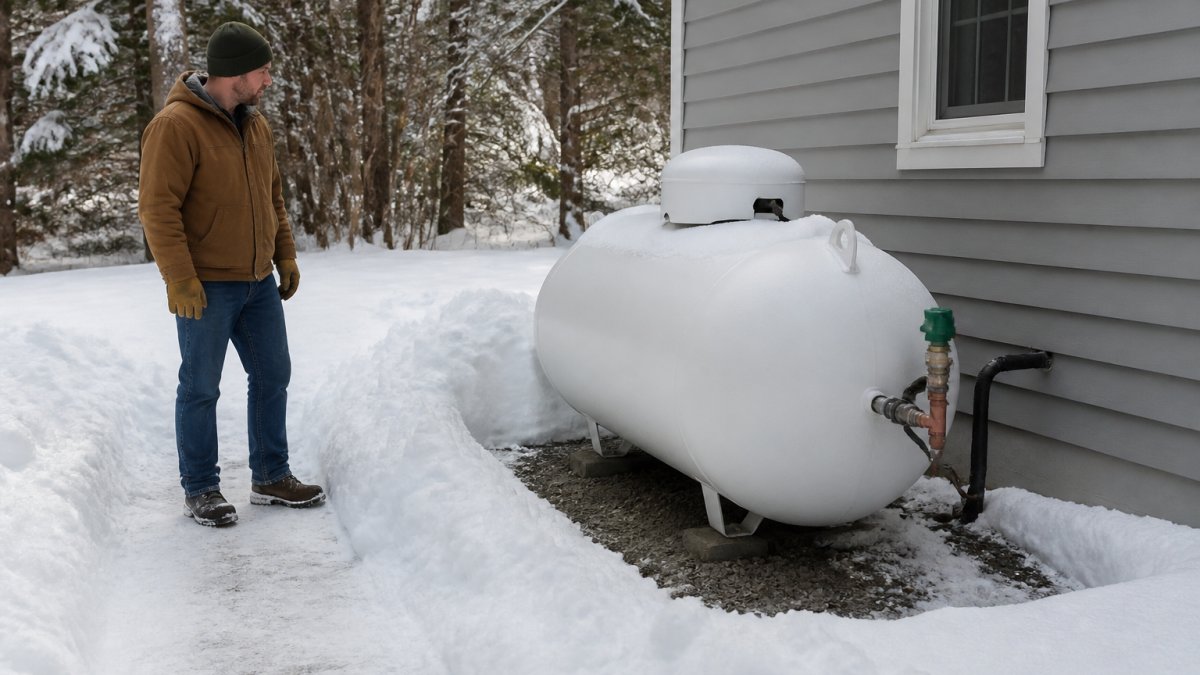
Never use a metal shovel, ice chipper, or snowblower within three feet of a propane tank, regulator, or exposed piping. A single strike can crack a fitting and create a leak you cannot see or smell reliably in cold weather.
Schedule a Professional System Inspection
A professional inspection catches problems you might miss. It’s worth the cost for safety and peace of mind.
A technician will check:
- Tank condition and connections
- Regulator function and vent clearance
- All gas lines for leaks
Inspections take 30-60 minutes. Schedule one in September or early October, before winter demand peaks.
An inspection is required if:
- You’ve never had your system inspected
- You’ve noticed any leaks or unusual smells
- You’re converting from oil to propane
What to Do If You Smell Propane
Propane has a strong odor added to it. If you smell it, act immediately:
- Do not use any electrical switches, phones, or lighters
- Leave your home immediately
- Go to a neighbor’s house or outside, away from your home
- Call your propane company’s emergency line from a safe location
- Do not re-enter your home until a technician says it’s safe
Propane is heavier than air and accumulates in low areas, and it’s colorless and odorless on its own, the smell is an additive. Small leaks may smell faintly near a connection; large leaks fill the home. Either way, call for help.
Never ignore a propane smell. Never try to find the leak yourself. Propane is explosive. Professional technicians have tools to locate leaks safely.
Common Winter Propane Problems and Solutions
Winter brings specific challenges. Knowing what to expect helps you respond quickly.
Frozen Regulator Vent
Problem: Your heating stops working in heavy snow.
Low Tank Pressure
Problem: Your furnace runs but heat is weak.
Slow Gas Flow
Problem: Your stove or water heater works slowly.
Leaking Connection
Problem: You smell propane near a fitting.
At Discount Propane, we make winter preparation easy.
Frequently Asked Questions
How do I check my propane tank level before winter?
Most propane tanks have a gauge on top showing the fill percentage. Check it monthly as temperatures drop. If your gauge reads below 20%, contact your propane supplier to schedule delivery before cold weather arrives. For older tanks without gauges, a qualified technician can measure the level for you.
What’s included in a propane system winterization checklist?
A complete propane system winterization checklist includes: checking tank capacity and fuel level, inspecting valves and regulators for leaks or damage, testing all appliances and heating equipment, clearing snow and debris around the tank, marking the tank location for delivery drivers, scheduling a professional inspection, and verifying that regulator vents remain unobstructed. Start this checklist in fall before cold weather arrives to catch any issues early.
When should I schedule my propane delivery before winter?
Schedule propane delivery planning for winter by September or October, before peak heating season. This ensures your tank is full before the first cold snap and gives your supplier time to fit you into their delivery schedule. If you use automatic delivery or a keep-full plan, confirm your settings are active and your contact information is current. For commercial or construction site heating needs, arrange regular scheduled deliveries well in advance to avoid service interruptions.
What should I do immediately if I smell propane?
If you smell propane, evacuate your home or building immediately and move to fresh air. Do not use electrical switches, light matches, or start engines, propane is highly flammable. Once outside, call your propane supplier’s emergency line or 911 from a safe distance. Do not re-enter the building until a qualified technician has inspected your system and cleared it for use. Propane has a distinctive odor added for safety, so any smell indicates a potential leak that requires professional attention.