

Table of Contents
- What You’ll Pay: Breaking Down Oil to Propane Conversion Costs
- Factors That Influence Your Installation Price
- Heating Oil vs. Propane Efficiency: Which Fuel Works Harder
- Cost to Remove Your Oil Tank
- Oil to Propane Conversion Incentives and Rebates
- ROI Calculator: When Propane Pays for Itself
- Permitting, Inspections, and What Local Codes Require
- Conclusion
- Frequently Asked Questions
Last Updated: September 2, 2026
What You’ll Pay: Breaking Down Oil to Propane Conversion Costs
An oil to propane conversion cost typically ranges based on your system’s current condition, equipment required, and local installation labor rates. The total investment includes furnace replacement or retrofit, propane tank installation, new piping, venting modifications, and professional labor.
Most homeowners should expect a substantial upfront expense. Your existing heating oil furnace won’t burn propane without significant modification or replacement. A high-efficiency propane furnace alone costs several thousand dollars before installation labor begins.
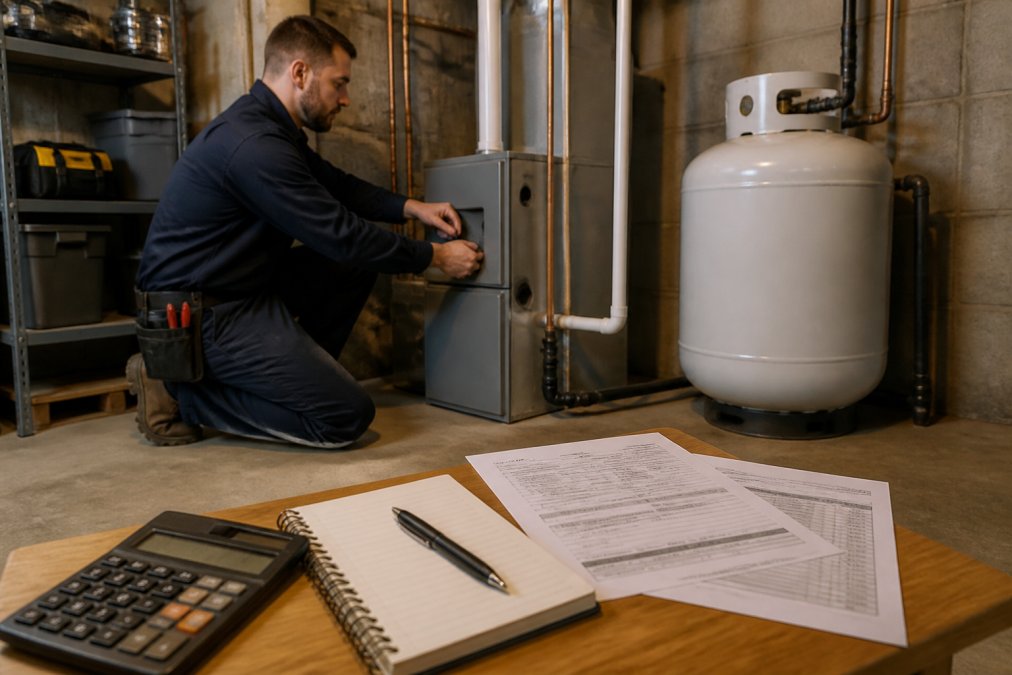
The real cost breakdown depends on whether you’re retrofitting your current furnace or replacing it entirely. Retrofit conversions cost less upfront but may not deliver the same efficiency gains. Full furnace replacement with a high-efficiency propane unit costs more initially but typically recovers that investment through lower fuel bills over time.
Beyond the furnace, you’ll need a propane tank, either above-ground or underground. Underground tanks integrate seamlessly into your property but require excavation. Above-ground tanks are cheaper to install but take up yard space. A 500-gallon tank suits most residential homes, but larger properties might need 1,000 gallons or more.
Piping and venting represent another significant line item. Propane requires different piping materials and venting configurations than oil systems to meet safety codes. These modifications are mandated by building inspectors and insurance underwriters.
When evaluating oil to propane conversion cost, factor in installation site complexity. Basements with easy access cost less than cramped crawl spaces. Properties with existing gas lines may reduce piping expenses. Homes requiring new electrical work for propane system controls will see additional charges.
At Discount Propane, we help Long Island homeowners manage their propane needs. The key is understanding that conversion cost isn’t just about equipment, it’s about proper installation, code compliance, and long-term system reliability.
Factors That Influence Your Installation Price
Several variables determine whether your conversion sits at the lower or higher end of the cost spectrum. Your current heating system’s age and condition directly impact whether retrofit or replacement makes sense. A 20-year-old furnace approaching the end of its lifespan practically demands replacement.
Your home’s heating demand matters significantly. Larger homes require higher BTU output furnaces, which cost more than units sized for smaller spaces. A 4,000-square-foot colonial needs different capacity than a 1,500-square-foot ranch.
Tank placement choices affect installation complexity and cost. Underground tanks require soil excavation, permitting, and specialized installation crews. If your property has rocky soil or a high water table, excavation costs spike dramatically. Above-ground tanks avoid these complications but require adequate yard space.
Distance from the property line to your home’s heating system influences piping costs. Long runs of new propane line require more materials and labor. Homes with centrally located furnaces cost less to pipe than those with furnaces in remote corners.
Local labor rates vary considerably by region. Urban areas with high construction costs charge more per hour than rural communities. Spring or fall conversions typically offer better pricing than winter, when contractors juggle emergency repairs alongside new installations.
Your existing infrastructure can reduce costs substantially. Homes with natural gas lines already installed might reuse some piping components. Properties with good electrical service to the furnace location require less rewiring. Conversely, homes needing electrical upgrades, new venting penetrations, or structural modifications face higher bills.
Building code requirements in your jurisdiction add another layer. Some municipalities mandate specific tank setback distances from property lines or structures. Code-compliant installation costs more than cutting corners, but it’s the only legal and insurable approach.
Heating Oil vs. Propane Efficiency: Which Fuel Works Harder
Propane operates at higher efficiency in modern furnaces than heating oil. A modern propane furnace achieves AFUE ratings (Annual Fuel Use Efficiency) of 90-98%, meaning 90-98 cents of every dollar spent on fuel becomes usable heat. Older heating oil furnaces typically max out around 80-85% AFUE.
The efficiency gap matters for your wallet. A propane furnace converts more fuel to actual heat, reducing the volume you need to burn. Over a heating season, this efficiency advantage accumulates into measurable fuel cost savings, assuming propane prices remain competitive with heating oil in your area.
Modern propane furnaces capture more heat before it exits the chimney compared to older oil systems. One gallon of propane contains roughly 91,500 BTU of energy, while one gallon of heating oil contains approximately 140,000 BTU (eia.gov). On a per-gallon basis, heating oil packs more energy, but propane furnaces burn more efficiently, so the practical difference narrows considerably.
The real efficiency story depends on your furnace’s age and condition. Replacing a 25-year-old heating oil furnace with a new propane unit delivers massive efficiency gains. Retrofitting a relatively modern oil furnace to burn propane might not justify the conversion cost if your current system still operates near acceptable efficiency levels.
When comparing heating oil vs propane efficiency, focus on the furnace’s AFUE rating rather than the fuel itself. A high-efficiency propane furnace beats a low-efficiency oil furnace every time, but a mid-range propane unit might not justify replacing a relatively new high-efficiency oil system.
Cost to Remove Your Oil Tank
Tank removal represents a separate line item that many homeowners underestimate. Abandoning your heating oil tank in place creates future liability. If you sell the property, the new owner inherits responsibility for that tank. If it leaks, environmental cleanup falls on whoever owns the property at that moment.
Proper tank removal involves pumping out remaining oil, cleaning the tank interior, and physically removing it from the ground or basement. Underground tank removal requires excavation, which is the expensive part. Excavators must carefully expose the tank, disconnect fuel lines and venting, and lift it from the ground.

Above-ground tanks in basements cost less to remove than buried tanks. A basement tank simply needs to be drained, disconnected, and hauled away. No excavation required.
Soil testing often follows underground tank removal. If the tank leaked during its decades of service, contaminated soil must be identified and remediated. Environmental cleanup costs far exceed tank removal itself.
Tank abandonment-in-place is an alternative some homeowners consider to save money. You leave the tank underground but fill it with inert material and cap it permanently. This avoids excavation costs but doesn’t eliminate liability. Future property owners may still demand removal if they discover the abandoned tank during foundation work.
Insurance and lending considerations matter here. Many homeowners insurance policies require tank removal before issuing coverage. Mortgage lenders often demand proof of proper tank disposal before approving property sales.
The cost to remove your oil tank varies dramatically based on tank size, depth, soil conditions, and local environmental regulations. Underground tanks in accessible yards cost less than those under patios or driveways.
Oil to Propane Conversion Incentives and Rebates
Federal and state programs occasionally offer rebates for converting from heating oil to propane or other cleaner heating fuels. These incentives fluctuate based on energy policy priorities and available funding. Checking current programs before committing to conversion could reduce your net costs significantly.
Some utility companies offer rebates for switching away from heating oil. State energy offices sometimes administer heating system conversion grants. Eligibility often depends on household income, property location, and the specific fuel switch. Low-income households may qualify for more generous rebates than higher-income homeowners.
Tax credits at the federal level occasionally include heating system upgrades. When available, these credits apply to energy-efficient furnace installations. You claim the credit on your federal tax return, reducing your tax liability.
Energy audit programs in some states identify cost-saving opportunities and connect homeowners with rebate programs. A professional energy audit might reveal that your conversion qualifies for incentives you didn’t know existed.
The challenge with incentive programs is their temporary nature. Funding runs out. Eligibility requirements change. Before planning your conversion budget around expected rebates, verify current program availability through your state energy office or utility company.
Never assume rebate programs will cover your conversion costs. Use incentives as a bonus that reduces your net expense, not as the foundation of your financial plan. Programs disappear, budgets get cut, and eligibility restrictions tighten unexpectedly.
ROI Calculator: When Propane Pays for Itself
Understanding when your conversion investment breaks even requires comparing your current heating oil costs against projected propane costs. This calculation depends on your annual heating demand, current and projected fuel prices, furnace efficiency improvements, and the total conversion cost.
Start by calculating your annual heating oil consumption. Review past heating bills to determine how many gallons you typically burn per year. A typical single-family home burns 800-1,200 gallons annually (eia.gov).
Next, estimate your annual propane consumption. A propane furnace with higher AFUE efficiency burns less fuel than your current oil system. As a rough estimate, you’ll need approximately 40-50% less energy from propane than from heating oil. If you currently burn 1,000 gallons of oil annually, expect to need roughly 600-700 gallons of propane equivalent energy.
Fuel price comparison requires checking current market rates. Contact local suppliers for current pricing. Propane isn’t always cheaper than heating oil; the cost advantage depends on regional market conditions.
Calculate your annual fuel cost savings by multiplying your projected propane consumption by the propane price, then comparing that to your current annual heating oil bill. If you currently spend $3,000 annually on heating oil and propane would cost $2,000 annually, your yearly savings equal $1,000.
Divide your total conversion cost by your annual savings to determine your payback period. If conversion costs $8,000 and you save $1,000 annually, your payback period is eight years. After eight years, the conversion has paid for itself.
This calculation assumes fuel prices remain stable, which they won’t. Propane prices might rise or fall relative to heating oil. Your heating demand might decrease if you improve insulation or upgrade to a programmable thermostat.
Furnace lifespan affects the ROI timeline. A new propane furnace typically lasts 15-20 years. If your payback period is eight years, you’ll enjoy 7-12 years of pure savings before the furnace reaches end-of-life.
The conversion pays for itself when cumulative fuel savings equal the upfront conversion cost. Most conversions break even within 5-15 years, depending on fuel price differentials and efficiency improvements. After breakeven, you’re saving money every heating season.
Permitting, Inspections, and What Local Codes Require
Converting from heating oil to propane isn’t a DIY project. Building codes strictly regulate fuel system installations for safety reasons. Your local building department requires permits before work begins. Inspectors verify compliance at multiple stages: before work starts, during installation, and after completion.
Permit requirements vary by municipality but generally include detailed plans showing the propane system layout, tank placement, piping routes, and venting configuration. Inspectors verify that proposed installations meet current codes before issuing a permit.
Tank placement must comply with setback requirements. Propane tanks cannot sit too close to property lines, buildings, or other structures. Setback distances vary by code but typically range from 5-30 feet depending on tank size and location (nfpa.org). Your contractor should know local requirements, but verify them with your building department.
Venting requirements for propane furnaces differ from heating oil systems. Category III or Category IV venting systems are typical for high-efficiency propane furnaces. These systems use special vent pipe materials and configurations to handle the specific characteristics of propane combustion.
Piping materials must meet code specifications. Propane piping requires different materials than heating oil fuel lines. Copper, steel, or approved flexible connectors are typical. Piping must be properly supported, protected from damage, and routed safely away from electrical systems.
Safety inspections verify that all components function properly before the system operates. Inspectors check for gas leaks using specialized equipment. They verify that pressure regulators, safety shutoffs, and ignition systems all work correctly.
Insurance underwriters often require proof of code-compliant installation before issuing homeowners coverage. Unpermitted or non-compliant work can void your insurance protection.
The permitting and inspection process typically takes 2-4 weeks from application to final approval, depending on your municipality’s workload.
Skipping permits to save money creates serious problems. Unpermitted work violates building codes, voids insurance coverage, and creates liability when you sell the property. Buyers’ inspectors discover unpermitted systems, and lenders refuse to finance properties with code violations. The money you save on permits costs far more when selling.
Conclusion
Converting from heating oil to propane represents a significant investment in your home’s heating infrastructure. The oil to propane conversion cost includes furnace replacement or retrofit, propane tank installation, new piping, venting modifications, and professional labor, each component contributes to a total that demands careful financial planning.
The decision ultimately hinges on your current system’s condition, local fuel price differentials, and how long you plan to remain in your home. A furnace nearing the end of its lifespan makes conversion more economical. Stable propane pricing relative to heating oil improves your return on investment. Remaining in your home long enough to recoup the conversion cost through fuel savings validates the expense.
Discount Propane simplifies the fuel side of this equation with transparent, real-time pricing and convenient online ordering. Once your system conversion is complete, you’ll know exactly what propane costs before scheduling delivery, no hidden fees, no surprises. Our flexible payment options and fast delivery scheduling make managing propane straightforward. Get Propane Price and see current rates for your area, then work with a qualified HVAC contractor to evaluate your complete conversion costs and timeline.
Frequently Asked Questions
How much does it cost to convert an oil furnace to a propane furnace?
Oil to propane conversion cost depends on your current heating system, tank location, and whether you need a new furnace. Conversion typically involves installing a propane furnace, tank, gas lines, and venting. Equipment replacement, labor, and permitting all factor into the total expense. Pricing varies by location and system complexity. Visit Discount Propane’s website to get current pricing.
Is converting from oil to propane worth it?
Conversion can be worthwhile if you plan to stay in your home long-term and fuel costs favor propane. Propane furnaces typically achieve higher AFUE ratings than older oil systems, reducing energy consumption. You’ll also eliminate oil tank maintenance and storage concerns. Calculate your break-even point by comparing current heating costs against projected propane expenses. Many homeowners recoup conversion costs through fuel savings.
What are the hidden costs of switching from oil to propane?
Beyond furnace and tank installation, budget for underground tank abandonment (soil testing, tank removal, or in-place closure), gas line piping to your furnace, venting system upgrades, and safety inspections required by local building codes. Permitting fees vary by municipality. Some older homes may need chimney modifications or new ductwork. Always request a detailed estimate that includes labor, materials, permits, and inspections to avoid surprises.
Does converting to propane increase home value?
Propane heating systems appeal to buyers because they’re cleaner-burning, more efficient, and eliminate concerns about aging oil tanks. Homes with modern, high-efficiency propane furnaces and Energy Star certification often show stronger resale value. However, the increase depends on your local market and buyer preferences. Buyers generally perceive propane favorably over oil, especially if you’ve upgraded to a new high-efficiency system with proper documentation of all work and permits.
How long does an oil to propane conversion take?
Installation typically takes 2-5 days depending on system complexity, tank location, and whether you’re replacing an existing furnace or installing new ductwork. Permitting and inspections can add 1-2 weeks to the overall timeline. Underground tank removal extends the process if required by local codes. Plan for the full project to take 3-4 weeks from permit application to final inspection and system startup. Coordinate with your HVAC technician and local building department for scheduling.
Do I need to replace my entire heating system to switch to propane?
Not necessarily. If your current furnace is in good condition, you may be able to convert it to propane by replacing the burner assembly and fuel lines. However, older oil furnaces (15+ years) often have lower combustion efficiency and higher operating costs. Replacing the entire furnace with a new high-efficiency propane unit typically offers better long-term savings. Your HVAC technician can assess whether conversion or replacement makes more financial sense for your system.
Is it cheaper to heat your house with oil or propane?
Propane is generally more efficient and often costs less per BTU output than heating oil. Propane furnaces achieve higher AFUE ratings, meaning less fuel waste. However, actual heating costs depend on fuel prices in your area, which fluctuate seasonally. Propane also eliminates annual tank maintenance expenses. Over a heating season, propane users may see fuel cost savings compared to oil customers, though this varies by local pricing and system efficiency.
This article was written using GrandRanker