
Table of Contents
- Why Construction Sites Need a Dedicated Propane Delivery Partner
- What to Look in Reliable Propane Delivery for Construction Sites
- Comparing Delivery Models: Scheduled, Automatic, and On-Demand
- OSHA Propane Storage Regulations Construction Teams Must Follow
- Propane Tank Monitoring Systems for Contractors: Preventing Runouts
- Calculating Propane Consumption for Temporary Site Heating
- Evaluating the Cost of Converting Heating Systems to Propane
- Secure Your Site’s Fuel Supply With Discount Propane
- Frequently Asked Questions
Last Updated: September 8, 2026
Cold-weather delays and equipment downtime are the fastest ways to erase a project’s margin. For general contractors and site superintendents, securing a fuel partner is often an afterthought until a heater runs dry on a 30-degree morning. Reliable propane delivery for construction sites is not a convenience; it is a critical component of operational uptime.
Propane delivery is the process of transporting bulk fuel to on-site storage tanks, ensuring a continuous supply for temporary heating, equipment, and infrastructure support. The most effective arrangements are proactive, not reactive.
Why Construction Sites Need a Dedicated Propane Delivery Partner
Relying on spot purchases or portable tank exchanges is a gamble on an active site. When concrete curing depends on ambient temperature or a crew is framing in late fall, a fuel shortage stops work entirely. A dedicated partner provides project-based delivery that aligns with your schedule.
General contractors often manage multiple subcontractors, each with competing priorities. A supplier who understands construction logistics will coordinate deliveries around crane placement, material staging, and crew hours.
Waiting until a heater sputters to order fuel is the most common mistake on job sites. Emergency delivery requests often face delays because the supplier must reroute trucks, and that lag time translates directly into lost labor hours and missed deadlines.
What to Look in Reliable Propane Delivery for Construction Sites
When evaluating a fuel partner, look beyond the per-gallon price. The true cost includes scheduling flexibility, response time, and safety protocols. A supplier that offers online ordering with real-time scheduling eliminates the friction of phone tag.
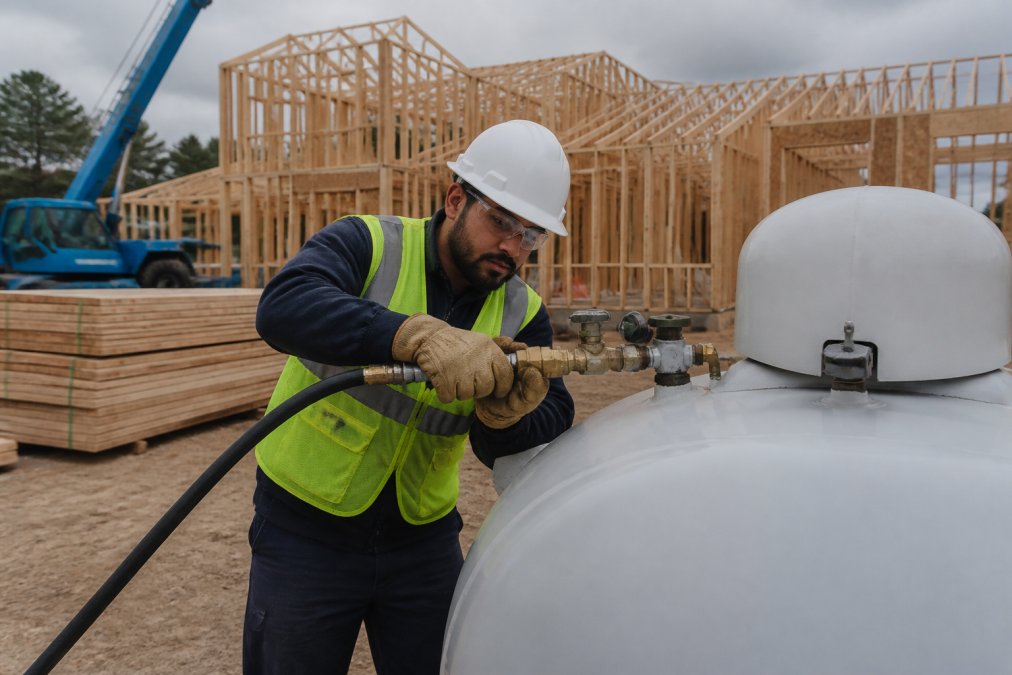
Tank installation and maintenance are equally critical. The supplier should handle the logistics of tank placement, ensuring the unit sits on stable ground away from ignition sources and high-traffic equipment paths. Ask about their safety record and whether their drivers are trained in OSHA construction site safety standards. A professional crew will also perform a leak check and pressure test before leaving the site.
Flexible service plans matter for cash flow. Some projects run hot for three weeks then idle for two. A partner offering metered service or project-based delivery without long-term commitment suits the construction cycle better than a rigid annual contract.
Comparing Delivery Models: Scheduled, Automatic, and On-Demand
Choosing a delivery model is less about picking a preference and more about matching the fuel supplier’s operational rhythm to the unpredictable pulse of a construction site. The table below outlines the baseline differences, but the real value lies in understanding how each model behaves under the stress of a live project.
| Delivery Model | How It Works | Best For | Risk Level |
|---|---|---|---|
| Scheduled | Fixed dates based on your project timeline | Known, extended phases | Moderate |
| Automatic | Supplier monitors usage and refills before empty | Constant, high-demand heating | Low |
| On-Demand | You call or order when fuel is needed | Short-term or variable use | High |
Scheduled delivery works well when you have a defined timeline, such as a winter build-out lasting eight weeks. However, the weakness is rigidity. If a concrete pour is delayed by weather and the heating load shifts by three days, a fixed schedule can arrive too early or too late. The key is to confirm the supplier’s rescheduling window.
Automatic refill shifts the monitoring burden to the supplier, but on a construction site, the assumption of steady consumption is often wrong. A standard automatic system uses degree-day calculations, which predict usage based on historical weather patterns. This works for a home with a consistent thermostat setting. On a site, however, a crew may run four heaters at full output for 48 hours straight to cure concrete, then shut them all down for a weekend. If you choose automatic delivery, ask if their system can handle high-velocity drawdowns or if they use tank monitors that trigger refills based on actual level, not just weather predictions. The latter is the only reliable method for construction.
On-demand delivery offers flexibility but carries the highest risk, particularly during peak cold snaps. When temperatures drop below freezing for three consecutive days, every contractor in the region is calling for fuel simultaneously. A supplier’s on-demand capacity is finite. If you rely on this model, you are effectively betting that your call will be answered before your tank hits empty. A common pattern is that on-demand customers get squeezed out by automatic delivery customers during a cold snap. For a construction site, on-demand should be reserved for short-term tasks, not for sustained operations.
A delivery model is only as reliable as the supplier’s local dispatch capacity. Ask for their average lead time for on-demand requests during a cold-weather event. If they cannot guarantee a 24-hour turnaround when temperatures are below freezing, that model is not reliable for your site.
The most effective approach for many contractors is a hybrid: an automatic delivery agreement with a tank monitor for the primary heating season, supplemented by the ability to place an on-demand order for a sudden spike in usage, such as an unexpected overnight pour.
Before signing any service agreement, verify the supplier’s policy on emergency drops. Some providers charge a premium for after-hours or weekend deliveries, which can add hundreds of dollars to a single fill. Others, particularly those serving commercial accounts, will waive these fees if you hold an active automatic delivery contract.
OSHA Propane Storage Regulations Construction Teams Must Follow
Compliance is non-negotiable on a jobsite. The Occupational Safety and Health Administration construction standards govern how propane tanks must be stored and handled to protect workers and property.
OSHA propane storage regulations construction teams must follow typically require that storage containers be positioned at specific distances from building openings, ignition sources, and property lines. For larger tanks, the regulations specify separation distances based on the container’s water capacity. Aboveground tanks must be secured on a firm, level foundation, and the area should be kept clear of debris and combustible materials.
Your propane supplier should be well-versed in these requirements and willing to assist with site layout. A reputable provider will not place a tank in a location that violates code, even if the crew insists it is the only convenient spot. construction debris removal.
When a supplier handles tank installation, confirm in writing that the placement meets current OSHA separation and security requirements. The liability for a violation typically falls on the general contractor, not the fuel company.
Propane Tank Monitoring Systems for Contractors: Preventing Runouts
Propane tank monitoring systems for contractors have evolved significantly, but the technology is only half the equation. On an active construction site, the physical placement of the tank and the monitor’s communication method are just as critical as the sensor’s accuracy. A monitor that works flawlessly in a residential backyard can fail silently on a site where the tank sits behind steel beams or near heavy equipment that generates radio interference.
Modern monitoring options range from basic float gauges to wireless sensors that transmit usage data directly to the supplier via cellular networks. For construction sites, where tanks may be filled and emptied rapidly by multiple heaters, real-time data is invaluable. However, the most common failure point is not the sensor itself but the cellular signal. Many active sites are in semi-rural or industrial zones with spotty coverage. Before relying on a wireless monitor, confirm the supplier’s device uses a carrier with strong local coverage and has a visual or audible low-level alarm as a backup.
Wireless monitoring eliminates the need for manual checks, which often get skipped during busy phases. The sensor tracks the fuel level and sends an alert when it crosses a threshold, triggering an automatic delivery. But the data is only useful if the tank is accessible for a refill. A monitor can tell you the tank is at 15%, but if the tank is positioned in a corner that is now blocked by a material delivery, the supplier cannot get a hose to it.
Tank placement on a construction site is a logistical decision that must account for the full project timeline, not just the current phase. A tank placed for easy access during foundation work may be unreachable once framing begins and material staging shifts. Coordinate with the supplier to position the tank in a location that will remain accessible for the duration of the project, even as the site layout evolves.
On space-constrained sites, such as urban infill projects or sites with a tight footprint, the standard rule of placing a tank 10 feet from a building opening may conflict with the only available space. This is where a supplier’s experience with construction logistics matters. A knowledgeable provider will work with the site superintendent to identify a location that meets OSHA separation requirements while remaining reachable by the delivery truck’s hose length, which is typically limited to 100 feet.
Another consideration is the physical protection of the tank itself. On a busy site, a tank is vulnerable to impact from forklifts, excavators, or falling debris. OSHA regulations require that tanks be protected from vehicular damage, which often means installing bollards or guard posts around the tank. This protection must be planned before the tank is placed.
If a supplier offers monitoring as part of their service, it is worth prioritizing, but verify the specifics. Ask whether the monitor is integrated into their dispatch system or if it simply sends an email alert to the site manager. The former is far more effective because it removes the human step of noticing the alert and placing a call.
Calculating Propane Consumption for Temporary Site Heating
Estimating usage prevents both shortages and over-ordering. The calculation starts with the BTU output of your heaters. A standard 100,000 BTU heater will consume roughly one gallon of propane per hour at full output.
To calculate for a specific site, follow this process:
- Total the BTU rating of all heaters running simultaneously.
- Divide that number by 91,500 (the approximate BTUs per gallon of propane) to find gallons per hour (afdc.energy.gov).
- Multiply by the expected daily run time to get daily consumption.
- Multiply by the number of days in the heating period to estimate total project demand.
For example, a site running four 100,000 BTU heaters for 10 hours a day uses roughly 44 gallons daily. Over a 30-day period, that approaches 1,300 gallons. This figure informs whether you need a 500-gallon tank or a larger bulk storage solution.
Evaluating the Cost of Converting Heating Systems to Propane
The cost of converting heating systems to propane involves more than the fuel itself. Contractors weigh this option against diesel or electric alternatives, and the analysis depends on equipment lifespan and site conditions.
Propane-powered equipment generally burns cleaner than diesel, reducing maintenance on heaters and improving air quality in enclosed spaces. While the upfront cost of a propane unit can be higher, the fuel efficiency and lower emissions often offset the difference over a single project.
When comparing fuels, account for the tank rental or purchase, the cost of the conversion kit or new burner, and the delivery logistics. Diesel requires on-site refueling from a truck, while propane tanks can be swapped or refilled by the delivery service.
Secure Your Site’s Fuel Supply With Discount Propane
Managing fuel should not distract from managing the build. A dependable propane partner brings transparency and scheduling ease to a chaotic environment. Discount Propane offers upfront, real-time online pricing, so you see the cost before the truck rolls.
Our online ordering platform lets you schedule delivery without waiting on hold, and flexible payment options, including credit card, cash on delivery, or Zelle, simplify accounting across multiple projects. For Long Island construction sites that need consistent supply for heaters and propane-powered equipment, we provide the reliable infrastructure support to keep your timeline intact.
Get started with Discount Propane and secure your site’s fuel supply with transparent pricing and delivery that shows up when you need it.
Frequently Asked Questions
How do I calculate propane needs for temporary construction heating?
A standard temporary heater consumes roughly 1 gallon per 100,000 BTUs per hour of operation. Calculate your total BTU load from all heaters, multiply by expected daily run hours, then factor in a 3-5 day buffer for weather delays. Share this number with your propane delivery provider so they can recommend the right tank size and delivery schedule.
What safety regulations apply to propane storage on construction sites?
OSHA and NFPA 58 govern propane storage on construction sites. Requirements include keeping storage at least 10 feet from building openings and ignition sources, securing tanks against vehicle impact, and posting ‘No Smoking’ signs within 10 feet of the storage area. Your delivery provider should confirm your site layout meets these standards before installation.
How can I ensure consistent fuel supply during peak construction months?
Set up automatic delivery with a propane tank monitoring system. These systems track your fuel level remotely and trigger a refill before you run out. This removes the need for manual checks and protects your schedule during high-demand periods when last-minute orders face delays.
What are the benefits of on-site propane tank monitoring for contractors?
Tank monitoring systems provide real-time fuel level data, enabling automatic refills and preventing costly runouts that stop work. They also provide usage history, helping you predict fuel costs for future projects and verify deliveries. This reduces administrative time and keeps your crew working.