
Table of Contents
- Best Propane Delivery for Businesses: 2026 Guide
- 1. Discount Propane: Transparent Pricing and Fast Scheduling
- 2. AmeriGas: Flexible Pricing Plans for Enterprise Accounts
- 3. Ferrellgas: Bulk Delivery and Cylinder Exchange Network
- 4. Suburban Propane: Online Monitoring and Multi-State Coverage
- 5. Superior Plus Propane: Smart Tank Monitoring Technology
- Understanding Commercial Propane Delivery Rates and Contract Options
- Emergency Propane Delivery Services: Availability and Response Times
- How to Choose a Propane Supplier for Your Business
- Frequently Asked Questions
Last Updated: September 1, 2026
Best Propane Delivery for Businesses: 2026 Guide
When your business depends on consistent propane supply, the wrong supplier choice costs money, creates downtime, and leaves you vulnerable to price swings. The propane market has fragmented in recent years as national chains, regional specialists, and transparent online platforms now compete where incumbents once dominated. This guide breaks down the actual options available to businesses in 2026, covering what separates a reliable supplier from one that will frustrate you when you need them most.
The best propane delivery balances three things: transparent pricing you can verify before ordering, reliable delivery windows you can count on, and flexibility to adjust volume without penalties.
Quick Picks:
- Best Overall: Discount Propane, transparent online pricing, fast scheduling, forklift tank exchange
- Best for Enterprise Scale: AmeriGas, nationwide network, flexible contract options, dedicated account support
- Best for Bulk Delivery: Ferrellgas, extensive distribution, cylinder exchange network, 24/7 emergency response
- Best for Tank Monitoring: Superior Plus Propane, SMART Tank wireless technology, automated delivery optimization
- Best for Multi-Location Operations: EspriGas, consolidated billing, real-time telemetry dashboard, national supplier network
1. Discount Propane: Transparent Pricing and Fast Scheduling
Discount Propane stands apart because it publishes real-time pricing online and lets you schedule delivery without committing to a contract. You see the price per gallon on their website, add your volume, and get a total before you order. No hidden fees appear when the truck arrives.
This transparency matters because many businesses report that their current supplier’s quoted price differs significantly from what they’re invoiced, with delivery charges, tank rent, or “market adjustment” fees appearing after the fact. Discount Propane offers both automatic delivery and will-call options, meaning you control the schedule. For construction sites, seasonal operations, or businesses with unpredictable demand, will-call eliminates the risk of paying for fuel you don’t need yet.
They also handle forklift cylinder exchange and tank rentals, so you’re not locked into owning infrastructure. Payment flexibility includes credit cards, cash on delivery, and Zelle transfers, reducing administrative overhead for multi-site operations.
The tradeoff: service area is limited to Long Island. If your operation spans multiple states, you’ll need a national supplier. But for concentrated operations, the transparency and ease of online ordering often outweigh the limitations of larger chains that require phone calls and custom quotes.
Use their online price checker before calling any competitor. You’ll immediately see whether you’re being overcharged by your current supplier; many businesses discover they’re paying more than market rate once they see real-time pricing.
2. AmeriGas: Flexible Pricing Plans for Enterprise Accounts
AmeriGas is the largest retail propane marketer in the United States, offering nationwide coverage (sec.gov). For businesses operating across multiple states, they’re often the default choice simply because they’re everywhere.
Their strength is contract flexibility. They offer three pricing models: Market Price (you pay current market rates), Fixed Contract Price (locked rate for a set period), and Floating Contract Price (a hybrid with a cap and floor). This range lets you choose your risk tolerance. AmeriGas assigns dedicated account representatives to commercial customers, providing a human touchpoint when something goes wrong.
The friction point: pricing isn’t transparent online. You’ll call for a quote, and the number varies depending on which local depot handles your account, your volume, tank ownership, and contract type. This opacity makes it hard to compare against competitors or verify you’re getting market rates.
Before signing an AmeriGas contract, get quotes from at least two other suppliers with identical specifications. AmeriGas pricing can vary depending on [your location](/service-area/) and negotiating power.
3. Ferrellgas: Bulk Delivery and Cylinder Exchange Network
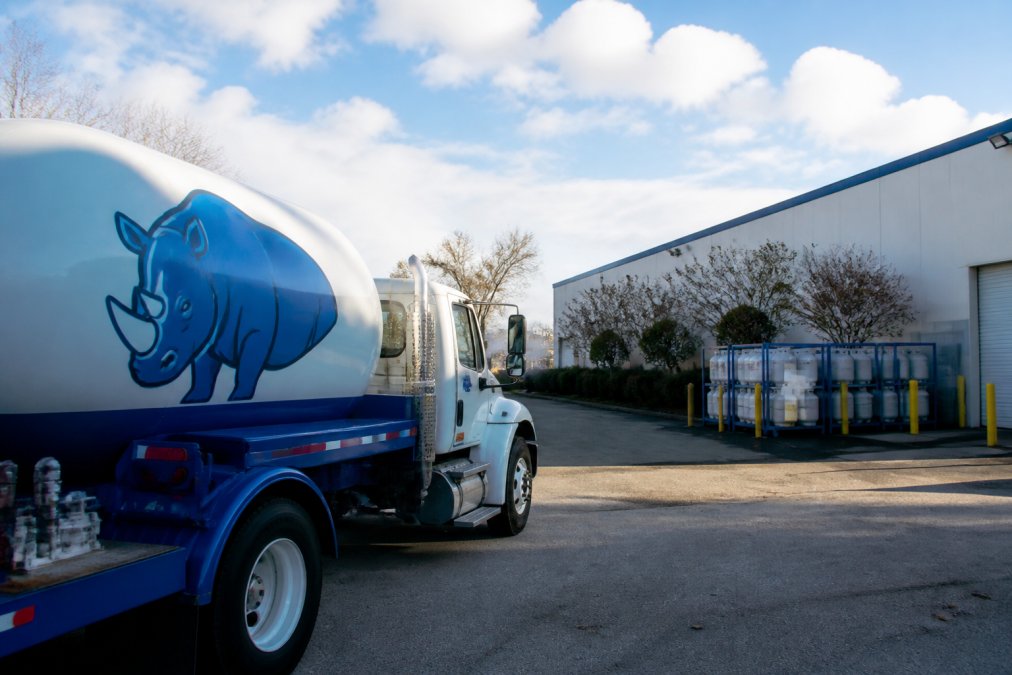
Ferrellgas operates one of the broadest distribution networks in the country and owns the Blue Rhino cylinder exchange brand, giving them flexibility across business sizes (sec.gov). If you need both bulk tank delivery and convenient cylinder swaps, they can handle both from one supplier.
For bulk propane, Ferrellgas offers automatic and will-call delivery with market-rate, fixed-price, and capped pricing options. They install and lease tanks, so you don’t need to own equipment. The Blue Rhino network adds convenience, if you run out between scheduled deliveries, you can swap a cylinder at thousands of retail locations nationwide. Their 24/7 emergency response is useful for businesses that can’t afford downtime.
The downside is pricing inconsistency. Ferrellgas pricing varies significantly by location, tank ownership, and customer status. Customer satisfaction reviews are mixed, with complaints about price increases after contract renewal and unexpected fees. Shop pricing against competitors every year.
4. Suburban Propane: Online Monitoring and Multi-State Coverage
Suburban Propane operates across 41 states with particular strength in the Northeast and Mid-Atlantic. Their competitive advantage is the MySuburbanPropane online portal, which lets you monitor tank levels in real time, schedule deliveries, and manage payments without calling. For businesses with multiple locations, this centralized visibility is valuable.
Pricing programs include market-rate, fixed-price contracts, capped pricing, and budget billing. They also offer cylinder cages and onsite cylinder filling for businesses using multiple small tanks.
The catch: Suburban Propane’s pricing tends to run higher than independent suppliers, particularly in competitive areas. Some customers report additional fees for tank rent, restocking, and account closeout that aren’t immediately obvious in initial quotes. The online portal is genuinely useful, but it doesn’t offset pricing that’s above market in many regions.
5. Superior Plus Propane: Smart Tank Monitoring Technology
Superior Plus differentiates on technology. Their SMART Tank wireless monitoring system automatically tracks propane levels and triggers deliveries before you run out. For businesses that have experienced propane shortages, this automation feels like insurance.
The mySUPERIOR mobile app and website let you manage your account from your phone, view delivery history, and adjust settings. They offer Variable (market-based), Fixed (locked rate), and Equal Payment Plans. The SMART Tank technology genuinely reduces run-out risk by learning your consumption patterns and optimizing delivery timing, which saves money by reducing emergency deliveries.
The limitation: specific pricing isn’t public, and new customers often face minimum annual consumption requirements and mandatory tank rental. You’ll need to contact them for a quote.
Tank monitoring technology has moved from luxury to standard in the propane industry. If your current supplier doesn’t offer real-time tank visibility, you’re missing a basic efficiency tool that most competitors now provide.
Understanding Commercial Propane Delivery Rates and Contract Options
Propane pricing moves with commodity markets, but your contract structure determines how much volatility you absorb. Understanding the difference between contract types is the single biggest factor in controlling your fuel costs.
Market Price vs. Fixed-Rate Contracts
Market Price contracts tie your rate to the current wholesale propane market. When prices drop, you pay less. When prices spike, you pay more. This model works if you can absorb price volatility or operate in a market with stable, low prices. The advantage is simplicity: no contract terms, no minimums, no long-term commitment. choosing fuel types.
Fixed-Rate Contracts lock your price for a set period, typically one or two years. You pay the same per-gallon rate regardless of market swings. This eliminates uncertainty for budget planning. The tradeoff: if market prices drop significantly, you’re locked in at the higher rate. Fixed contracts typically include minimum volume commitments.
The decision hinges on your business model. If you can forecast demand accurately and tolerate price swings, market pricing saves money during low-price periods. If you need budget certainty and can commit to minimum volumes, a fixed contract removes the guessing.
Propane Supply Contract vs Spot Pricing: Which Model Works Best
Spot pricing is essentially market pricing, you pay the daily or weekly wholesale rate plus the supplier’s margin. It’s the most transparent model because your cost directly reflects commodity prices. Spot pricing works for businesses with flexible budgets, short-term or project-based needs, and preference for no long-term commitments.
Supply contracts lock terms: price, volume, delivery frequency, and duration. They’re designed for businesses that want predictability and work best for operations with stable, year-round demand, long-term facilities, and companies that can commit to minimum volumes.
Most businesses use a hybrid: lock in a fixed contract for baseline winter heating demand, then use spot pricing or will-call for additional volume during peak season.
| Contract Type | Best For | Pricing Model | Commitment | Upside | Downside |
|---|---|---|---|---|---|
| Market/Spot Pricing | Flexible budgets, seasonal demand, short-term needs | Daily/weekly wholesale rate + margin | None | Lower costs when prices drop | Higher costs during spikes |
| Fixed-Rate Contract | Stable demand, budget forecasting, long-term operations | Locked rate for 1-2 years | Minimum volume | Budget certainty, no price volatility | Overpays if market drops |
| Capped Pricing | Risk-averse operations, moderate volume | Market rate with price ceiling | Varies | Benefits from price drops up to cap | Pays premium for price protection |
| Equal Payment Plan | Monthly budgeting, seasonal businesses | Averaged annual cost divided by 12 | Varies | Predictable monthly expense | May overpay in low-use months |
Emergency Propane Delivery Services: Availability and Response Times
When your propane runs out unexpectedly, response time determines whether you lose a shift of production, a day of heating, or a week of business. National suppliers like Ferrellgas and Suburban Propane advertise 24/7 emergency response. The practical reality varies by location, rural areas may see longer response times even from national chains, while local suppliers often respond faster in their service area.
Discount Propane’s advantage is direct contact. You reach someone who can authorize emergency delivery immediately rather than navigating a phone tree. Some suppliers charge premiums for emergency calls. Budget for this if your operation can’t tolerate downtime.
Prevention is cheaper than emergency response. Tank monitoring systems prevent run-outs by triggering deliveries before you’re empty. Automatic delivery schedules eliminate the risk of forgetting to order.

How to Choose a Propane Supplier for Your Business
Choosing a propane supplier is a procurement decision, not a commodity purchase. The cheapest price per gallon often costs more when you factor in downtime, hidden fees, contract penalties, and poor customer service.
Evaluate Delivery Reliability and Service Area
Start by confirming the supplier serves your location. Call their customer service line and ask: What’s the typical delivery window? Can you get same-day or next-day delivery? What happens if you need emergency fuel?
Reliability also means consistency. Some suppliers batch deliveries to reduce costs, which means you might wait 10 days between deliveries even if you request weekly service. Ask current customers in your area about their experience. In competitive markets with multiple suppliers, you have negotiating power. In rural areas with limited options, suppliers know you have few alternatives and price accordingly.
Compare Tank Ownership vs. Rental Options
Renting means the supplier owns the tank, maintains it, and replaces it if it fails. You pay a monthly or annual rental fee, typically $5-15 per month. Renting is ideal if you want to avoid capital expenditure, minimize maintenance responsibility, or preserve flexibility to switch suppliers. The downside: rental fees add up over time.
Owning means you purchase the tank outright (typically $500-2,000 depending on size) and are responsible for maintenance and inspections. You eliminate monthly rental fees and own an asset. The downside: you’re committed to that location, and switching suppliers becomes more complicated.
For permanent installations, ownership often makes financial sense. For temporary or mobile operations, renting avoids stranded assets.
Assess Safety Standards and Leak Testing Protocols
Every supplier must comply with Department of Transportation (DOT) regulations and ASME (American Society of Mechanical Engineers) standards (dot.gov). What differentiates suppliers is their approach beyond minimum compliance. Ask:
- How often are tanks inspected?
- What’s your leak detection process?
- Are tanks cleaned before delivery?
- Do you provide safety documentation?
Transparent suppliers publish their safety protocols. Suppliers that avoid the question may cut corners. For businesses with sensitive equipment, tank cleanliness matters, dirty tanks introduce contaminants that damage equipment and create maintenance costs.
If a supplier can’t clearly describe their leak testing and tank inspection process, that’s a red flag. Safety is the one area where “we do the minimum required” isn’t acceptable. Propane leaks cause fires, explosions, and injuries; your supplier’s standards directly affect your liability.
Choosing the best propane delivery requires balancing price, reliability, and service quality. Transparent suppliers like Discount Propane eliminate guesswork on pricing and offer fast scheduling without long-term commitments. National chains like AmeriGas and Ferrellgas provide scale and emergency response. Technology-forward providers like Superior Plus prevent run-outs through smart monitoring. Start by getting real-time quotes from at least three suppliers, comparing not just per-gallon rates but contract terms, delivery windows, and hidden fees. Most businesses overpay because they never shop their supplier. Get Discount Propane’s transparent online pricing and compare it against your current bill, you’ll likely discover significant savings.
Frequently Asked Questions
Q: What factors should businesses consider when choosing a propane supplier?
A: Evaluate delivery reliability, service area coverage, pricing transparency, tank ownership options, and 24/7 emergency support. Check whether the supplier offers automatic delivery, will-call options, and online account management. Verify they meet safety standards including leak testing and regulatory compliance. Consider contract flexibility and whether they provide forklift cylinder exchange or other services your business needs.
Q: How does commercial propane delivery differ from residential rates and service?
A: Commercial propane delivery rates typically depend on volume, contract type, and tank ownership. Businesses often qualify for fixed-price contracts, market-rate pricing, or capped pricing options. Commercial accounts usually receive dedicated support, automatic delivery scheduling, online monitoring tools, and access to bulk quantities. Service includes tank installation, maintenance, and specialized solutions like forklift cylinder exchange for industrial operations.
Q: What is the difference between propane supply contract vs spot pricing?
A: Fixed-rate contracts lock in a set price for a defined period, protecting against price volatility and aiding budget planning. Spot pricing fluctuates with market conditions, offering potential savings when prices dip but exposing businesses to cost increases. Some suppliers offer capped pricing, combining market rates with a price ceiling. Your choice depends on cash flow predictability needs and risk tolerance regarding fuel pricing volatility.
Q: Do all propane companies charge a delivery fee?
A: Most propane suppliers include delivery in their service, but fees vary based on order size, distance, and account type. Some charge separate delivery fees while others bundle costs into the per-gallon price. Tank rental fees, restocking charges, and closeout fees may apply depending on the supplier and contract terms. Always request a transparent breakdown of all fees before signing an agreement to avoid surprises.
Q: What should I do if I need emergency propane delivery?
A: Contact your propane supplier’s 24/7 emergency line immediately. Most major suppliers offer emergency response for run-out situations and safety concerns. Have your account number and location details ready. Emergency delivery may incur additional fees or require a minimum order. Prevent emergencies by choosing a supplier offering automatic delivery or tank monitoring technology that alerts you before levels drop critically low.
This article was written using GrandRanker