
Table of Contents
- Why Propane Powers Construction Sites
- Types of Propane Heaters for Jobsite Use
- Sizing Your Propane Heater: Using a BTU Calculator
- OSHA Construction Heater Safety Regulations and Compliance
- Temporary Heating Fuel Consumption and Cost Management
- Propane Delivery for Jobsite Heaters: What Contractors Need
- Indoor vs. Outdoor Propane Heater Operation
- Maintenance, Troubleshooting, and Cold Weather Performance
Last Updated: August 15, 2026
Why Propane Powers Construction Sites
Propane for construction site heaters is the standard fuel choice for temporary heating across jobsites, warehouses, and industrial facilities. It’s reliable, portable, and delivers consistent heat when you need it most, especially in cold weather when project timelines can’t afford delays.
Unlike electric heaters that demand expensive infrastructure upgrades or natural gas lines that require permanent installation, propane arrives when you schedule it and leaves when the job’s done. You don’t commit to infrastructure or wait weeks for utility approvals. But what separates a smooth heating operation from a frustrating one is understanding what you’re buying: BTU output, fuel consumption, safety regulations, and tank sizing. These aren’t academic details, they’re the difference between a site that runs smoothly and one that shuts down mid-winter because the heater wasn’t sized correctly or ran out of fuel at the wrong moment.
This guide walks you through the decisions that actually matter.
Types of Propane Heaters for Jobsite Use
Two main heater types dominate construction sites, and they work in fundamentally different ways. Choosing between them depends on your space, your team’s comfort priorities, and what you’re actually heating.
Forced Air Heaters
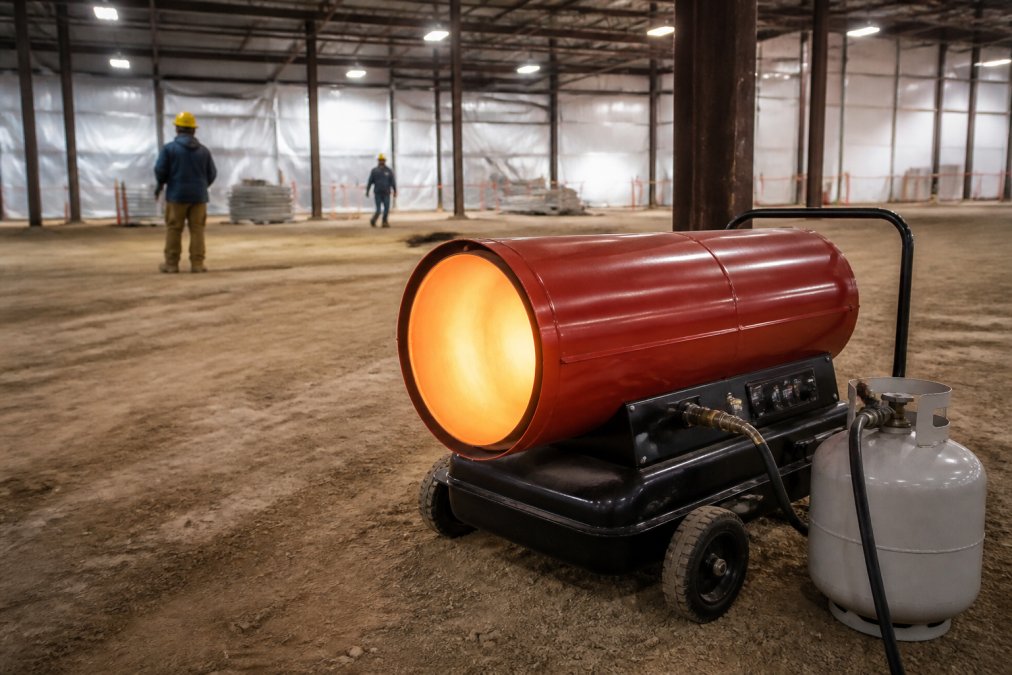
A forced air heater is a propane burner that heats air and forces it out through a fan. The heat distribution is aggressive and immediate. A 50,000 BTU forced air heater can warm a 1,000-square-foot warehouse in 15-20 minutes. They’re industrial grade, built to handle jobsite abuse, and the ignition system is simple and reliable. A thermocouple detects the flame, and if it goes out, the safety shut-off prevents gas from flowing.
The tradeoff is noise and uneven heat distribution. Forced air heaters create hot spots and cold spots, the area directly in front gets blasted with heat while corners stay cool. For large, open spaces where workers move around, that’s acceptable. Fuel consumption runs high because you’re constantly running a fan and heating a large volume of air. A 50,000 BTU unit might consume 1-1.5 gallons of propane per hour at full output.
Radiant Heaters
Radiant heaters emit infrared radiation, like standing in sunlight. The heat travels directly to objects and people in its path, not through the air. They’re quieter than forced air units and more fuel-efficient because they’re not constantly running a fan. A 30,000 BTU radiant heater can keep a small workshop or covered jobsite entrance comfortable without heating the whole building.
The limitation is range and coverage. Radiant heat doesn’t fill a large open space evenly, and it requires clear line-of-sight to the area you’re heating. Radiant heaters consume less propane than forced air units of similar BTU output, a 30,000 BTU radiant unit might use 0.5-0.8 gallons per hour.
Sizing Your Propane Heater: Using a BTU Calculator
Most contractors guess at heater size, then either run the heater constantly to maintain temperature or discover it’s undersized and the site stays cold. BTU output is the amount of heat energy the heater produces per hour. What matters is matching the heater’s BTU output to the cubic footage of the space and the temperature rise you need.
How to Calculate BTU Requirements
Start with three numbers: square footage, ceiling height, and target temperature rise.
Step 1: Calculate cubic footage. Multiply square footage by ceiling height. A 2,000-square-foot warehouse with 12-foot ceilings is 24,000 cubic feet.
Step 2: Determine the temperature rise needed. If it’s 20 degrees outside and you want the space to be 60 degrees, that’s a 40-degree rise.
Step 3: Apply the BTU formula. A common rule of thumb is 1 BTU per cubic foot per degree Fahrenheit of temperature rise. So: 24,000 cubic feet × 40-degree rise = 960,000 BTU needed.
In practice, you’ll lose heat through walls, doors, and ventilation. For a well-insulated space with minimal air leakage, reduce the requirement by 20-30%. For a poorly insulated space or one with open doors and windows, add 20-30%. Using the example above: 960,000 BTU × 0.75 = 720,000 BTU required.
A practical approach is to use a BTU calculator that factors in insulation quality and air changes per hour.
Matching BTU Output to Square Footage
Here’s a quick reference for common scenarios:
| Space Size | Ceiling Height | Insulation | Recommended BTU Output |
|---|---|---|---|
| 500 sq ft | 8 ft | Poor | 50,000-75,000 |
| 1,000 sq ft | 10 ft | Average | 75,000-100,000 |
| 2,000 sq ft | 12 ft | Good | 100,000-150,000 |
| 5,000 sq ft | 14 ft | Poor | 200,000-300,000 |
These are approximations for a 40-degree temperature rise. If you need a larger temperature rise, increase the BTU output by 25-50%. Right-sizing saves propane and keeps your site comfortable. Oversizing causes the heater to cycle on and off constantly, wasting fuel and stressing equipment. Undersizing means the heater runs continuously and still doesn’t maintain temperature.
OSHA Construction Heater Safety Regulations and Compliance
OSHA doesn’t specify which type of heater to use, but it has strict requirements about how you operate one. These regulations exist because propane heaters create real hazards: carbon monoxide, fire risk, and oxygen depletion in enclosed spaces.
Ventilation and Carbon Monoxide Requirements
Propane combustion produces carbon monoxide. In an unventilated or poorly ventilated space, carbon monoxide accumulates and kills people. OSHA requires that any temporary heating equipment in an enclosed space must have adequate ventilation to remove combustion byproducts.
Most propane heater manufacturers specify that heaters must not be used in spaces with less than 1 air change per hour, meaning the entire volume of air in the space is replaced at least once per hour. In a small enclosed room, that means opening windows or doors. In a sealed building, it means operating a ventilation system.
For outdoor or partially enclosed spaces, ventilation requirements are less stringent because air naturally circulates. The practical rule: if workers are in an enclosed space with a propane heater, ensure continuous air exchange. This typically means cracking doors or windows, running exhaust fans, or using ventilation equipment designed for the space.
Safety Shut-Off Systems and Thermocouples
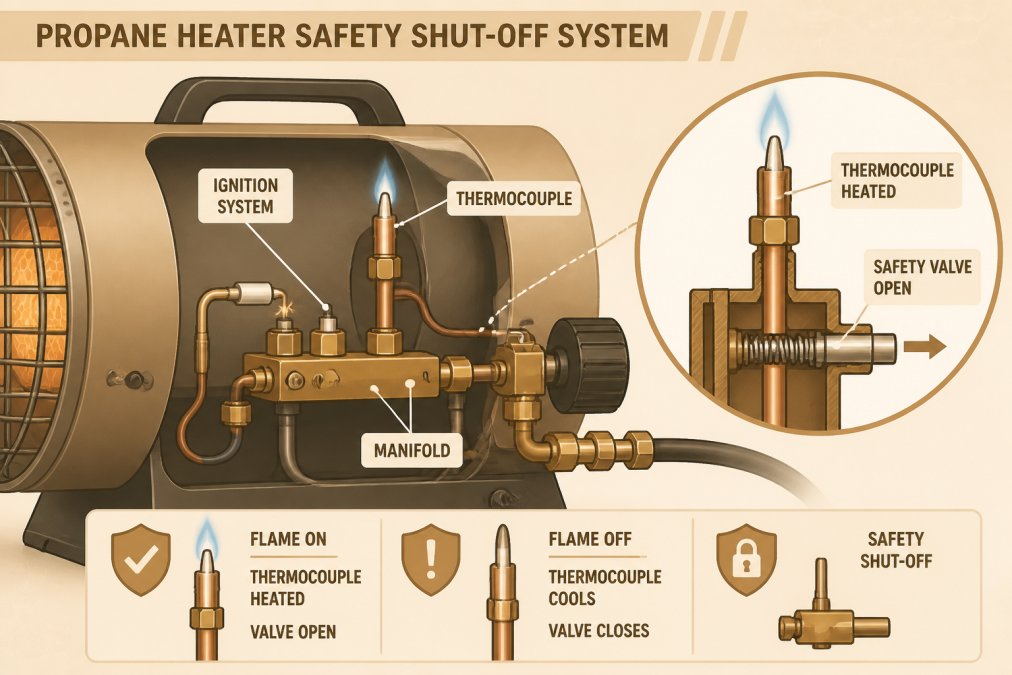
Every propane heater for jobsite use must have a thermocouple, a safety device that detects whether the pilot light or main burner is burning. If the flame goes out, the thermocouple stops sending a signal, and a solenoid valve shuts off the gas supply. Without a thermocouple, propane would continue flowing into the space even if the flame is out, creating an explosion hazard.
OSHA requires that heaters meet American National Standards Institute (ANSI) standards for safety shut-off systems. Most commercial propane heaters sold for jobsite use already meet these standards, but confirm before you rent or buy.
Practical safety measures include:
- Never operate a heater in a space where workers are sleeping
- Don’t use heaters as drying equipment
- Keep heaters at least 10 feet away from combustible materials
- Inspect the hose assembly and regulator before each use
Temporary Heating Fuel Consumption and Cost Management
Propane consumption is where many contractors get surprised. A heater that runs constantly burns fuel fast, and if you’ve miscalculated how long the heating season will last, you can run through a tank faster than expected.
Calculating Daily and Weekly Propane Usage
Fuel consumption depends on three variables: the heater’s BTU output, how hard it’s working (the thermostat setting), and the outdoor temperature.
A forced air heater set to 50,000 BTU output at full capacity burns roughly 1-1.5 gallons of propane per hour. A radiant heater at 30,000 BTU burns 0.5-0.8 gallons per hour. But most heaters don’t run at full capacity all the time. The thermostat cycles the burner on and off to maintain the target temperature.
On a moderately cold day (30-40 degrees outside), a 50,000 BTU forced air heater maintaining 60 degrees inside might cycle on for 20 minutes, then off for 10 minutes, roughly 50% duty cycle. At that rate, consumption drops to 0.5-0.75 gallons per hour.
To estimate weekly consumption:
- Estimate the average outdoor temperature for the week
- Estimate the duty cycle (what percentage of the time the heater runs)
- Multiply: (BTU output in thousands) × (duty cycle as a decimal) × (hours per week) × (0.01) = gallons per week
Example: 50,000 BTU heater, 50% duty cycle, 7 days × 24 hours = 168 hours per week.
(50 × 0.5 × 168 × 0.01) = 42 gallons per week
Tank Sizing and Cylinder Management
Propane is stored as a liquid under pressure in tanks. A standard 100-pound propane cylinder holds about 23.5 gallons. At 42 gallons per week consumption, that’s roughly 4 days of heating. If your propane delivery schedule allows weekly refills, a 100-pound cylinder works. If deliveries are less frequent, you need a larger tank or multiple cylinders.
Many jobsites use a 500-pound tank (approximately 120 gallons) or a 1,000-pound tank (approximately 240 gallons). These require a delivery truck to refill but reduce refill interruptions. Plan your tank size and delivery schedule around peak consumption periods, January and February typically see the highest usage.
Order a refill when the tank reaches 20-30% capacity. This ensures you never run out and gives the delivery company flexibility in scheduling.
Propane Delivery for Jobsite Heaters: What Contractors Need
Reliable propane delivery is as important as the heater itself. A delivery that’s three days late costs you more than the propane itself, it costs you labor time, project delays, and crew morale.
When arranging propane delivery for construction site heaters, communicate clearly with your supplier about your needs: the size and type of tank you’re using, your expected consumption rate, your preferred delivery schedule, any access restrictions at the jobsite, and whether you need the tank refilled on-site or will swap it out for a full one.
Discount Propane offers upfront, transparent pricing and easy online ordering, so you can see what propane costs before you commit to delivery. Fast delivery scheduling is critical during cold months. Confirm your supplier’s emergency delivery response time before the heating season starts.
Indoor vs. Outdoor Propane Heater Operation
The location where you operate the heater determines which safety rules apply and how efficiently the heater works.
Outdoor operation is straightforward. A propane heater in open air with good air circulation is inherently safe from a carbon monoxide perspective because the gas disperses. Ventilation requirements are minimal. The main concerns are wind (which can blow out the pilot light) and weather protection.
Indoor operation requires strict adherence to ventilation rules. An enclosed space with a propane heater must have continuous air exchange to prevent carbon monoxide buildup. In a sealed warehouse, that means running exhaust fans or opening doors and windows. In a construction trailer or small office, it means leaving a door or window cracked open at all times the heater runs.
Some contractors try to seal a space completely to maximize heating efficiency. This is dangerous. The heater consumes oxygen and produces carbon monoxide. In a sealed space, both problems compound quickly. Accept that heating an indoor space requires some ventilation. This slightly reduces heating efficiency, but it keeps people safe.
Maintenance, Troubleshooting, and Cold Weather Performance
Propane heaters are simple machines, but they need basic maintenance to run reliably through a long heating season.
Before the heating season starts, inspect the heater. Check the ignition system, the pilot light should ignite within a few seconds of startup. Listen for unusual sounds. Check the manifold and hose assembly for damage or corrosion. If the heater is used, have it serviced by a propane technician before you rely on it.
During the heating season, monitor heater performance. If the heater cycles on and off more frequently than usual, the space might be losing heat faster. If the heater won’t ignite, the thermocouple might be dirty or the pilot might be clogged. A simple cleaning often fixes this. If the heater produces a strong smell of propane, shut it off immediately and check for a gas leak.
Cold weather affects propane performance. Propane vaporizes less efficiently in extreme cold, which can reduce the heater’s output. In temperatures below 0 degrees, a standard propane tank might not supply gas fast enough to keep the heater running at full capacity. For sites in extreme cold, propane suppliers sometimes provide tank heaters or larger tanks to maintain adequate vaporization.
At the end of the heating season, have the heater serviced and stored properly. Drain any remaining fuel, clean the burner, and store the heater in a dry location. A well-maintained heater lasts for years.
Managing propane for construction site heaters comes down to matching the heater to your space, sizing it correctly, understanding fuel consumption, and following safety rules. The technical details matter because they directly affect your project timeline and your team’s safety. Discount Propane provides transparent pricing and reliable delivery so you can focus on the work instead of worrying about running out of heat mid-winter. Get a propane price online and schedule delivery that fits your jobsite schedule.
Frequently Asked Questions
How many square feet will a 50,000 BTU propane heater cover?
A 50,000 BTU propane heater typically covers 1,200 to 1,500 square feet in well-insulated spaces, or 800 to 1,000 square feet in poorly insulated jobsite buildings. Actual coverage depends on ceiling height, insulation, outdoor temperature, and desired indoor temperature. Use the formula: Square footage = (BTU output × 1.4) / temperature rise to calculate precisely for your space.
What are the OSHA requirements for propane heaters on job sites?
OSHA requires propane heaters on construction sites to have proper ventilation, carbon monoxide detection, and safety shut-off systems. Heaters must be positioned away from combustible materials, have a thermocouple safety device, and be regularly inspected. Forced air heaters require venting to prevent CO buildup. Always follow manufacturer instructions and maintain clear access to shut-off valves and regulators.
How do you calculate propane consumption for temporary heating?
Temporary heating fuel consumption depends on BTU output, hours of operation, and heating efficiency. A 50,000 BTU heater running 8 hours daily typically consumes 20-30 pounds of propane per day. Calculate using: Daily consumption = (BTU output × hours run) / (propane BTU content × efficiency). Track actual usage over one week to establish your site's baseline and plan cylinder deliveries accordingly.
Are propane construction heaters safe to use indoors?
Only certain propane heaters are safe indoors. Forced air heaters with proper venting and safety shut-off systems can be used indoors; unvented radiant heaters should not be. All indoor heaters require adequate ventilation and carbon monoxide detection. Never block ventilation openings, and inspect regulators and hose assemblies regularly. Follow OSHA guidelines and manufacturer safety instructions to prevent combustion hazards.
This article was written using GrandRanker