

Table of Contents
- Where to Find Your Propane Tank Gauge
- How to Read a Propane Tank Gauge Step by Step
- Converting Gauge Percentage to Gallons Remaining
- Reading Propane Tank Gauges on Different Tank Sizes
- How to Check Propane Level Without a Gauge
- When to Schedule a Propane Refill
- Propane Tank Safety Regulations You Should Know
- Conclusion
Last Updated: August 10, 2026
Where to Find Your Propane Tank Gauge
The propane tank gauge is located underneath the dome lid on top of your tank, the rounded plastic or metal cap at the very top of a residential above-ground tank. Lift it off and you’ll find the float gauge dial sitting right there, typically protected from the elements and easy to read once you know what you’re looking at.
Most residential tanks have a single gauge with a dial face that displays fuel level as a percentage. The dome lid on most tanks simply lifts straight off with no tools required. If the lid is corroded or stuck, contact your propane delivery provider rather than prying it open and risking damage to the gauge housing.
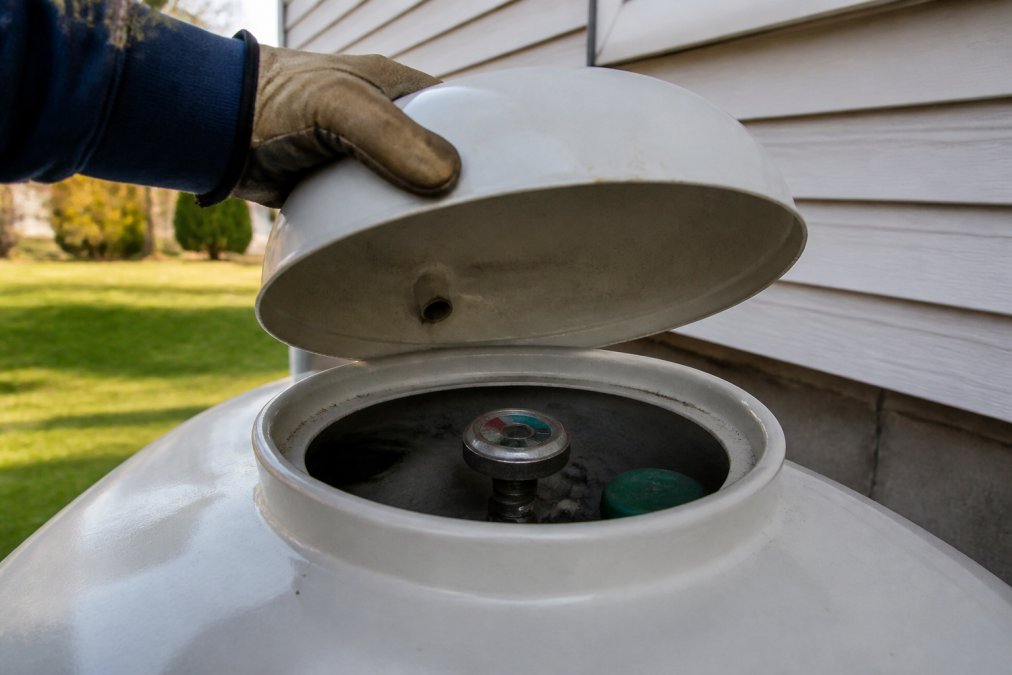
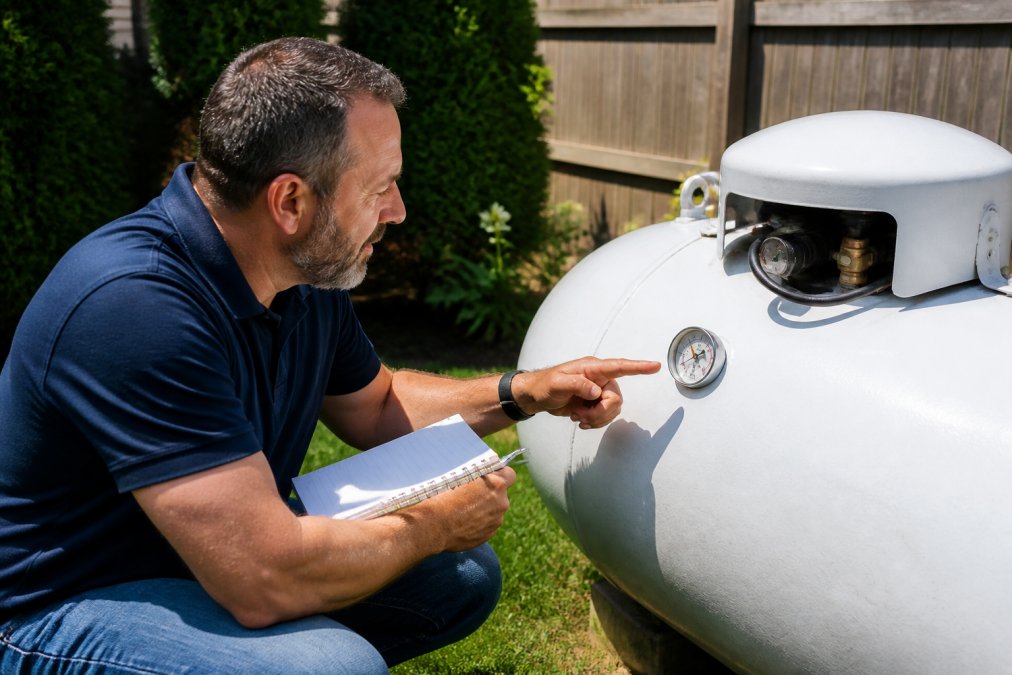
On horizontal tanks, the gauge is typically mounted on the side of the tank near the valve end rather than on top. Look for a small dial face near the regulator assembly.
How to Read a Propane Tank Gauge Step by Step
Reading a propane tank gauge correctly takes less than a minute:
- Remove the dome lid. Lift the plastic or metal cap straight up and set it aside.
- Locate the gauge dial. The float gauge sits in the center of the dome opening, usually recessed slightly into the tank collar.
- Read the percentage displayed. The needle points to a number on the dial face, representing the percentage of the tank’s total capacity currently filled with liquid propane.
- Note the reading. Write it down or take a photo if you’re tracking consumption over time.
- Replace the dome lid. Press it firmly back into place to protect the gauge from weather exposure.
Understanding the Dial Face and Percentage Readings
The dial face on a float gauge is marked in increments, typically showing numbers like 10, 20, 30, 40, 50, 60, 70, 80, and sometimes 90. These numbers represent percentage of tank capacity. A reading of 50 means your tank is half full; a reading of 30 means it’s roughly one-third full.
The gauge needle can stick if your tank has been sitting unused for months or if the float mechanism has aged. Gently tap the dome housing with your knuckle and watch whether the needle shifts. If it doesn’t move at all regardless of tapping, the gauge may need replacement.
Why the Gauge Stops at 80% When Full
A propane tank that reads 80% is considered full. This is a deliberate safety requirement, not a malfunction or short-delivery.
Liquid propane expands significantly with temperature increases. According to the National Fire Protection Association’s NFPA 58 Liquefied Petroleum Gas Code, propane tanks must never be filled beyond 80% of their total volume to allow for this thermal expansion. The remaining 20% is called the vapor space, and it acts as a built-in safety buffer. If a tank were filled to 100% and then exposed to summer heat, the expanding liquid would create dangerous pressure conditions.
Never attempt to “top off” a propane tank beyond 80%. Overfilling eliminates the vapor space and creates a serious pressure hazard, particularly in warm weather. If you suspect a tank was overfilled, contact your supplier immediately and keep the tank away from ignition sources.
Converting Gauge Percentage to Gallons Remaining
Knowing your gauge percentage is useful. Knowing how many gallons that actually represents is more useful. The conversion is simple math once you know your tank’s total capacity.
The formula: Gallons remaining = (Gauge percentage ÷ 100) × Tank capacity in gallons
Most residential tanks come in standard sizes:
| Tank Size | 80% (Full) | 50% | 30% | 20% (Order Now) |
|---|---|---|---|---|
| 120-gallon tank | 96 gallons | 60 gallons | 36 gallons | 24 gallons |
| 250-gallon tank | 200 gallons | 125 gallons | 75 gallons | 50 gallons |
| 500-gallon tank | 400 gallons | 250 gallons | 150 gallons | 100 gallons |
| 1,000-gallon tank | 800 gallons | 500 gallons | 300 gallons | 200 gallons |
To find your tank’s capacity, check the data plate stamped on the tank collar near the valve assembly. It will list the water capacity in gallons (WC). Propane capacity is approximately 42% of the water capacity figure.
Calculating Remaining Runtime by Appliance
One gallon of liquid propane contains approximately 91,500 BTUs of energy. To calculate runtime:
Runtime (hours) = (Gallons remaining × 91,500) ÷ Appliance BTU rating
For example, a 100,000 BTU whole-home furnace running on a 500-gallon tank at 30% capacity has roughly 150 gallons remaining, which works out to approximately 137 hours of continuous run time. In practice, a furnace doesn’t run continuously, so actual days of heat will be considerably longer depending on outdoor temperatures and thermostat settings.
Reading Propane Tank Gauges on Different Tank Sizes
Not all propane gauges work the same way, and tank orientation affects where you find the gauge and how you read it.
Residential Tanks vs. RV and Portable Cylinders
Residential tanks (120 gallons and up) almost always use a float gauge with a percentage dial under the dome lid. These tanks are stationary and typically serviced by a delivery company on a scheduled or will-call basis.
RV propane systems often use two 20-pound or 30-pound cylinders with an automatic switchover valve. Some RV setups include a gauge on the regulator assembly that shows approximate pressure rather than a true fuel level. Pressure readings are less reliable than float gauges because propane pressure stays relatively constant until the tank is nearly empty, then drops sharply.
Portable cylinders (the standard 20-pound grill tank) have no built-in gauge on most models. You need to use an alternative method to check the level.
For residential heating, a float gauge reading below 20% should trigger an immediate delivery order, especially heading into winter. On portable cylinders without gauges, weigh the tank or use the warm water test to estimate remaining fuel.
How to Check Propane Level Without a Gauge
Checking propane level without a gauge is particularly useful for portable cylinders used with grills, patio heaters, or job site equipment.
The most reliable no-gauge methods are:
-
The warm water method. Pour warm (not boiling) water down the side of the cylinder. Run your hand along the metal surface from top to bottom. The section containing liquid propane will feel noticeably cooler than the empty section above it. The boundary between cool and warm is your approximate fuel line.
-
Weigh the tank. Every 20-pound propane cylinder has its tare weight stamped on the collar. Weigh the full cylinder on a household scale and subtract the tare weight. The difference is the approximate pounds of propane remaining. Propane weighs approximately 4.2 pounds per gallon, so divide by 4.2 to get gallons.
-
Aftermarket gauge adapters. Inline gauge adapters thread between the tank valve and your regulator and display a color-coded pressure reading. They are inexpensive and widely available at hardware stores.
For large residential tanks that have lost their gauge entirely, contact your propane supplier. As documented in the U.S. Department of Energy’s propane safety guidance, propane is stored as a liquid under pressure and requires careful handling. Never use an open flame near a tank valve when checking fuel levels.
When to Schedule a Propane Refill
The standard recommendation is to schedule a propane refill when your tank gauge reads 20% to 25%. Waiting until the gauge hits 10% or lower creates real risk during cold snaps when delivery demand spikes across the region.
- Order at 25% during heating season. This gives you a buffer of several days to a week, enough time to receive a standard delivery without stress.
- Order at 20% in summer. Lower heating demand means slower consumption and more flexibility in scheduling.
- Never let the tank run to empty. An empty propane tank requires a pressure test and system inspection before it can be refilled, adding cost and downtime.
Seasonal Variations That Affect Fuel Consumption
Consumption is not linear across the year. A tank that lasts three weeks in October may last less than a week during a January cold snap. Propane also becomes denser in cold weather, which can cause float gauges to read slightly lower than the actual fuel volume present.
In summer, hot weather causes liquid propane to expand, which can make float gauges read slightly higher than actual content. Fall and spring are the best times to schedule a top-off fill, when delivery demand is lower and scheduling is more flexible.
The practical takeaway: check your gauge more frequently in November through February, and schedule fills proactively rather than reactively.
Propane Tank Safety Regulations You Should Know
Propane tank safety in the United States is governed primarily by NFPA 58, the Liquefied Petroleum Gas Code published by the National Fire Protection Association, along with regulations enforced by the U.S. Department of Transportation for cylinder transport. State-level regulations in New York also apply to installation setbacks, tank placement, and service technician licensing.
Key regulations every propane user should understand:
- 80% fill rule: Tanks must not be filled beyond 80% of total capacity. This is a code requirement, not a suggestion.
- Setback requirements: Residential propane tanks must be placed a minimum distance from structures, property lines, and ignition sources. A 500-gallon tank, for example, requires a minimum 10-foot setback from any building opening under NFPA 58.
- Pressure relief valves: Every propane tank is required to have a pressure relief valve. Never tamper with it, paint over it, or obstruct it.
- Tank ownership: In most cases, the propane tank on your property is owned by your supplier, not you. This matters for maintenance and replacement responsibilities.
If you’re unsure whether your tank installation meets current code, a licensed LP gas technician can perform an inspection. New York State requires LP gas technicians to hold a valid license through the Department of State.
Smart Monitoring Options for Remote Tank Tracking
Remote monitoring devices are small wireless units that attach to the gauge or valve assembly and transmit fuel level data to a smartphone app or web dashboard in real time. Instead of walking out to check the gauge in January, you check your phone. Low-level alerts notify you automatically when the tank drops below a threshold you set, typically 20% to 25%.
Most smart monitors use cellular or wireless connectivity and require no wiring or professional installation. For contractors managing multiple job site heaters or businesses operating several tanks across a facility, remote monitoring removes the guesswork from fuel supply management entirely.
Running low on propane is a manageable problem when you catch it early. Discount Propane offers upfront, real-time online pricing and easy online ordering, so Long Island homeowners and contractors can check current prices and schedule a delivery the moment their gauge reading calls for it. No commitment required to check pricing, and flexible payment options include credit card, cash on delivery, and Zelle. Get your propane price at Discount Propane and schedule your next fill before the gauge hits 20%.
Frequently Asked Questions
How do I tell how much propane is left in my grill tank?
Small grill cylinders typically do not have a built-in float gauge. The easiest method is the warm water test: pour warm water down the side of the cylinder, then run your hand along the metal. The point where the metal feels noticeably cooler marks the liquid propane level inside. You can also weigh the tank and subtract the tare weight stamped on the collar to calculate the remaining fuel in pounds.
Why should a propane tank only be filled to 80 percent?
Liquid propane expands as temperature rises. Leaving 20% of the tank volume empty gives the gas room to expand safely without building dangerous pressure. This 80% fill limit is required under NFPA 58, the Liquefied Petroleum Gas Code that governs propane storage and handling across the United States. A properly calibrated float gauge on a residential tank will read 'full' at 80%, not 100%, so that reading is normal and correct.
What level is too low for a propane tank?
Schedule a refill when your propane tank gauge reads 20% or below. Running a tank completely empty can introduce air and moisture into the lines, which requires a leak test and system purge before the tank can be safely refilled and restarted, adding time and cost. For heating systems during winter on Long Island, ordering at 20-25% gives enough buffer to avoid running out if a storm delays delivery.
What is 80% of a 250-gallon propane tank?
A 250-gallon propane tank holds a maximum of 200 gallons of liquid propane at the 80% fill limit. To find usable gallons for any tank, multiply the tank's stated capacity by 0.80. For common sizes: a 500-gallon tank holds up to 400 gallons, and a 1,000-gallon tank holds up to 800 gallons. Your propane tank gauge percentage always reflects a share of the full tank volume, not just the usable 80% portion.
This article was written using GrandRanker