
Table of Contents
- Why Scheduled Propane Delivery for Contractors Is Different
- Automatic vs Will-Call Propane Delivery: Which Works for Jobsites?
- Temporary Construction Heating Propane: Sizing and Planning
- OSHA Propane Storage Requirements for Construction Sites
- Bulk vs. Scheduled Delivery: Cost-Benefit Breakdown
- How to Set Up Scheduled Propane Delivery for Your Crew
- Conclusion
Last Updated: August 11, 2026
Why Scheduled Propane Delivery for Contractors Is Different
Scheduled propane delivery for contractors differs fundamentally from residential service. On a construction site, running out of propane means halted concrete curing, frozen pipes, and crews standing idle on payroll. Fuel management is a production problem, not just procurement.
Contractor accounts also have irregular demand curves. A residential home burns consistent fuel through winter, while a construction site spikes dramatically when exterior framing closes in and temporary heat runs around the clock, then drops near-zero during interior finish work. Any delivery schedule that doesn’t account for production phases fails at the worst possible time.
Scheduled propane delivery for contractors is the practice of arranging recurring, pre-planned fuel deliveries calibrated to a jobsite’s production schedule rather than reacting to low-tank alerts. It eliminates the "call when empty" model that introduces unnecessary supply chain risk to active construction.
The sections below break down how to choose the right delivery model, size your temporary heating setup, stay compliant with OSHA storage rules, and set up a delivery account that works for construction workflows.
Automatic vs Will-Call Propane Delivery: Which Works for Jobsites?
Most contractors assume automatic delivery is the obvious choice. The reality is more nuanced, and the wrong choice adds cost or risk depending on your site type.
How Automatic Delivery Works on a Construction Schedule
Automatic delivery uses predictive usage monitoring to estimate when your tank needs a refill and dispatches a truck before you hit a critical level. For sites running torpedo heaters through a cold snap, this model works well.
The catch is that automatic delivery algorithms are tuned for consistent, predictable consumption. Construction sites throw irregular demand at the model: a week of exterior work where heaters run continuously, followed by a week of interior rough-in where consumption drops sharply. Predictive monitoring built for homes can misread those swings and either over-deliver or under-deliver at critical moments.
For contractors running multi-phase projects, the most reliable approach is a hybrid: enroll in automatic delivery but communicate actively with your supplier about project milestones. When you know a pour is coming that will require 24-hour heat for three days, flag it. Good suppliers can override the algorithm and schedule a pre-delivery.
When Will-Call Makes More Sense for Contractors
Will-call delivery means you contact the supplier when you need fuel. For contractors, this model makes sense in specific scenarios:
- Short-duration projects where total fuel volume is small and timing is predictable
- Warm-weather work where heating is only needed for a brief cold spell
- Sites with variable access, where scheduling on-demand gives you control over truck arrival
- Projects near completion where you’re winding down fuel use
The risk with will-call is human nature. Tanks get low, and the call happens too late. According to the U.S. Energy Information Administration’s propane supply guidance, supply disruptions are most common during peak heating demand periods, exactly when a last-minute will-call order is hardest to fill quickly. Build a minimum-level trigger into your site management process: when the tank gauge hits a defined threshold, the call goes in same day.
Temporary Construction Heating Propane: Sizing and Planning
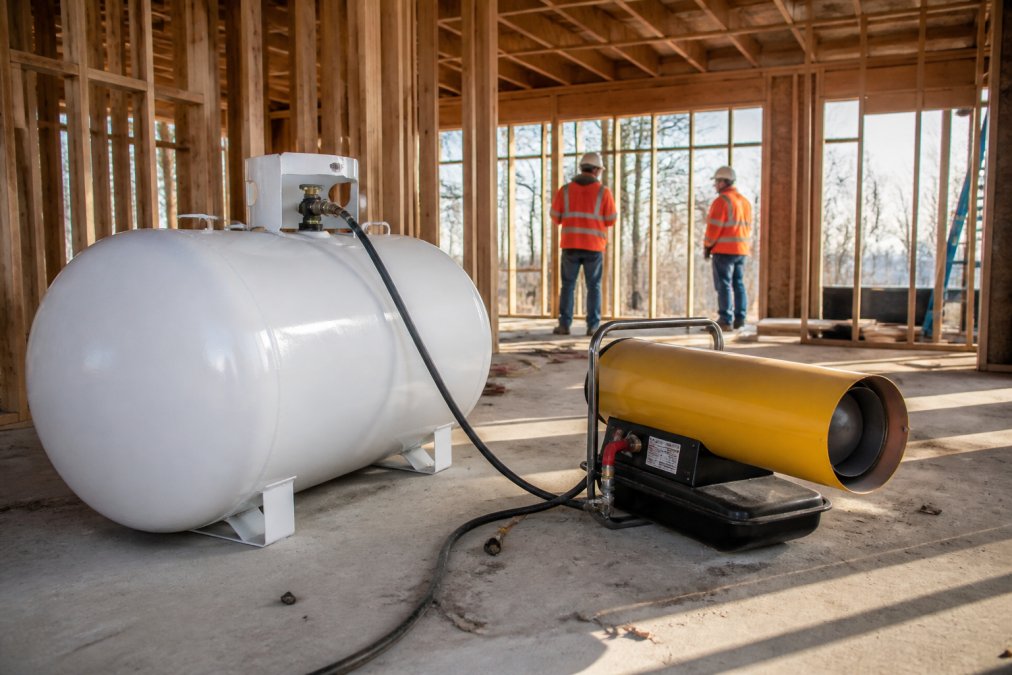
Temporary construction heating propane is one of the most underplanned aspects of a winter build. Most contractors size their tank based on gut feel or what fit on the last job.
Estimating Fuel Consumption Rates for Your Site
Fuel consumption rates for construction heating depend on three variables: the BTU output of your heaters, operating hours per day, and the thermal load of the space being heated (square footage, insulation status, and ambient temperature).
The colder the outside temperature, the harder the heater works and the faster it burns fuel. An open, uninsulated structure in sub-freezing temperatures consumes far more fuel per square foot than a partially insulated space. Many experienced superintendents plan for higher consumption during the first weeks when the building envelope is open, then revise estimates downward as exterior work closes in.
A practical approach: track your actual burn rate for the first week of heating operations, then project forward based on your production schedule. If you’re running multiple heaters across different zones, meter them separately.
Tank Sizing and On-Site Storage Options
Tank sizing for construction sites follows a straightforward principle: size for your peak demand period, not your average. Running out of fuel during a concrete cure can mean scrapping work and starting over.
Common on-site storage configurations for construction heating include:
- 120-gallon tanks: Suitable for small residential builds with one or two heaters running intermittently
- 250-gallon tanks: A practical starting point for most single-family construction projects with sustained heating needs
- 500-gallon tanks: Appropriate for larger structures or projects running multiple high-BTU heaters
- 1,000-gallon tanks and above: Used for commercial construction or large-footprint buildings
Tank placement on a construction site is governed by both practical and regulatory considerations. Tanks must be accessible to delivery vehicles. Coordinate with your propane supplier before the tank is placed.
| Tank Size | Typical Use Case | Delivery Frequency Needed |
|---|---|---|
| 120 gallons | Small residential, 1 heater | Weekly or more |
| 250 gallons | Single-family build, 1-2 heaters | Every 7-14 days |
| 500 gallons | Mid-size build, 2-4 heaters | Every 10-21 days |
| 1,000 gallons | Commercial or multi-unit build | Monthly or less |
OSHA Propane Storage Requirements for Construction Sites
OSHA propane storage requirements for construction are not optional, and fines for non-compliance are significant. The relevant standard is OSHA 29 CFR 1926.153, covering LP-gas use in construction, which governs everything from container storage to regulator placement to distance requirements from ignition sources.
The most commonly violated requirements on active construction sites:
- Storage distance: Containers must be stored away from open flames, sources of ignition, and building openings.
- Upright storage: Cylinders must be stored and used in an upright position unless equipment is specifically designed for horizontal use.
- Valve protection: Valve caps or plugs must be in place on all containers not in use.
- Segregation from other materials: Propane containers must not be stored near flammable liquids, oxidizing gases, or corrosive materials.
- Ventilation: Storage areas must be adequately ventilated to prevent gas accumulation.
Jobsite propane inspections can happen without advance notice. A single non-compliant storage setup, a cylinder stored horizontally, a tank too close to a doorway, or missing valve protection can result in a stop-work order and fines. Review your storage setup against OSHA 29 CFR 1926.153 before the first delivery arrives.
Regulatory compliance also intersects with local fire codes, which can be more restrictive than the federal OSHA standard. Check with your local Authority Having Jurisdiction (AHJ) before finalizing tank placement. Many municipalities require a permit for temporary propane storage above a certain volume threshold.
Bulk vs. Scheduled Delivery: Cost-Benefit Breakdown
The bulk vs. scheduled delivery decision comes down to two factors: your storage capacity and your cash flow tolerance.
Bulk delivery means ordering a large volume in a single delivery, typically filling the tank as close to capacity as possible. The advantage is a lower per-gallon cost because the supplier makes one trip for a large volume. The disadvantage is that you’re paying for a large fuel inventory upfront, and if your project timeline shifts, you may end up with more fuel than you need.
Scheduled delivery means smaller, more frequent deliveries timed to your consumption rate. Per-gallon cost may be slightly higher, but your capital isn’t tied up in a full tank. For contractors managing tight project budgets or running multiple simultaneous sites, this model offers better cash flow flexibility.
If you have a 500-gallon or larger tank and your project runs more than 60 days, bulk delivery almost always wins on total fuel cost. For projects under 30 days or with uncertain timelines, scheduled delivery gives you the flexibility to scale back without sitting on unused inventory.
A few practical considerations for the cost-benefit analysis:
- Off-route fees: Some suppliers charge extra for deliveries outside their standard route or outside normal business hours.
- Emergency service premiums: If you need an emergency delivery, expect a significant premium. Scheduled delivery eliminates most of these situations.
- Tank rental vs. ownership: If you’re renting a tank from your supplier, the rental cost is part of your total fuel cost calculation.
According to the National Propane Gas Association’s contractor resources, commercial propane customers who establish account-based delivery relationships with suppliers consistently report fewer supply disruptions than those relying on spot delivery.
How to Set Up Scheduled Propane Delivery for Your Crew
Setting up scheduled propane delivery for contractors is straightforward when you approach it systematically.
Step 1: Define your fuel requirements before contacting a supplier.
Know your tank size, estimated daily consumption rate, and project timeline. Suppliers can help you refine these estimates, but walking in with your own numbers makes the conversation faster and more accurate.
Step 2: Establish a commercial account.
A commercial account for a construction site should include your site address, access instructions for the delivery driver, and a designated site contact who can be reached on delivery days.
Step 3: Choose your delivery model.
Based on the automatic vs. will-call analysis above, decide which model fits your project. If you’re unsure, start with scheduled delivery and adjust based on actual consumption data from the first two weeks.
Step 4: Set up payment terms that match your billing cycle.
Look for a supplier that offers flexible payment options, credit card, cash on delivery, or electronic payment, so fuel costs fit into your existing accounts payable process.
Step 5: Establish a communication protocol for schedule changes.
Your project schedule will shift. Confirm the supplier’s process for modifying a scheduled delivery before you sign up.
Step 6: Conduct a pre-delivery safety inspection.
Before the first delivery, walk the tank location against your OSHA and local fire code requirements. Confirm the access path for the delivery truck is clear and that all required safety clearances are in place.

Checklist for scheduled propane delivery setup:
- Tank size confirmed and placed per OSHA/AHJ requirements
- Site address and access instructions documented for supplier
- Estimated daily fuel consumption calculated
- Delivery model selected (automatic, scheduled, or will-call)
- Payment method established (credit card, COD, or electronic)
- Site contact designated for delivery days
- Communication process confirmed for schedule changes
- Pre-delivery safety inspection completed
Discount Propane makes this process straightforward for contractor accounts: real-time pricing is visible online before you commit, ordering can be done from your phone or desktop, and payment options include credit card, cash on delivery, or Zelle. No waiting on hold, no surprise fees when the truck arrives.
The biggest mistake contractors make when setting up fuel delivery is treating it as a last-minute procurement task. Set up your delivery account before the site is active, size your tank for peak demand, and establish a communication protocol with your supplier for schedule changes. These three steps eliminate most fuel-related delays.
As the U.S. Department of Energy’s guide to fuel management for commercial operations notes, establishing supplier relationships and delivery schedules before peak demand periods is the most reliable way to ensure supply continuity during high-demand weather events.
Managing propane supply on an active construction site is a logistics problem that most contractors solve reactively, and pay for it in delays, emergency delivery premiums, and compliance headaches. Discount Propane offers contractor accounts with transparent, real-time online pricing, flexible scheduling, and multiple payment options including credit card and Zelle, so you can manage fuel delivery from the field without administrative overhead. Check current pricing and schedule your first delivery at Discount Propane’s website.
Frequently Asked Questions
How does automatic propane delivery work for a commercial job site?
A provider monitors your tank level using usage data or tank telemetry and schedules deliveries before you run low. For construction sites, delivery windows are coordinated around your production schedule. You set a minimum tank level threshold, and the system triggers a delivery automatically. This removes the need to track fuel manually and eliminates the risk of a mid-project shutdown due to an empty tank during cold weather or peak equipment demand.
What are the OSHA requirements for propane storage on a construction site?
OSHA 29 CFR 1926.153 governs propane storage on construction sites. Key rules include keeping cylinders upright and secured, storing them away from ignition sources and high-traffic areas, limiting the quantity stored in any single location, and ensuring containers are not placed near open flames or electrical panels. Tanks must pass regular safety inspections, and workers handling propane must receive hazard communication training. Always confirm current requirements directly with OSHA or a qualified safety officer.
What is the 80/20 rule for propane, and how does it affect delivery scheduling?
Propane tanks are filled to a maximum of 80% capacity, not 100%. The remaining 20% allows for liquid expansion as temperature rises. For delivery scheduling, this means a '500-gallon tank' holds roughly 400 usable gallons. When estimating how often you need deliveries, base your fuel consumption calculations on 80% of the tank's rated capacity to avoid running short between delivery windows, especially during high-demand periods like winter construction heating.
How do I estimate propane usage for temporary construction heating?
Start with the BTU rating of your heaters and multiply by daily run hours to get a daily BTU demand. One gallon of propane produces roughly 91,500 BTUs. Divide your daily BTU demand by 91,500 to get your daily gallon usage. Factor in outdoor temperature, building envelope progress, and the number of heaters running simultaneously. A conservative approach is to add a 15-20% buffer to account for weather-based spikes and equipment inefficiency, then use that figure to set your reorder trigger point.
This article was written using GrandRanker