
Table of Contents
- Propane vs Heating Oil: The Price-Per-Gallon Trap
- BTU Output of Propane vs Heating Oil: The Real Comparison
- Fuel Storage, Delivery Logistics, and Supply Reliability
- Efficiency, AFUE Ratings, and Equipment Lifespan
- Environmental Impact: Carbon Emissions and Clean-Burning Performance
- Cost of Converting Oil Furnace to Propane: Is It Worth It?
- Propane vs Heating Oil: Side-by-Side Summary
- Conclusion
Last Updated: August 9, 2026
Propane vs Heating Oil: The Price-Per-Gallon Trap
Most homeowners comparing propane and heating oil make the same mistake: they look at the price per gallon and stop there. That number is nearly meaningless on its own. The honest answer is that whether propane is cheaper than heating oil depends entirely on which metric you’re using, and the per-gallon sticker price is the wrong one.
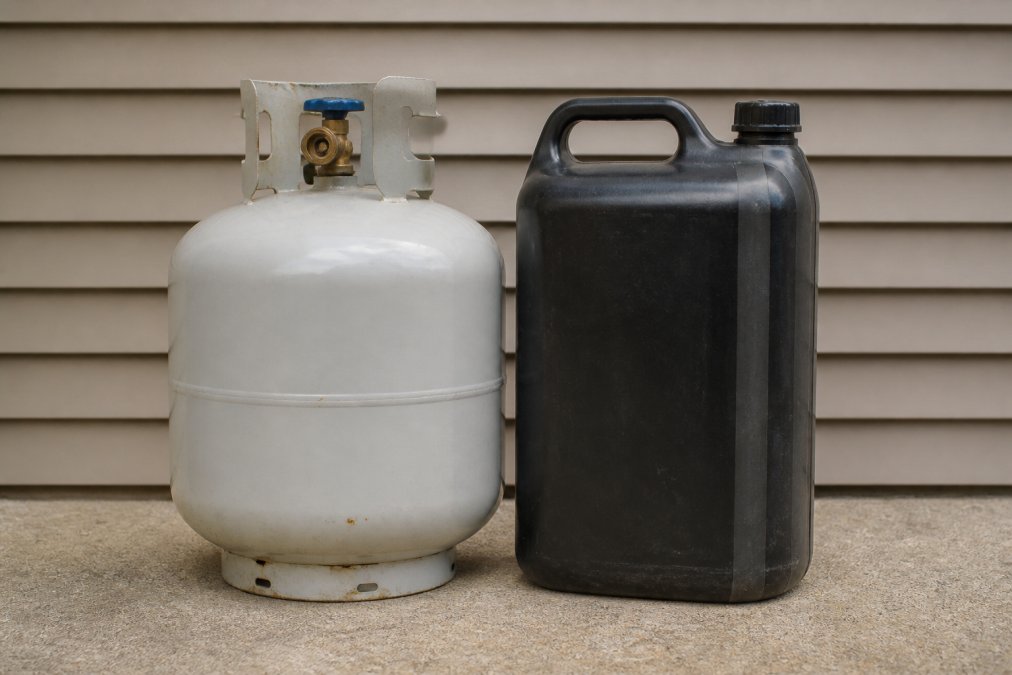
Here’s the trap. Heating oil and propane contain different amounts of energy per gallon. Propane delivers roughly 91,500 British Thermal Units per gallon. Heating oil delivers approximately 138,500 BTUs per gallon. That means heating oil packs about 51% more energy into each gallon it burns. So even if propane costs less per gallon at the pump, you will burn more gallons of propane to produce the same amount of heat.
System efficiency, equipment age, local market pricing, and delivery logistics all shift the calculation. The sections below walk through each factor so you can run the actual numbers for your home, not a national average that may not reflect what you’re paying on Long Island.
BTU Output of Propane vs Heating Oil: The Real Comparison
Propane delivers approximately 91,500 BTUs per gallon. Heating oil delivers approximately 138,500 BTUs per gallon. That energy density gap is the single most important number in this entire comparison, and most price-comparison tools ignore it entirely.
To make a fair comparison, you need to convert both fuels to a cost-per-BTU basis. The U.S. Energy Information Administration heating fuel data publishes regular price surveys that let you do exactly this calculation using current regional prices.
For every gallon of heating oil you replace with propane, you need roughly 1.5 gallons of propane to produce equivalent heat output. This ratio is the foundation of any honest fuel cost comparison.
How to Calculate Your Actual Cost to Heat
The cost-per-BTU formula gives you the only number that matters for a true fuel comparison:
Cost per BTU = Price per gallon ÷ BTUs per gallon
Then multiply by 100,000 to get a more readable figure (cost per 100,000 BTUs):
- Propane: Price per gallon ÷ 91,500 × 100,000
- Heating oil: Price per gallon ÷ 138,500 × 100,000
Practical example using hypothetical prices:
If propane costs $3.00/gallon and heating oil costs $4.00/gallon:
- Propane: $3.00 ÷ 91,500 × 100,000 = $3.28 per 100,000 BTUs
- Heating oil: $4.00 ÷ 138,500 × 100,000 = $2.89 per 100,000 BTUs
At those prices, heating oil is cheaper per BTU despite costing more per gallon. Run this calculation with current prices from the NYSERDA Heating Fuel Prices Dashboard to get accurate New York State figures before making any decision.
Check the NYSERDA dashboard weekly during heating season. Propane and heating oil prices move independently, and the cost-per-BTU crossover point shifts throughout the winter. What’s cheaper in October may not be cheaper in February.
Fuel Storage, Delivery Logistics, and Supply Reliability
Fuel storage is one of the most overlooked factors in the propane vs. heating oil comparison, and it has real implications for both cost and convenience.
Heating oil is stored in a tank, typically in your basement or outside, holding 275-500 gallons. Heating oil has a shelf life of 18-24 months, and older tanks can develop rust and sediment that clog fuel lines and damage equipment.
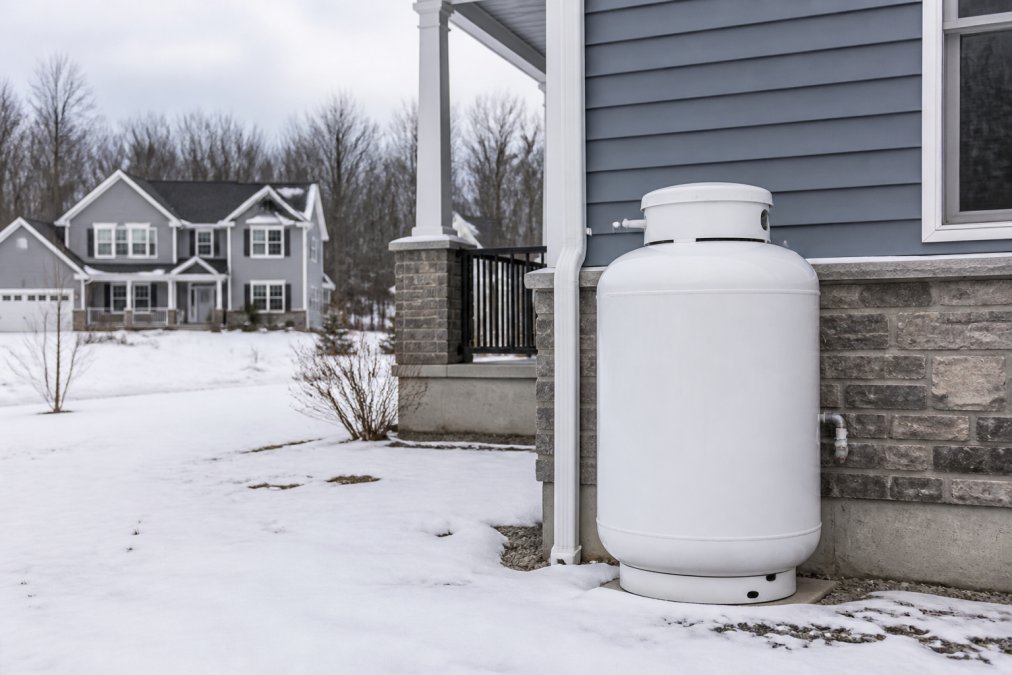
Propane is stored in a pressurized above-ground tank, typically 120-500 gallons for residential use. Propane tanks are more durable than older oil tanks and don’t accumulate sediment. However, propane must be kept above 20-30% fill because the fuel vaporizes before combustion. Running a propane tank too low can cause delivery pressure problems in extreme cold.
Heating oil has a well-established Northeast distribution network with next-day or same-day delivery. Propane delivery is also widely available, but scheduling matters more because running out mid-winter is a genuine risk.
Running your propane tank below 20% fill in January is a real risk. Many suppliers cannot guarantee same-day delivery during peak demand periods. Set an automatic delivery threshold or monitor your gauge closely during cold snaps.
Efficiency, AFUE Ratings, and Equipment Lifespan
The fuel’s energy content is only half the equation. How efficiently your equipment converts that fuel into usable heat determines your actual energy consumption.
Annual Fuel Use Efficiency (AFUE) is the standard measure of heating system efficiency. An 80 AFUE rating means 80% of the fuel’s energy becomes heat; the remaining 20% is lost through exhaust. Modern high-efficiency furnaces and boilers achieve AFUE ratings of 95-98%.
Propane has a structural advantage over older oil systems. Many Northeast homes still run oil furnaces with AFUE ratings in the 70-80% range. Modern propane furnaces routinely achieve 95-98% AFUE. That efficiency gap can offset a significant portion of propane’s lower energy density per gallon.
| Factor | Propane | Heating Oil |
|---|---|---|
| BTUs per gallon | ~91,500 | ~138,500 |
| Typical AFUE (modern equipment) | 95-98% | 85-95% |
| Typical AFUE (older equipment) | 80-90% | 70-85% |
| Equipment lifespan | 15-25 years | 15-30 years |
| Carbon dioxide emissions (per MMBtu) | Lower | Higher |
| Storage tank complexity | Pressurized, durable | Atmospheric, corrosion risk |
| Fuel price volatility | Moderate | Higher |
Propane burns cleaner than heating oil, producing less combustion residue and requiring lower maintenance frequency. Oil systems require annual cleaning of the combustion chamber and nozzle replacement, which adds to annual operating costs. The cleaner combustion of propane can extend heat exchanger life in some system designs.
Environmental Impact: Carbon Emissions and Clean-Burning Performance
Propane produces fewer carbon dioxide emissions per BTU than heating oil. Both are fossil fuels, and neither is a zero-emission heating option, but the difference in environmental footprint is meaningful for homeowners weighing long-term considerations.
Heating oil combustion produces more carbon dioxide per million BTUs than propane and higher levels of sulfur dioxide and particulate matter. Propane burns cleaner, with near-zero sulfur output and lower particulate emissions.
The U.S. Environmental Protection Agency emissions factors documentation provides detailed combustion emissions data for both fuels if you need precise figures for a carbon footprint calculation.
Propane infrastructure is compatible with renewable propane, a drop-in replacement produced from biological and waste feedstocks. Renewable propane is not yet widely available at scale, but a propane system could theoretically run on a lower-carbon fuel source in the future without equipment replacement. Heating oil has no equivalent renewable pathway at comparable scale.
Cost of Converting Oil Furnace to Propane: Is It Worth It?
Converting from an oil furnace to propane is a significant upfront investment, and the long-term ROI depends on several variables specific to your home and local market.

The conversion requires a new propane-compatible furnace or boiler, a propane storage tank installation, new gas lines run to the equipment, and adjustment or replacement of the flue system. Many homeowners also need permits and inspections, which vary by municipality on Long Island.
A qualified HVAC contractor should assess your existing system before any conversion begins. If your oil system is at or near end-of-life, the incremental cost of going propane versus staying on oil narrows considerably.
The BTU output of propane vs heating oil means a propane system must be more efficient to break even on fuel cost. The conversion math works best when you’re replacing an aging, low-efficiency oil system with a high-AFUE propane unit, not when you’re pulling out a recently installed modern oil furnace.
Long-Term ROI and Hybrid Heating System Options
The long-term ROI of converting to propane depends on the efficiency gain from new equipment, the relative price of propane versus heating oil in your market over time, and the total conversion cost amortized over the system’s lifespan.
Hybrid heating systems pair a propane furnace or boiler with an electric heat pump. The heat pump handles most of the heating load during moderate temperatures at very high efficiency. The propane system takes over during extreme cold, when heat pump performance drops. For Long Island’s climate, which sees cold but not extreme winters, a hybrid system can be particularly cost-effective.
A practical ROI checklist for conversion decisions:
- Get the AFUE rating of your current oil system
- Get quotes for a high-efficiency propane system (target 95%+ AFUE)
- Calculate current annual heating oil consumption in gallons
- Apply the BTU conversion to estimate equivalent propane consumption
- Compare projected annual fuel costs at current prices using the cost-per-BTU formula
- Add total conversion costs (equipment, tank, lines, permits)
- Divide total conversion cost by annual savings to get payback period
- Assess whether a hybrid heat pump configuration reduces payback period further
A payback period under 7-10 years generally indicates a conversion worth pursuing. Above 12-15 years, the math is harder to justify unless the existing system is failing.
Propane vs Heating Oil: Side-by-Side Summary
Answering whether propane is cheaper than heating oil requires looking at the complete picture, not just the per-gallon price.
| Category | Propane | Heating Oil | Advantage |
|---|---|---|---|
| Energy per gallon | ~91,500 BTUs | ~138,500 BTUs | Heating Oil |
| Modern equipment AFUE | 95-98% | 85-95% | Propane |
| Carbon emissions per BTU | Lower | Higher | Propane |
| Equipment maintenance | Lower frequency | Annual cleaning required | Propane |
| Price volatility | Moderate | Higher | Propane |
| Storage tank durability | High (pressurized) | Moderate (corrosion risk) | Propane |
| Northeast supply reliability | Good | Very good | Heating Oil |
| Renewable fuel pathway | Yes (renewable propane) | Limited (biodiesel blends) | Propane |
| Conversion cost from oil | Significant upfront | N/A | Heating Oil |
| Hybrid system compatibility | Yes | No | Propane |
Is propane cheaper than heating oil in 2026 depends on current regional prices and your equipment’s efficiency rating. Propane wins on environmental footprint, equipment efficiency potential, and long-term flexibility. Heating oil wins on energy density per gallon and established Northeast supply infrastructure. Run the cost-per-BTU calculation with current prices before making any decision.
For Long Island homeowners, propane has become increasingly competitive as high-efficiency propane equipment has improved and heating oil price volatility has remained elevated. The U.S. Energy Information Administration weekly propane and heating oil price survey tracks both fuels weekly and is the most reliable source for current price comparisons in the Northeast.
Choosing between propane and heating oil is one of the most consequential decisions a Long Island homeowner can make for their annual energy budget. Discount Propane makes that decision easier with upfront, real-time online pricing so you can see exactly what propane costs before committing to anything. Check current prices, schedule delivery, and manage your account entirely online with flexible payment options including credit card, cash on delivery, and Zelle. Get your propane price from Discount Propane and run the cost-per-BTU comparison with a real number, not a guess.
Frequently Asked Questions
Is it cheaper to heat your house with propane or heating oil?
The answer depends on current market prices and your equipment's efficiency, not just the price per gallon. Heating oil contains more British Thermal Units per gallon than propane, but modern propane furnaces often run at higher annual fuel utilization efficiency (AFUE) ratings. When you calculate cost per BTU delivered, the two fuels trade places depending on local market conditions and your system's age. Check current per-gallon prices in your area and factor in your furnace's AFUE rating before deciding which fuel is cheaper for your home.
What is the cheapest fuel to heat a house in the US?
Natural gas is typically the least expensive home heating fuel in most US regions when it's available. Where natural gas pipelines don't reach, propane and heating oil compete closely, with the winner varying by region and season. On Long Island and throughout the Northeast, heating oil has historically been the dominant fuel, but propane prices can be more stable during periods of high crude oil price volatility. Comparing cost per BTU rather than cost per gallon gives you the most accurate picture for your specific location.
Does propane burn cleaner than heating oil?
Yes. Propane combustion produces significantly lower carbon dioxide emissions and virtually no particulate matter compared to heating oil. Heating oil combustion releases more carbon dioxide per BTU and can produce soot that accumulates in the flue and heat exchanger, requiring more frequent furnace maintenance. Propane is classified as a clean-burning fossil fuel under the Clean Air Act, making it the lower-emissions choice between the two. For homeowners concerned about their environmental footprint, propane is the cleaner option of the two liquid and gas fuels.
How much does it cost to convert an oil furnace to propane?
Conversion costs vary based on whether you replace the entire heating system or retrofit the existing unit. A full propane furnace or boiler installation typically ranges from several thousand dollars, covering equipment, labor, and the propane storage tank. Some oil furnaces can be converted with a burner swap at lower cost, though older systems often make full replacement the better long-term investment. The long-term ROI depends on the price difference between propane and heating oil in your area over time. Get a site-specific quote before committing.
What are the downsides of using propane for heating?
Propane requires an on-site storage tank, which involves installation costs and periodic safety inspections. Fuel delivery must be scheduled before the tank runs low, unlike natural gas which flows continuously. Propane prices can experience market fluctuations tied to crude oil and liquefied petroleum gas supply chains. In very cold climates, propane vaporization can slow at extremely low temperatures if tank pressure drops. Despite these factors, propane remains a reliable and efficient heating fuel for homes beyond the reach of natural gas infrastructure.
This article was written using GrandRanker