
Table of Contents
- Commercial Propane Heating Efficiency: How It Compares
- Propane vs Electric Heat for Business: Cost and Performance
- Cost of Converting Heating Systems to Propane: What to Expect
- ROI Calculation for Small Businesses Switching to Propane
- Regulatory and Zoning Compliance for Commercial Propane Use
- Leasing vs Owning Propane Tanks: Which Fits Your Business?
- Smart Building Tech Integration with Propane Heating
- Frequently Asked Questions
Last Updated: September 17, 2026
Commercial Propane Heating Efficiency: How It Compares
Propane heating is a viable choice for small businesses that operate outside natural gas service areas, particularly where electric resistance heat drives up utility bills. This guide from Discount Propane examines the real trade-offs: combustion efficiency, BTU output, and operating costs.
Propane burns hotter than most alternatives. A single gallon contains roughly 91,500 BTUs, and modern propane furnaces convert 90% or more of that into usable heat. Electric resistance heating, by contrast, converts nearly all electricity to heat but loses efficiency at the grid and generation level. That gap matters when you’re heating a warehouse or job site.
The upshot: propane delivers more heat per unit of energy, and for many small businesses, that translates to lower operational costs over time.
Propane vs Electric Heat for Business: Cost and Performance
Propane vs electric heat for business comes down to two numbers: cost per BTU and peak-load reliability. Propane generally wins on both, but the margin depends on your local utility rates and heating demand.
Performance favors propane in most commercial settings:
- Faster recovery: Propane furnaces heat spaces quickly, which suits high-ceiling warehouses.
- Higher thermal output: Per unit of fuel, propane produces more usable heat than electricity.
- Grid independence: When power disruption hits, a propane system keeps running.
Electric heat has one advantage: near-zero upfront equipment cost for small spaces. For a business heating 5,000 square feet or more, that advantage disappears fast. The U.S. Department of Energy heating comparison notes that heat pump and furnace efficiency varies widely by climate, so run your own numbers before committing.
Cost of Converting Heating Systems to Propane: What to Expect
The cost of converting heating systems to propane depends on your current fuel type, equipment age, building layout, and whether you need a new tank. Most small businesses should budget for four cost buckets, not three, the fourth (site work and ancillary trades) is the one that blows up estimates.
| Conversion Component | What Drives the Cost | Typical Scope |
|---|---|---|
| Equipment | Furnace or boiler capacity, efficiency rating (AFUE), venting type | New propane-ready unit sized to your load |
| Tank and installation | Tank size (typically 500-1,000 gal for small commercial), above-ground vs underground, distance from building | On-site storage setup, pad or excavation, regulator |
| Labor and permits | Line runs, gas piping, inspections, licensed contractor work | Mechanical, plumbing, and electrical trades |
| Site work and ancillary | Concrete pad, bollards, trenching, electrical disconnect, roof or sidewall venting | Often overlooked line items |
A few fuel-specific realities shape the total:
- Converting from oil: You will likely need new supply and return lines, a new burner or full appliance swap, and tank removal or abandonment. Oil-to-propane is the most expensive common conversion.
- Converting from electric resistance: The switch is usually simpler because there is no existing fuel line to replace, but you may need a new electrical circuit for the ignition and controls, plus venting where none existed.
- Converting from natural gas: If your building already has gas piping, the conversion can be mostly an appliance swap plus a tank and regulator installation, often the least disruptive path.
Get at least two written quotes that itemize each bucket separately. A single lump-sum bid makes it impossible to tell whether you are paying for a tank pad, a permit, or a markup.
Ask your supplier whether the tank is leased or owned before signing. Leased tanks often lock you into one fuel provider, while owned tanks let you shop delivery prices freely. Also confirm who pays for the pad, the regulator, and the first fill, these are common points of dispute.
ROI Calculation for Small Businesses Switching to Propane
Calculate propane ROI by comparing your current annual heating spend against projected propane costs, then factoring in conversion expenses. Most small businesses want a payback window of two to four years, but the number that matters is the one built from your own bills, not a rule of thumb.
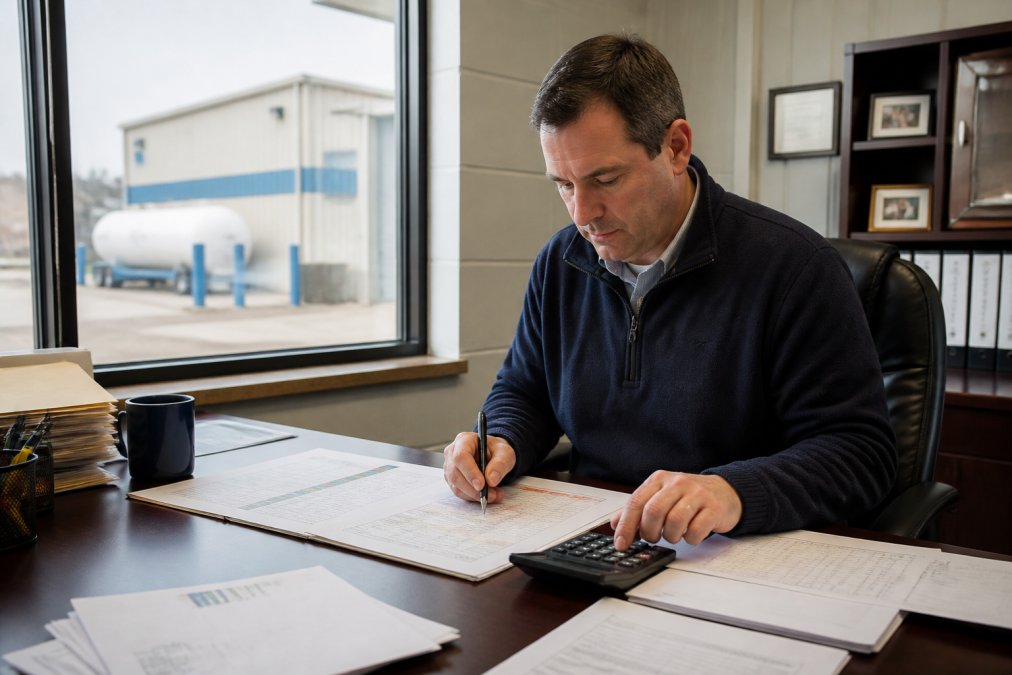
Here is a framework you can run in a spreadsheet:
- Step 1, Baseline your current spend. Add up twelve months of heating fuel and any electric resistance or supplemental heating on your utility bills. Do not use a single winter month; seasonal swings distort the comparison.
- Step 2, Estimate propane demand. Convert your annual heating load to BTUs (your HVAC contractor can do this from a Manual N or equivalent load calculation), then divide by the BTU content of propane (about 91,500 BTU per gallon) and by your equipment’s AFUE to get annual gallons.
- Step 3, Price the propane. Multiply annual gallons by your quoted delivered price per gallon. Ask your supplier for a fixed-price or capped contract option and model both a capped and a floating price.
- Step 4, Net the savings. Subtract projected annual propane cost from your baseline spend. That difference is your annual savings.
- Step 5, Payback. Divide total conversion cost by annual savings. That is your simple payback in years.
Worked example (illustrative, not a quote): A 6,000 sq ft shop currently spends $9,000/year on electric resistance heat. A load calculation shows it needs about 600 million BTUs of delivered heat annually. At 92% AFUE, that is roughly 7,100 gallons of propane. At a delivered price of $2.50/gal, propane cost is about $17,750, which is worse than the electric baseline.
Three variables move the answer more than anything else:
- Delivered price per gallon, varies widely by region, season, and contract type. Model a high and low case.
- Your current electric rate, commercial rates in high-cost markets make propane look far better than in low-cost markets.
- Conversion cost, a simple appliance swap pays back much faster than an oil-to-propane conversion with tank removal.
Do not run this calculation on a single month of winter bills or on a national average propane price. Both will mislead you. Use your own twelve-month history and a written delivered-price quote from a supplier who serves your ZIP code.
Regulatory and Zoning Compliance for Commercial Propane Use
Zoning compliance is the step most small businesses overlook. Commercial propane storage and use fall under local fire codes and the NFPA 58 Liquefied Petroleum Gas Code, which sets tank setback distances, ventilation rules, and installation standards.
Before you install a tank, confirm:
- Local zoning allows commercial propane storage at your address
- Tank setbacks meet fire code for your lot size
- Licensed installers handle all connections and inspections
- You have documentation ready for any fire marshal review
Leasing vs Owning Propane Tanks: Which Fits Your Business?
Leasing a propane tank lowers upfront cost but ties you to one supplier. Owning the tank costs more initially but gives you freedom to compare fuel delivery prices and switch providers when it saves money.
| Factor | Leased Tank | Owned Tank |
|---|---|---|
| Upfront cost | Low or none | Higher |
| Supplier flexibility | Limited | Full |
| Maintenance | Usually covered | Your responsibility |
| Best for | Low-volume users | High-volume operations |
Smart Building Tech Integration with Propane Heating
Smart building integration lets propane systems talk to thermostats, tank monitors, and building management software. Tank-level monitors, for example, can trigger automatic fuel delivery before you run low, which removes the risk of a mid-winter runout.
Propane’s real advantage for small businesses isn’t just price per gallon. It’s the combination of high BTU output, off-grid reliability, and fuel that can be monitored and delivered automatically.
Frequently Asked Questions
What are the downsides of using propane for heating?
Propane heating requires on-site storage tanks, which need space and periodic refilling. Fuel costs fluctuate with market conditions, so budgeting requires attention. You also need to schedule regular furnace maintenance to maintain combustion efficiency. In remote locations, delivery logistics can affect reliability, though many suppliers offer automatic delivery and tank monitoring. Overall, the main drawbacks are infrastructure needs and fuel price volatility, not performance.
How many days will 100 gallons of propane last?
A 100-gallon tank typically holds about 80 gallons usable due to the 80/20 rule. A small commercial space with a 100,000 BTU furnace running 8 hours daily might consume 3-5 gallons per day, so 100 gallons could last 16 to 26 days. Actual duration depends on BTU output, insulation, outdoor temperature, and heating demand. For precise planning, track your fuel consumption and adjust delivery schedules accordingly.
Is it cheaper to heat with electricity or propane?
Propane often costs less per BTU than electric resistance heating, especially in areas with high electricity rates. Propane produces about 91,500 BTUs per gallon, while electricity delivers 3,412 BTUs per kWh. However, heat pumps can narrow the gap. For small businesses, the cost-effectiveness of propane heating depends on local fuel prices, equipment efficiency, and usage patterns. Compare utility bills and get current propane pricing to run your own numbers.
How can small businesses estimate their monthly propane heating costs?
Start by calculating your heating demand in BTUs based on square footage and insulation. Then divide by your furnace’s BTU output and efficiency rating to find gallons needed per hour. Multiply by daily operating hours and days per month. Finally, multiply by your propane price per gallon. For example, a 100,000 BTU furnace running 8 hours daily at $2.50 per gallon might cost $20-$30 per day. Get a quote for accurate pricing.
Is it cheaper to convert an existing heating system to propane?
Conversion costs vary based on your current system and required modifications. Switching from oil to propane often involves replacing the furnace or burner, installing a propane tank, and updating fuel lines. While upfront costs can be significant, many businesses see lower operational costs and reduced maintenance over time. Calculate the cost of converting heating systems to propane against projected annual savings to determine if the investment makes sense for your facility.
Small businesses face a real decision when heating costs climb and grid reliability wavers. Propane offers higher thermal output, dependable supply, and growing smart-tech compatibility. Discount Propane makes the switch straightforward with upfront online pricing, fast delivery scheduling, and flexible payment options including credit card, cash on delivery, and Zelle. Get your propane price today and see what conversion could save your operation.