
Last Updated: October 31, 2026
Quick Summary
The right propane tank size comes from your heater’s hourly burn rate, not the room’s square footage. Convert the heater’s BTU input to gallons per hour, multiply by daily run hours and job days, then add a reserve margin of about 20 percent.
- Divide the heater’s BTU input by 91,500 to get gallons per hour.
- Apply a duty cycle to estimate real average consumption instead of full-fire burn.
- Add BTU inputs together when running multiple heaters on one tank.
- Add roughly 20 percent reserve for cold snaps and schedule slips.
- Check cold-weather vaporization limits, since a full tank can still fail on a cold morning.
Table of Contents
- Step 1: Calculate Your Heater’s Propane Consumption Per Hour by BTU
- Step 2: Estimate How Long a Propane Tank Lasts With a Heater
- Step 3: Choose the Propane Tank Size for a Construction Heater
- Cold Weather and Propane Tank Vaporization Rate Limits
- Placement, Safety and Refill Planning for Temporary Sites
- Booking Your Temporary Propane Delivery With Discount Propane
- Frequently Asked Questions
Picking a propane tank for a job site heater is not the same as picking one for a house. A home furnace runs for months at a steady pace.
The good news is that sizing is simple math once you know three things: how much fuel your heater burns per hour, how many hours it runs each day, and how many days you need it. This guide walks through each step so you can pick the right propane tank size for your temporary heating job.
The key idea is this: size the tank to the heater’s hourly burn rate, not to the square footage of the space. Two heaters in the same room can need very different tanks.
Step 1: Calculate Your Heater’s Propane Consumption Per Hour by BTU
Every propane heater lists its input rating in BTUs per hour. That number is printed on the nameplate or in the manual. It tells you how much heat energy the heater pulls from the fuel each hour.
Start by finding that BTU input rating. Portable construction heaters come in a wide range of BTU ratings. Write the number down before you go any further.
Common mistakes to avoid:
- Using the output rating instead of the input rating. Output is lower because some heat is lost.
- Forgetting to check the rating for each heater if you are running more than one.
- Assuming the heater runs at full power all the time. Many run lower most of the day.
Converting BTU Input to Gallons Per Hour
Propane holds about 91,500 BTUs per gallon. To convert, divide the heater’s BTU input by 91,500.
For example, a heater rated at 60,000 BTUs per hour burns about 0.66 gallons per hour at full power. That is 60,000 divided by 91,500.
Keep in mind this is a theoretical figure. Real burn rates can run a little higher in cold weather because the tank has to work harder to keep vapor flowing.
Step 2: Estimate How Long a Propane Tank Lasts With a Heater
Now multiply your gallons per hour by the number of hours the heater will run each day. Then multiply by the number of days on the job.
Here is the base formula:
- Gallons per hour × hours per day × days on site = total gallons needed
Using the 60,000 BTU example above, a heater running 10 hours a day for 5 days burns about 33 gallons. That is 0.66 × 10 × 5.
That single-line calculation is where most sizing guides stop.
Adjust for Duty Cycle (Real Run Time vs. Full-Fire Hours)
A 60,000 BTU heater does not pull 60,000 BTUs every minute it is switched on. Most portable heaters cycle on and off as the space reaches the thermostat setpoint.
To account for this, multiply your full-fire gallons per hour by an estimated duty cycle:
- Full-fire gallons per hour × duty cycle = average gallons per hour
For the 60,000 BTU heater at a 60 percent duty cycle: 0.66 × 0.60 = about 0.40 gallons per hour average. Over 10 hours, that is about 4 gallons instead of 6.6.
Do not size the tank on the average alone. Size on the coldest expected day at or near full fire, then use the average to plan refill frequency. Sizing to the average is how tanks run dry on the one night the temperature drops.
Total the Demand When You Run Multiple Heaters
If two or more heaters share a tank or a manifold, add their BTU inputs together before converting to gallons. Do not average them and do not size each one separately.
Worked example, two heaters on one tank:
- Heater A: 60,000 BTU/hr input
- Heater B: 125,000 BTU/hr input
- Combined input: 185,000 BTU/hr
That total is the number you compare against usable tank capacity, not the single-heater figure. If the heaters run on different schedules, calculate each heater’s daily gallons separately and add the daily totals, that handles changing loads more accurately than one blended duty cycle.
Add a Reserve Margin for Cold Snaps and Schedule Slips
Temporary heating jobs rarely end exactly on schedule, and the coldest day is usually not the average day. Add a reserve on top of your calculated total for cold snaps and schedule slips.
Using the two-heater example above: 141 gallons × 1.20 = about 169 gallons of usable fuel to plan for. That reserve is what covers the extra day, the colder night, or the heater that gets added mid-project.
Turn Gallons Into a Refill Schedule
Once you have total gallons and usable tank capacity, divide to see how many fills you need and how often:
- Total gallons needed ÷ usable gallons per tank = number of tank-fills
- Days on site ÷ number of fills = days between refills
If your plan calls for 169 usable gallons and your tank holds 100 usable gallons, you need two fills across the project, one at the start and one roughly midway. Schedule the second delivery before you reach the halfway point of your fuel, not after the gauge drops low, so weather or access delays do not leave you without heat.
After the first full day, log the actual gauge reading and hours run. Compare actual burn to your estimate and adjust the refill schedule immediately, real-site data beats the planning number every time.
Step 3: Choose the Propane Tank Size for a Construction Heater
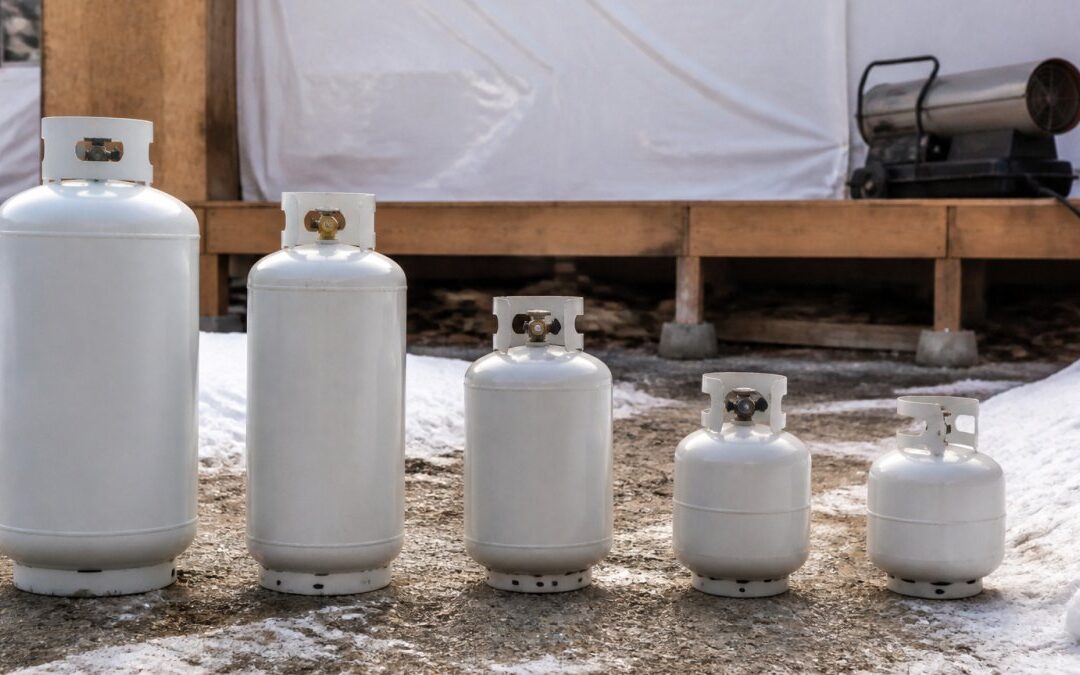
With your total gallons in hand, pick a tank that covers the job without sitting oversized and heavy on site. Portable cylinders and larger stationary tanks come in several common sizes.
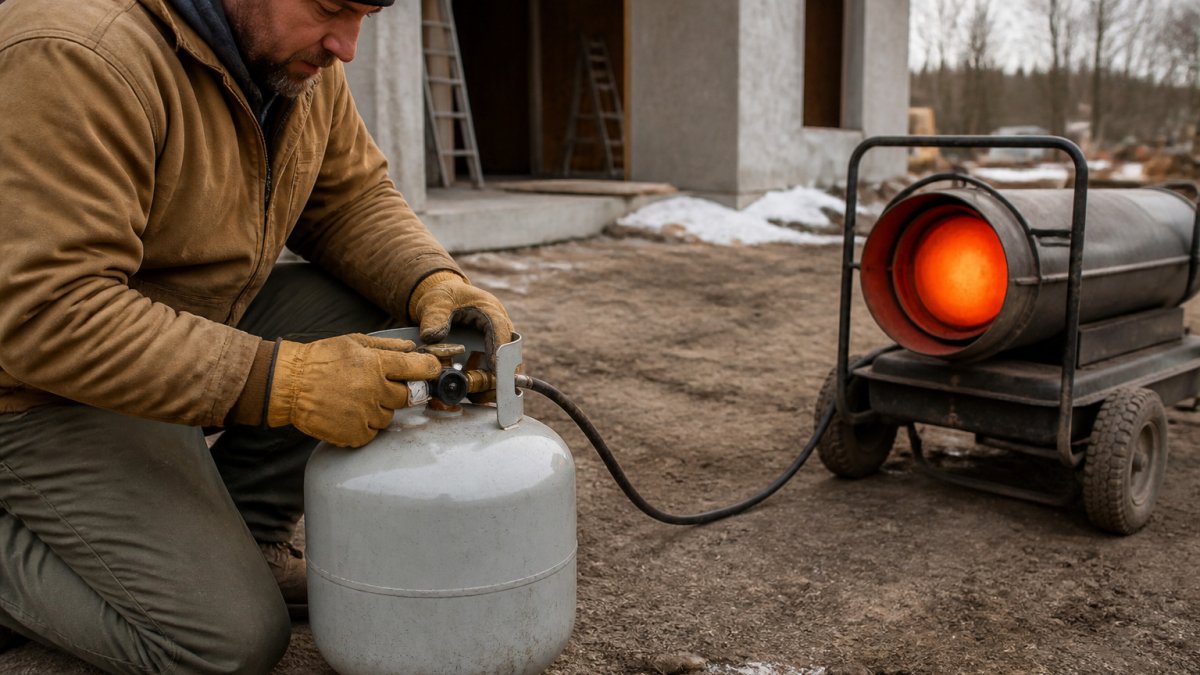
Match the tank to the job like this:
- Short, low-burn jobs: small portable cylinders that you can swap by hand
- Multi-day, steady-burn jobs: a mid-size tank with a delivery schedule
- Long projects or multiple heaters: a larger stationary tank with regular delivery
As a rule, pick a tank whose usable capacity covers your total gallons with a margin of about 20 percent. For a workshop-style space, you can calculate propane tank size for workshops in more detail.
Usable Capacity and the 80 Percent Fill Limit
A propane tank is never filled to 100 percent. Fill limits are set by safety rules to leave room for propane to expand.
So a tank with a rated water capacity does not give you that full amount of fuel. Always check the usable capacity, which is the gallons you can actually burn.
Match the tank to the job using these common options.
| Job type | Tank option | Why it fits |
|---|---|---|
| Short, low-burn jobs | Small portable cylinders | Easy to move and swap by hand |
| Multi-day, steady-burn jobs | Mid-size tank | Works with a delivery schedule |
| Long projects or multiple heaters | Larger stationary tank | Suits high burn rates with regular delivery |
Cold Weather and Propane Tank Vaporization Rate Limits
Tank capacity alone does not decide whether a tank can run your heater. A tank can be full and still fail to supply enough vapor on a cold morning. This is the single most misunderstood part of temporary heating, and most sizing guides skip it entirely.
How Propane Vaporization Actually Works
Propane is stored as a liquid under pressure. The heater burns vapor, not liquid. Vapor forms at the liquid surface as propane evaporates, and that process absorbs heat from the surrounding air through the tank walls. Three things control how fast vapor is produced:
- Temperature: Colder air means slower evaporation. The vaporization rate drops as the temperature falls, and it drops sharply below freezing.
- Liquid level (fill level): A tank with less liquid has less wetted surface area inside, so it makes vapor more slowly. A tank that is nearly empty in cold weather is the worst combination.
- Withdrawal rate: The faster the heater pulls vapor, the more heat the tank must absorb, and the colder the liquid and tank walls become. High draw rates chill the tank and further slow vaporization.
When the heater’s demand exceeds what the tank can vaporize, tank pressure falls, the regulator cannot hold delivery pressure, and the heater loses flame, sputters, or shuts off. This is a supply problem, not a fuel-quantity problem, refilling a tank that is already half full will not fix it.
Why Tank Size and Shape Matter in the Cold
Larger tanks have more surface area and more liquid mass, so they vaporize faster and hold temperature better under load. A small cylinder that runs a small heater fine in mild weather can fall short for the same heater on a cold night.
A practical rule: check the tank’s published vaporization capacity at your expected lowest temperature against the heater’s BTU input.
Practical Fixes When Vaporization Is the Bottleneck
- Use a larger tank or two tanks in parallel. Two smaller tanks manifolded together share the draw and expose more surface area than one small tank.
- Keep the liquid level up. Refill before the tank gets low in cold weather, because vaporization slows as the liquid level falls.
- Shelter the tank from wind. Wind strips heat from the tank walls and slows vaporization. A windbreak, not an enclosure that traps gas, helps.
If a heater sputters or shuts off in cold weather, the cause is often vaporization, not an empty tank. Check the gauge before assuming you need fuel, and address the supply limit rather than repeatedly refilling.
Plan for the coldest day you expect, not the average, that is the day the tank’s vaporization rate is tested, and the day a temporary heating job is most likely to fail.
Placement, Safety and Refill Planning for Temporary Sites
Where you set the tank matters as much as its size. Proper placement ensures safety during operation, much like the precision required when choosing the right furnace for long-term climate control.
Good site habits make a big difference:
- Set a refill schedule based on your burn math, not on guesswork.
- Keep a spare cylinder on hand for jobs that run past the planned end date.
- Check the gauge each morning and before each shift.
Planning refills early avoids the rush of an emergency delivery in bad weather. A simple log of fill dates and gauge readings will show you the actual burn rate after the first day, so you can adjust the plan fast.
Booking Your Temporary Propane Delivery With Discount Propane
Once you have your gallon total, tank size, and refill schedule, you are ready to order. Discount Propane makes this simple.
Online ordering lets you schedule delivery in advance, which helps you stay ahead of your burn rate.
Start by reviewing your options, then check current pricing on the Discount Propane website. When your numbers are set, you can place an order online and schedule delivery to match your site’s needs.
Frequently Asked Questions
How do you know what size your propane tank is?
Check the tank’s nameplate, which lists its water capacity in gallons, and the fill-level gauge for how much propane remains. Tanks are labeled with their water capacity, and usable propane is less than that rated figure. If the label is worn or missing, ask your supplier to confirm the tank size before estimating how long it will last.
How much propane does a temporary heater use per hour?
Consumption depends on the heater’s BTU input. Divide the heater’s BTU rating per hour by the energy content of propane, which is roughly 91,500 BTU per gallon, to get gallons per hour. Use the conversion above to estimate gallons per hour for your specific heater. Check the heater’s manual for its exact input rating, since actual use varies with thermostat settings and run time.
Can a small propane tank run a temporary heater overnight?
It can, but only if the tank’s usable capacity covers the full overnight run time at the heater’s consumption rate. A small cylinder may not supply a high-BTU heater through a long cold night, and cold temperatures slow vaporization. Calculate hours of run time by dividing usable gallons by gallons per hour, then add a safety margin before relying on a small tank for overnight heat.
What size propane tank is best for a construction heater?
The best size depends on total heater BTU input, expected hours of operation per day and how many days the site will need heat. Sites with several heaters or long shifts typically need a larger tank or a delivery schedule that keeps supply ahead of demand. Discount Propane’s pricing depends on quantity, dates and delivery, so request a current quote on its website to match the right tank to your job.
