
Table of Contents
- Determine Your Workshop’s Total BTU Requirements
- Understanding Propane Tank Vaporization Rate Chart
- Apply the 80/20 Rule to Tank Capacity
- How to Read Propane Tank Gauge Accurately
- Use a Propane BTU Calculator for Workshops
- Account for Cold Weather and Installation Factors
- Choosing Between Portable and Stationary Tanks
- Conclusion
- Frequently Asked Questions
Last Updated: October 3, 2026
Determine Your Workshop’s Total BTU Requirements
Sizing a propane tank size requires matching your equipment’s BTU demand to the tank’s vaporization rate. Every propane tool consumes fuel at a specific rate measured in BTU (British Thermal Units) per hour.
List every propane tool and its BTU/hour rating (found on the nameplate or manual). Add them to find your peak load, the maximum BTU when your heaviest equipment runs together. Most workshops don’t run everything at once, so peak load is more realistic than total capacity.
Common workshop BTU loads:
- Forge burners: 50,000-150,000 BTU/hour
- Space heaters: 20,000-50,000 BTU/hour
- Cutting torches: 10,000-30,000 BTU/hour
- Standby generators: 20,000-100,000 BTU/hour
Once you know your peak load, you’re ready to match it to a tank size. This is where the vaporization rate comes in.
Understanding Propane Tank Vaporization Rate Chart
Vaporization rate is how much liquid propane converts to vapor per hour at a given temperature. You can only withdraw vapor; pulling liquid damages equipment. Temperature directly affects vaporization: cold days reduce it, warm days increase it. This is why a tank that works in summer may fail in winter.
Typical vaporization rates by tank size and temperature:
- 20 lb tank at 60°F: ~8 lb/hour (roughly 40,000 BTU/hour)
- 100 lb tank at 60°F: ~35 lb/hour (roughly 175,000 BTU/hour)
- 500 lb tank at 60°F: ~100 lb/hour (roughly 500,000 BTU/hour)
Tank size must match vaporization rate at your coldest expected temperature, not just fuel volume. If your peak load is 150,000 BTU/hour and winter temperatures near 40°F, a 100 lb tank won’t supply fuel fast enough. You need a 500 lb or larger tank to maintain withdrawal rates safely.
Apply the 80/20 Rule to Tank Capacity
The 80/20 rule: never fill beyond 80% capacity. The remaining 20% allows thermal expansion. A 500 lb tank holds only 400 lbs usable propane. Divide your peak BTU load by the vaporization rate at your coldest temperature to find how many hours of continuous operation your tank supports.
Example calculation:
- Peak load: 150,000 BTU/hour
- Tank size: 500 lbs (usable: 400 lbs at 80%)
- Vaporization rate at 40°F: ~70 lb/hour
- Usable withdrawal: 70 lbs per hour
- Runtime: 400 lbs ÷ 70 lbs/hour = 5.7 hours
If you run equipment 8 hours daily, you may need refills more than once weekly. The 80/20 rule prevents dangerous pressure buildup in sealed tanks when they warm. Respecting it keeps your workshop safe.
How to Read Propane Tank Gauge Accurately
Most gauges use a float mechanism that tracks liquid level. Always read in shade, ideally in the morning, to avoid false high readings from sun-warmed tanks. Let the tank cool a few minutes if it’s been in direct sunlight.
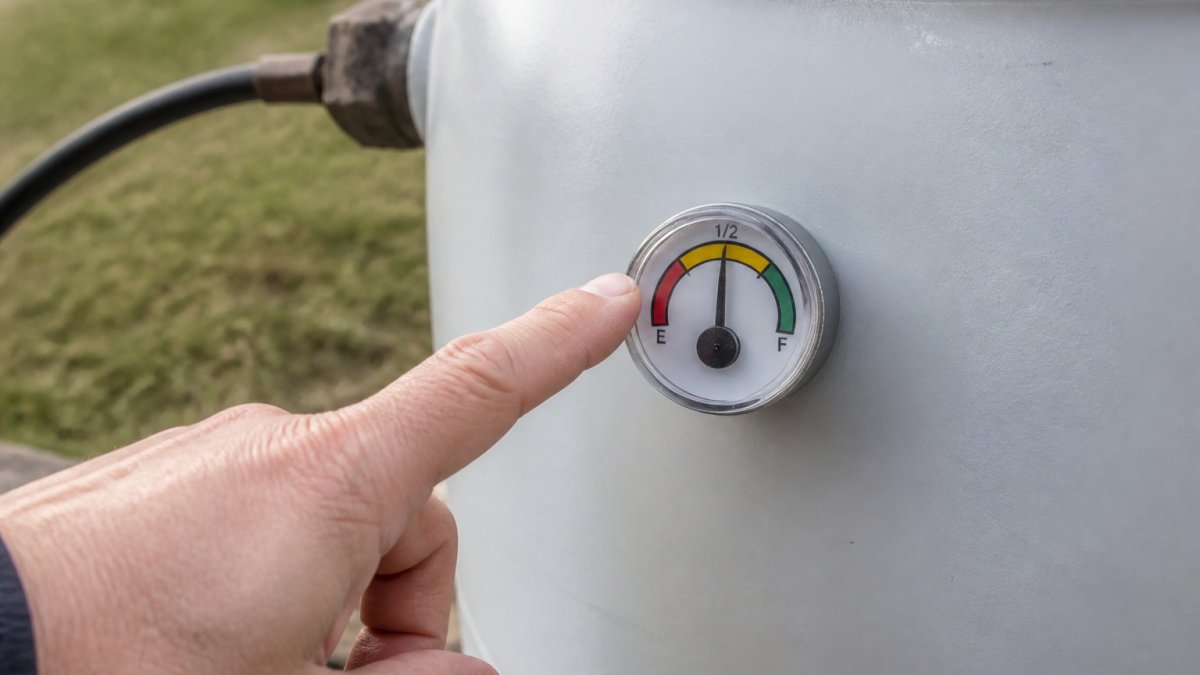
Steps to read your tank gauge:
- Locate the gauge on the tank (usually on the top or side)
- Stand directly in front of it so the needle is at eye level
- Note where the needle points on the dial (marked as percentages or in pounds)
- If the needle is below 25%, schedule a refill for the next business day
- Never let the tank drop below 10% if you rely on continuous supply
Many workshops use two tanks on a switchover system to prevent downtime and ensure continuous fuel supply.
Discount Propane offers easy online ordering so you can schedule refills before your tank hits critical levels. Real-time pricing and flexible delivery scheduling mean you’re never caught without propane.
Use a Propane BTU Calculator for Workshops
A BTU calculator removes guesswork, but knowing what to calculate yourself versus when to hire a professional is essential.
What you can calculate yourself:
You can estimate tank size if you know: (1) each equipment’s BTU/hour rating (from nameplate or manual), (2) your peak load (sum of simultaneous equipment), (3) your region’s minimum winter temperature (from National Weather Service data), and (4) your desired refill frequency (weekly, bi-weekly, or monthly).
Use this formula: Peak load (BTU/hour) ÷ 91,500 = lbs/hour needed. Multiply by hours between refills, then divide by 0.80 (80/20 rule) for minimum tank capacity. Example: 150,000 BTU/hour ÷ 91,500 = 1.64 lbs/hour; 1.64 × 168 hours (weekly) = 275 lbs; 275 ÷ 0.80 = 344 lbs (round to 500 lb tank). Most propane suppliers offer free online calculators that account for vaporization rates at different temperatures.
What requires a licensed technician:
Call a professional if: installing a stationary tank for the first time, adding new equipment, in a region with winter temps below 20°F, peak load exceeds 200,000 BTU/hour, connecting multiple pieces to one tank, or your local code requires a licensed installer. You can monitor gauges, swap portable tanks, clean exteriors, keep the area clear, and report leaks.
Finding a qualified technician:
Choose a supplier or contractor who is state-licensed, carries liability insurance, provides written estimates, performs pressure tests with documentation, and knows workshop equipment. Many offer free consultations to validate your calculations. Professional installation costs $300-$800 and prevents undersizing, code violations, and safety hazards.
Account for Cold Weather and Installation Factors
Most tank-sizing failures occur in cold weather. Propane vaporizes when heat from surrounding air transfers into the tank. Below certain temperatures, this heat transfer slows, and the tank cannot supply fuel fast enough, even if half full.
At 70°F, a 500 lb tank vaporizes at ~100 lb/hour. At 40°F, only ~60 lb/hour (40% reduction). At 0°F, ~30 lb/hour or less. The air is too cold to transfer enough heat to boil the liquid fast enough, not because the tank lacks propane.
This creates a critical mismatch: your equipment demands a fixed amount of BTU per hour (say, 150,000 BTU/hour for a forge), but a cold tank cannot supply it. The regulator will drop pressure, your burner will sputter, and you lose productivity, or worse, your equipment shuts down entirely.
Real-world cold-weather scenario:
A Minnesota workshop with a 150,000 BTU forge and 30,000 BTU heater (180,000 BTU peak) sizes a 500 lb tank based on summer rates (100 lb/hour at 70°F). In January at 10°F, vaporization drops to ~25 lb/hour.
Sizing for your region’s minimum temperature:
The solution is to size your tank based on the vaporization rate at your region’s coldest expected temperature, not your average temperature.
- If your region’s winter low is 30°F or above: Use standard vaporization tables (60°F baseline). Your tank sizing is straightforward.
- If winter lows are 0°F to 30°F: Increase your tank size by 50%. A 500 lb tank becomes a 750 lb tank. This larger surface area absorbs more heat from the cold air, raising the vaporization rate enough to meet demand.
- If winter lows drop below 0°F or you experience extended sub-zero periods: Increase by 100% or more. A 500 lb tank becomes a 1,000 lb tank. Some workshops in Alaska or northern Montana use 2,000 lb tanks for this reason.
- If you operate in a heated building: Reduce the adjustment by 25%. Indoor ambient temperature is typically 65-70°F, so vaporization rates stay higher even in winter.
Installation location matters as much as tank size:
Where you place the tank affects how much heat it absorbs:
- Outdoor, in shade: Coldest vaporization rates. Use full cold-weather adjustment.
- Outdoor, in direct sunlight: Better than shade, but still subject to nighttime cooling. Use 75% of the cold-weather adjustment.
- In an unheated garage or shed: Moderate improvement. Use 50% of the cold-weather adjustment.
- In a heated workshop: Vaporization rates stay near 70°F year-round. Use no cold-weather adjustment; size based on standard tables.
- Buried underground (rare for small workshops): Ground temperature stays 45-55°F year-round in most regions. Use 25% of the cold-weather adjustment.
Regulator and line considerations in cold weather:
Beyond the tank itself, cold affects the regulator and fuel lines. Propane regulators are designed to maintain consistent outlet pressure even as inlet pressure (from the tank) drops in cold weather. However, if the vaporization rate is too low, even a good regulator cannot compensate.
Code compliance for installation:
Local fire codes specify minimum setback distances for propane tanks:
- Minimum 10 feet from building openings (doors, windows, vents)
- Minimum 3 feet from property lines (check local ordinances; some require 5-10 feet)
- Minimum 10 feet from sources of ignition (grills, fire pits, electrical equipment)
- Must be on level, well-drained ground to prevent water pooling
- Must not be installed in a basement, crawl space, or enclosed area
These distances are non-negotiable and enforced by local building departments. Violating them can void your homeowner’s insurance and create a serious fire hazard.
Consult your local fire marshal or building department before installation to confirm exact setback requirements for your jurisdiction. Some areas have stricter rules, especially if your workshop is in a residential zone.
Choosing Between Portable and Stationary Tanks
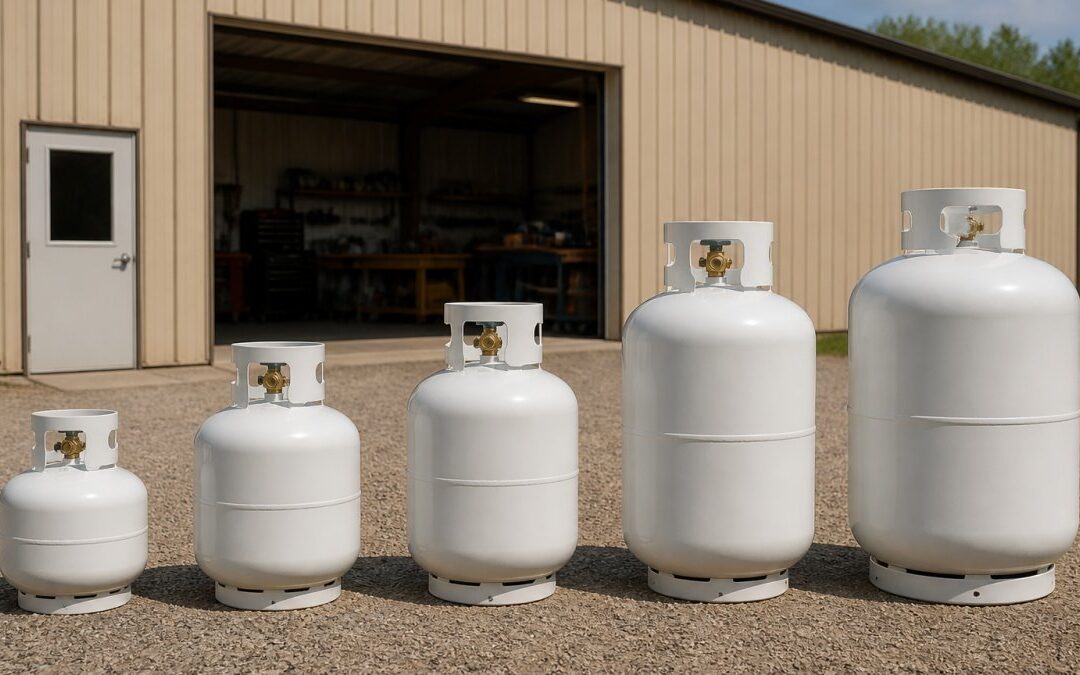
Portable tanks (20-100 lbs) are convenient for small projects and mobile equipment. You can swap them out yourself and store backups. They’re ideal for cutting torches, portable heaters, and small forge work.
Stationary tanks (100-1,000+ lbs) stay in one place, connected to your equipment via fixed propane plumbing. They handle continuous, high-demand loads. You order refills and the supplier fills them on-site.
Portable tanks work best when:
- You run equipment intermittently
- Your BTU demand is under 50,000 per hour
- You have space to store backup tanks
- You’re willing to swap tanks every few days
Stationary tanks work best when:
- You run equipment continuously or daily
- Your BTU demand exceeds 75,000 per hour
- You want to avoid manual tank swaps
- You need consistent fuel supply without interruption
Many workshops use both: a stationary tank for the main forge or heater, and portable tanks for portable torches and backup. This hybrid approach balances convenience with reliability.
A stationary tank requires professional installation, including a regulator, pressure gauge, and proper venting. The initial cost is higher, but the convenience and reliability pay off if you depend on propane daily.
Discount Propane makes stationary tank management straightforward. Schedule deliveries online, see pricing in real time, and choose flexible payment options including credit card, cash on delivery, or Zelle. No commitment required, you control when and how often you refill.
Conclusion
Sizing a propane tank size correctly means matching your equipment’s BTU demand to the tank’s vaporization rate, accounting for cold weather and the 80/20 safety rule. Most undersized tanks fail because workshops ignore vaporization limits and thermal effects.
Start by calculating your peak load in BTU per hour. Use a propane BTU calculator or consult a technician. Then choose a tank size that meets that demand even at your region’s coldest temperatures. Monitor your tank gauge regularly and refill before it drops below 25%.
Discount Propane delivers propane reliably with transparent, real-time pricing and flexible scheduling. Get your propane price today and schedule fast, convenient delivery to keep your workshop running without interruption.
Frequently Asked Questions
What is the 80/20 rule for propane tanks?
The 80/20 rule means you should only fill a propane tank to 80% capacity. This safety standard accounts for thermal expansion of liquid propane as temperature increases. The remaining 20% provides a safety buffer to prevent overpressurization and potential rupture. For a 100-pound tank, this means usable capacity is approximately 80 pounds of propane, even though the tank can hold more.
How do I calculate the total BTU load for my workshop equipment?
List each piece of propane equipment and find its BTU rating in the manufacturer’s manual or product specifications. Add all BTU ratings together for simultaneous use, if you run a 60,000 BTU heater and a 30,000 BTU forge at the same time, your total load is 90,000 BTU per hour. Multiply this hourly rate by the number of hours you run equipment weekly to estimate monthly consumption, then select a tank size that covers your usage pattern plus a safety margin.
How does ambient temperature affect propane tank vaporization rates?
Colder temperatures reduce the vaporization rate, the speed at which liquid propane converts to usable gas. In winter, a tank may not deliver gas quickly enough for high-demand equipment even if it contains adequate propane. This is why larger tanks are recommended in cold climates; they provide more surface area for vaporization. In extreme cold, you may need to insulate or heat the tank to maintain adequate withdrawal rates for your workshop equipment.
What are the safety clearance requirements for workshop propane tanks?
Propane tanks must be installed at least 10 feet from windows, doors, and ventilation openings. They require 3 feet of clearance on all sides for inspection and maintenance access. Tanks cannot be installed in basements, crawl spaces, or enclosed areas. They must be positioned on level ground, away from heat sources and ignition hazards. Check your local fire code for specific installation requirements, codes vary by jurisdiction and may require professional installation certification.