
Table of Contents
- Quick Comparison: Propane Generators vs Diesel Generators for Business
- Commercial Propane Generator Fuel Costs vs Diesel Operating Expenses
- Industrial Generator Fuel Storage Regulations and Compliance
- Maintenance Requirements, Engine Longevity, and Cold Weather Performance
- Total Cost of Ownership Over 5-10 Years
- Integrating Generators with Existing Renewable Energy Systems
- Cost of Converting Heating Systems to Propane for Business Facilities
- Which Generator Type Fits Your Business?
- Frequently Asked Questions
Last Updated: September 19, 2026
Quick Comparison: Propane Generators vs Diesel Generators for Business
For most businesses weighing propane generators vs diesel generators for business, propane wins on storage life and cold-weather starting, while diesel wins on fuel efficiency and power density under heavy loads. This guide breaks down fuel costs, storage rules, maintenance, and long-term ownership so you can pick correctly the first time. Consistent generator maintenance guide adherence ensures that whichever fuel source you select remains reliable throughout the lifespan of your equipment.
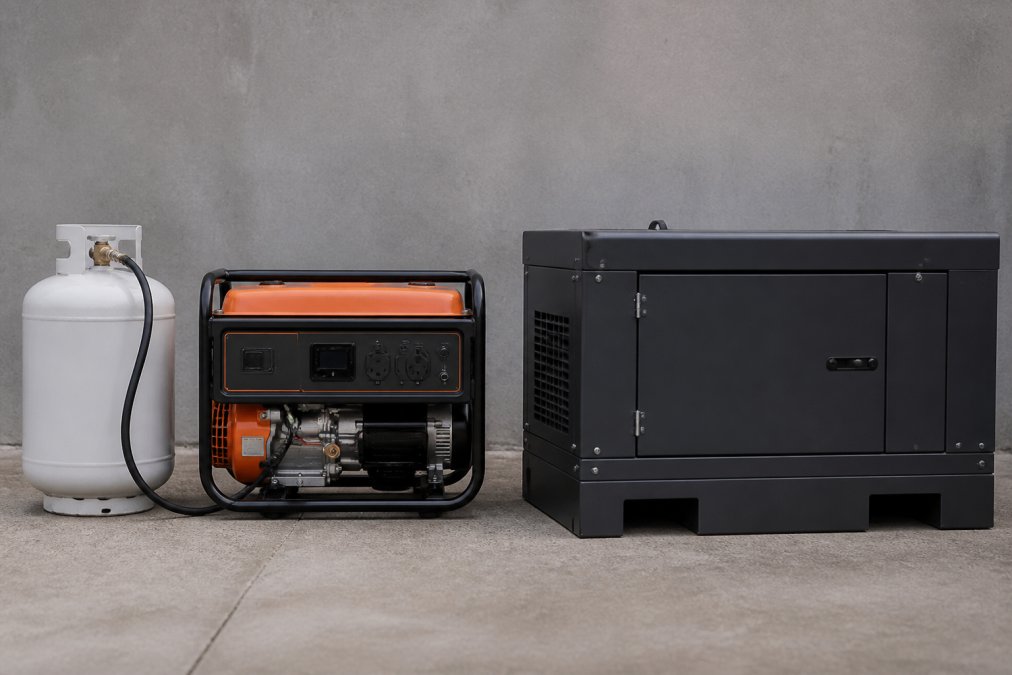
Propane generators run on liquefied petroleum gas stored in on-site tanks.
| Factor | Propane Generator | Diesel Generator |
|---|---|---|
| Fuel storage life | Indefinite | 6-12 months untreated |
| Cold-weather starting | Reliable | Needs block heater, additives |
| Fuel efficiency | Lower (gallons per hour higher) | Higher under heavy load |
| Power density | Moderate | High |
| Emissions | Cleaner burning | Higher particulate output |
| Upfront equipment cost | Lower to moderate | Higher |
| Maintenance intensity | Lower | Higher |
| Best for | Standby power, remote sites | Prime power, high-demand loads |
Propane’s biggest operational edge is storage stability. Diesel degrades in months; propane sits in the tank until you need it.
Commercial Propane Generator Fuel Costs vs Diesel Operating Expenses
Commercial propane generator fuel costs are typically higher per kilowatt-hour than diesel because propane carries less energy per gallon. That gap narrows once you factor in diesel’s additive costs, fuel polishing, and replacement of degraded fuel.
If your generator runs under 100 hours a year, calculate cost per running hour, not cost per gallon. Propane usually wins on total fuel spend at low annual runtime.
Industrial Generator Fuel Storage Regulations and Compliance
Industrial generator fuel storage regulations vary by fuel type, tank size, and the authority having jurisdiction (AHJ), usually your local fire marshal or building department. Two businesses in the same state can face different requirements depending on whether they sit in an ozone nonattainment area, a floodplain, or a municipality with its own fire code amendments. That variability is why compliance is one of the most underestimated line items in a generator decision.
Where the two diverge for a business owner:
- Diesel exposure is primarily environmental, SPCC plans, secondary containment, and spill liability.
- Propane exposure is primarily fire-safety, setbacks, licensed installers, and leak documentation.
- Diesel compliance costs scale with total stored volume across the site; propane compliance costs scale with individual tank size and placement.
- Both fuels require AHJ sign-off before the generator can be tied to a certificate of occupancy.
Practical sequence before you buy:
- Confirm the AHJ (fire marshal, building department, or both) and request the local fuel-storage amendment in writing.
- For diesel, tally every qualifying container on site against the 1,320-gallon SPCC threshold before committing to tank size.
- For propane, get a site plan showing tank setbacks against the NFPA 58 table for your chosen tank capacity.
- Budget for recurring items, inspections, containment maintenance, and documentation, not just the initial permit.
NFPA 58 Liquefied Petroleum Gas Code
If your site stores more than 1,320 gallons of oil in aboveground containers and could discharge to navigable waters, an SPCC plan is federally required, regardless of how often the generator runs.
Maintenance Requirements, Engine Longevity, and Cold Weather Performance
Maintenance and cold-weather behavior are where propane and diesel diverge most sharply in real operating conditions, and where most comparison articles stop at “diesel gels, propane doesn’t.” The mechanism matters more than the slogan.
Cold weather: the mechanism.
- Diesel gelling. As temperature drops, paraffin waxes in diesel crystallize. The temperature at which this begins is the cloud point; the temperature at which fuel can no longer flow through filters is the cold filter plugging point. Both vary by fuel grade and region. Winter-blend diesel (a No. 1 / No. 2 blend) lowers the cloud point, and anti-gel additives provide additional margin. A block heater or coolant heater keeps the engine warm enough to fire, but it does not fix gelled fuel in the tank or lines. A diesel generator that sits unheated for weeks in a cold snap can fail to start even with a block heater if the fuel itself has gelled.
- Propane vaporization. Propane must vaporize before it burns. Vaporization depends on tank temperature and the rate of draw. In cold weather, tank pressure drops, and a high-draw load can outrun the tank’s ability to vaporize, this is called vapor lock or excessive vaporization demand. The fix is a larger tank (more surface area for vaporization) or a vaporizer. For standby duty with moderate loads, propane starts reliably in cold weather without additives. For high-load cold starts, tank sizing matters more than the fuel choice.
What this means operationally:
- A diesel standby generator in a cold climate needs a block heater, winter-blend fuel, an anti-gel additive program, and ideally a heated fuel line or insulated tank. That is a recurring operational commitment, not a one-time install.
- A propane standby generator in a cold climate needs correct tank sizing for the expected vaporization rate and an annual leak inspection. No fuel additives, no fuel testing, no polishing.
- For a business whose generator runs a handful of times per year during winter outages, propane’s cold-start reliability is a genuine operational advantage, the failure mode is a sizing problem, not a fuel chemistry problem.
- For a business running prime power in cold weather, diesel’s efficiency under load usually outweighs the added cold-weather management, provided the fuel program is disciplined.
Maintenance intervals at a glance:
- Diesel: fuel filters every 200-500 hours, water separator checks at each service, annual fuel testing, periodic fuel polishing on stored fuel, block heater and anti-gel program in cold months.
- Propane: oil and filter changes at extended intervals, spark plug and ignition component service per manufacturer schedule, annual tank and line leak inspection, no fuel additives required.
If your site regularly sees sub-freezing temperatures and your generator is standby-only, size the propane tank for the coldest expected vaporization demand rather than the average. Undersized tanks are the most common cause of cold-weather propane starting problems.
Total Cost of Ownership Over 5-10 Years
Total cost of ownership over 5-10 years favors propane for standby applications and diesel for continuous prime power. The purchase price is only 20-30% of the real cost; fuel, maintenance, and compliance make up the rest.
| Cost Category | Propane (Standby) | Diesel (Standby) |
|---|---|---|
| Capital expenditure | Lower | Higher |
| Fuel spend over 10 yrs | Moderate | Lower per kWh |
| Maintenance over 10 yrs | Lower | Higher |
| Compliance setup | Moderate | Higher |
| Fuel waste risk | Minimal | Higher |
Buying diesel for standby-only use often means paying for fuel management you’ll never recover. Degraded fuel gets discarded, not burned.
Integrating Generators with Existing Renewable Energy Systems
Pairing a generator with solar or battery storage changes the decision. A propane unit works well as a backup for a battery bank, kicking in only when stored energy runs low. Its clean burn and stable storage suit hybrid setups.
Cost of Converting Heating Systems to Propane for Business Facilities
The cost of converting heating systems to propane depends on your current fuel, equipment age, and building size. Facilities moving from oil often need new burners, line work, and tank installation, so pricing varies widely by site.
U.S. Department of Energy propane heating guidance
Which Generator Type Fits Your Business?
Choose propane if your generator runs as standby power, sits in cold climates, or serves a remote site where fuel might sit for months. Choose diesel if you run prime power daily, need maximum power density, and can manage fuel quality.
EPA generator emissions standards
Frequently Asked Questions
Is it cheaper to run a generator on propane or diesel?
Diesel typically delivers more energy per gallon, so fuel consumption in gallons per hour is lower. However, propane often costs less per gallon and does not require additives or fuel polishing. The cheaper option depends on your load factor and local fuel prices. For businesses running generators only during outages, propane’s indefinite storage life prevents waste from fuel degradation. Request current pricing to compare operational expenditure accurately.
What are the downsides of a propane generator?
Propane has lower energy density than diesel, so a propane generator burns more fuel to produce the same kilowatt output. This means you need a larger on-site storage tank for extended runtimes. Propane also requires vaporization to work in cold weather, and below certain temperatures the fuel may not convert from liquid to gas fast enough without a vaporizer. Plan your tank size and winter setup carefully.
How does fuel storage shelf life compare between propane and diesel?
Propane stores indefinitely without degrading, which makes it ideal for standby power that sits unused for months. Diesel begins to degrade in 6 to 12 months without stabilizers, and can grow microbes or gel in cold weather. For emergency backup power where the generator may not run for long stretches, propane removes the fuel degradation problem entirely. Diesel requires a fuel maintenance schedule to stay reliable.
What are the primary maintenance differences between propane and diesel generators?
Propane burns cleaner, so spark plugs, oil, and filters last longer, and maintenance intervals can be extended. Diesel engines require more frequent oil changes, fuel filter replacements, and exhaust system checks. Diesel also needs load bank testing to prevent wet stacking. Propane generators have fewer preventative maintenance tasks overall, which lowers long-term operational expenditure for many businesses.
How do industrial generator fuel storage regulations differ for propane and diesel?
Diesel storage falls under EPA Spill Prevention, Control, and Countermeasure (SPCC) rules and local fire codes for aboveground tanks. Propane storage is regulated by NFPA 58, which sets separation distances from buildings, property lines, and ignition sources. Both require secondary containment and proper labeling. Check with your local fire marshal and zoning office before installing either system, because requirements vary by jurisdiction.
Choosing the wrong generator fuel locks your business into years of higher maintenance and fuel-management headaches. If standby reliability and cold-weather performance matter most, propane is the smarter fit for most commercial facilities. Discount Propane offers upfront online pricing, easy delivery scheduling, and flexible payment options so you can secure fuel without commitment. Get your propane price today and size your backup power with confidence.