

Table of Contents
- What Residents Actually Spend on Propane Each Year
- Average Residential Propane Usage Per Year
- Current Residential Propane Prices and Market Conditions
- Factors Affecting Propane Delivery Costs
- Estimating Your Annual Propane Bill
- Ways to Reduce Your Annual Propane Spending
- Conclusion
- Frequently Asked Questions
Last Updated: September 28, 2026
What Residents Actually Spend on Propane Each Year
Annual propane costs for Nassau County residents depend on consumption patterns, market conditions, delivery fees, and heating system efficiency. Your specific situation matters far more than a generic average.
The main challenge is finding transparent pricing and reliable delivery. Winter demand spikes prices, supply disruptions create shortages, and delivery surcharges add up quietly. Switching providers often feels risky when your current company already knows your system.
Average Residential Propane Usage Per Year
Residential propane consumption varies based on home size, insulation quality, heating degree days, and appliance load. Typical homes use propane for space heating, water heating, and sometimes cooking or pool heating.
The difference between an efficient home and an inefficient one can easily be 30-40% or higher. Homes with excellent insulation and efficient systems consume less; older homes with poor sealing consume considerably more.
Usage shifts with weather: colder winters drive consumption up, mild winters lower it. This volatility makes year-to-year comparisons tricky.
Check your delivery history from the past two or three years to get real consumption data specific to your home.
Current Residential Propane Prices and Market Conditions
Propane pricing reflects broader energy market volatility, fluctuating based on crude oil costs, seasonal demand, supply availability, and geopolitical factors. Understanding pricing mechanisms and your options for managing volatility is critical to budgeting.
The Commodity Price Plus Markup Model
The retail price per gallon includes three components: base commodity cost, supplier markup/delivery, and taxes. A supplier might quote $2.85/gallon as $1.95 commodity + $0.75 markup/delivery + $0.15 tax. When commodity prices drop, suppliers often keep markups stable while passing through only partial savings. Ask for the commodity component separately to verify fair pricing.
Seasonal Price Trends
Propane prices are lowest in late spring (May-June) and highest in winter (December-February), swinging $0.50-$1.00/gallon between seasons. A homeowner purchasing 300 gallons in June at $2.40/gallon pays $720, versus $990 in January at $3.30/gallon, a $270 difference. Off-season purchasing at lower rates saves money if your tank has capacity.
Pre-Buy Programs: How They Work and When to Use Them
Pre-buy programs let you purchase propane at a set price before winter. You commit to a minimum volume (often 200-500 gallons) at a locked-in price, typically in May-July, and pay that price regardless of market conditions through winter.
If you lock in $2.50/gallon and prices rise to $3.50/gallon, you save $1.00/gallon ($400 on 400 gallons). If prices fall to $1.80, you overpay by $0.70/gallon ($280 on 400 gallons).
Pre-buy programs appeal to homeowners who expect prices to rise, have tank capacity for extra propane, prefer price certainty, or have experienced price spikes. They’re less attractive if you believe prices will fall or your tank is at capacity.
Budget Billing: Smoothing Costs Across the Year
Budget billing spreads annual propane costs evenly across 12 months. The supplier estimates annual consumption and cost based on historical usage, divides by 12, and you pay that fixed amount monthly. At year-end, the supplier reconciles actual usage; if you used more, you owe a balance; if less, you get a credit.
Budget billing smooths cash flow and removes the shock of large winter bills, appealing to those on fixed incomes or with tight budgets. The downside: if prices drop mid-year, you’re locked into the higher estimated amount until reconciliation.
Fixed-Price Contracts vs. Variable Pricing
Fixed-price contracts lock in a per-gallon rate for a set period (typically one heating season). You pay that rate for every gallon delivered, regardless of market changes, without committing to a volume upfront.
Fixed-price contracts appeal to those wanting price certainty without upfront commitment. The locked rate is typically higher than current market rates (the supplier builds in margin for protection). If prices fall, you overpay; if they rise sharply, you save.
Choosing Your Strategy
If confident prices will rise, a pre-buy program or fixed-price contract locks in savings. If prices will fall or stay stable, variable pricing keeps you flexible. If volatility stresses budgeting, budget billing provides peace of mind. Many homeowners combine budget billing with a pre-buy commitment for 50% of expected winter consumption to hedge against spikes while capturing upside if prices fall.
Factors Affecting Propane Delivery Costs
Delivery costs hide supplier margins. Distance from the supplier’s depot, order volume, delivery frequency, and tank accessibility all influence per-gallon cost.
Distance and Service Territory Premiums
Suppliers may charge distance-based surcharges for deliveries far from their depot. Ask directly: “What is your delivery surcharge for my zip code?” This often reveals $15-$40 differences per fill-up between providers.
Volume Discounts and Minimum Order Requirements
Ordering 500 gallons costs less per gallon than 100 gallons. Many suppliers enforce minimum order quantities (50-100 gallons) and offer volume tiers: 200+ gallons may receive $0.10-$0.25/gallon discounts. Larger, less frequent deliveries cost less overall but require adequate tank space.
Tank ownership structure directly affects your annual costs and flexibility. Some suppliers own the tank and charge a monthly or annual lease fee (typically $10-$20/month or $100-$150/year). Others sell you the tank outright, requiring upfront capital ($500-$1,500 depending on size) but eliminating recurring lease fees. Leasing spreads costs over time but locks you into that supplier, switching providers means leaving the tank behind or paying a transfer fee. Ownership requires upfront investment but gives you freedom to switch providers later without penalty. Over a 10-year period, ownership often costs less, but the monthly cash flow impact matters if you’re budget-constrained.
Seasonal Demand Premiums
Winter demand peaks in January and February. Summer demand drops significantly. Suppliers charge premium prices during peak season to manage supply constraints and maximize margins. Off-season ordering (late spring, early summer) typically offers lower per-gallon rates, sometimes $0.30-$0.60/gallon cheaper than winter prices, though you need tank space to store extra propane. A homeowner who fills a 500-gallon tank in June at $2.50/gallon and stretches it through October saves considerably compared to purchasing the same volume in January at $3.20/gallon.
Emergency Refill Penalties
If your tank runs empty mid-winter and you need propane immediately, expect to pay 20-50% more than a scheduled delivery would cost. Emergency calls often carry rush fees ($50-$100), and suppliers prioritize paying customers, so you may wait hours or days. Planning ahead and monitoring your tank level prevents this expensive scenario. Many suppliers offer automatic delivery, they monitor your tank and refill when it drops to 25-30% capacity, which costs the same as a scheduled delivery but eliminates the risk of running empty.
Decoding the Supplier Quote
When you call for a price quote, ask for a complete breakdown: (1) per-gallon commodity price, (2) delivery surcharge (flat fee or per-mile), (3) tank lease or ownership terms, (4) any minimum order requirements, and (5) whether the quoted price includes taxes. Many suppliers quote only the per-gallon price, leaving you to discover surcharges when the bill arrives. Transparent suppliers list all components upfront. This breakdown lets you compare true all-in costs across providers rather than just per-gallon rates, which can be misleading.
Estimating Your Annual Propane Bill
Calculating your likely annual cost requires three inputs: expected consumption in gallons, average price per gallon in your area, and anticipated delivery and service fees.
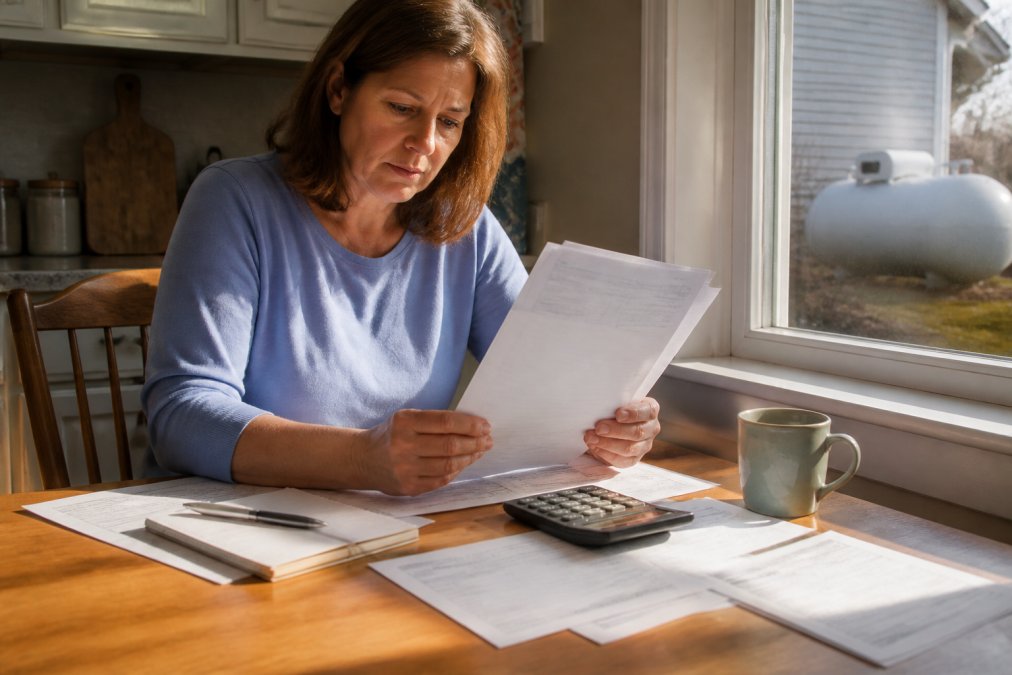
Start with consumption. Review past heating bills or delivery records if you’ve been a customer for multiple years. If you’re new to propane or switching from oil heating, use a baseline estimate and adjust after your first winter. Your HVAC contractor can provide rough consumption estimates based on your home’s square footage, insulation rating, and heating system efficiency.
Next, research current pricing. Contact local suppliers directly or check their websites for posted prices. Discount Propane offers transparent, real-time pricing online, you can see the current per-gallon rate without calling anyone or providing personal information. This lets you compare costs across suppliers immediately.
Factor in delivery fees. Ask suppliers directly: what’s the delivery charge for a standard fill-up? Does it vary by season? Are there minimum order quantities that affect the per-gallon cost? Some suppliers charge a flat delivery fee per trip. Others charge a percentage of the order value.
Ways to Reduce Your Annual Propane Spending
Lower consumption beats negotiating lower prices every time. A 20% reduction in usage saves more money than a 5% price reduction, and you control consumption directly.
| Strategy | Impact | Effort |
|---|---|---|
| Seal air leaks | 5-10% savings | Low |
| Improve attic insulation | 10-15% savings | High |
| Lower thermostat 5° at night | 10-15% savings | Low |
| Insulate water heater | 5-10% savings | Low |
| Budget billing | Cost smoothing | Low |
| Pre-buy programs | Price protection | Medium |
| Shop for better rates | 10-25% savings | Low |
| Tank monitoring tech | Prevents emergency fees | Medium |
Conclusion
Annual propane costs for Nassau County residents depend on consumption, market prices, delivery logistics, and how efficiently you use the fuel. Most homeowners can reduce spending through insulation improvements and thermostat management without sacrificing comfort. Transparent pricing and easy switching remove the friction that keeps customers locked into expensive suppliers.
Frequently Asked Questions
How many gallons of propane does an average home use per year?
Most residential homes use between 800 and 1,200 gallons annually for heating, depending on climate, home size, insulation quality, and heating degree days. Smaller homes or those in milder climates may use 600 gallons, while larger homes in colder regions can exceed 1,500 gallons. Your actual consumption depends on how efficiently your heating system operates and your thermostat settings.
What factors influence annual propane costs for homeowners?
Annual propane costs depend on gallons consumed, current market prices per gallon, delivery surcharges, tank capacity, seasonal demand fluctuations, and your location. Supply chain factors, heating degree days, and whether you use a fixed or variable pricing plan also affect your total bill. Budget billing plans can spread costs evenly across 12 months, making expenses more predictable.
Is it cheaper to own or lease a propane tank?
Tank ownership typically costs less over time if you stay in your home for many years, though the upfront purchase price is higher. Leasing offers flexibility and shifts maintenance responsibility to the propane company, but monthly lease fees add up annually. Calculate your break-even point based on local lease rates and tank purchase prices to determine which option makes sense for your situation.
How can I find transparent, upfront propane pricing?
Look for propane providers that display real-time prices online without requiring a phone call for quotes. Transparent companies show price per gallon, delivery fees, and any surcharges upfront before you order. Check if they offer easy online account management so you can see your costs before committing to a delivery.