
Table of Contents
- What You’ll Need Before You Store Propane Cylinders
- OSHA Propane Storage Requirements for Warehouse Operations
- Propane Tank Separation Distances You Must Follow
- Indoor Propane Cylinder Storage Regulations and Ventilation
- Step-by-Step: How to Safely Store Propane Tanks at Warehouses
- Warehouse Fire Suppression and Emergency Response Protocols
- Inventory Management and Segregation from Incompatible Materials
- Frequently Asked Questions
Last Updated: September 10, 2026
What You’ll Need Before You Store Propane Cylinders
This Discount Propane guide covers how to safely store propane tanks at warehouses, starting with physical prerequisites rather than paperwork.
Propane is a flammable gas stored as a liquid under pressure, so warehouse rules treat it differently from ordinary inventory. A cylinder that tips, overheats, or sits near a spark can release vapor that finds an ignition source fast.
Gather these before you designate a storage area:
- A dedicated outdoor storage cage or rack, anchored and lockable
- Chains, straps, or rack brackets rated for cylinder securement
- A concrete or paved pad that drains away from the building
- Class B fire extinguishers within reach of the storage area
- A leak detection solution, either soapy water or an electronic combustible gas detector
- Signage marking the area as flammable gas storage
- A written log for cylinder receipts, moves, and inspections
The OSHA compressed gas storage guidance treats compressed gas cylinders as hazardous materials, so the storage area needs to be planned before the first delivery, not after.
The most common mistake is storing cylinders indoors “temporarily” while a bay is reorganized. Propane vapor is heavier than air and pools at floor level, where forklifts, chargers, and floor equipment create ignition risk.
OSHA Propane Storage Requirements for Warehouse Operations
OSHA propane storage requirements for warehouses center on separation, securement, and ventilation, whether you store five cylinders or five hundred.
Key OSHA Standards That Apply to Your Warehouse
The core rules under OSHA’s compressed gas standards (29 CFR 1910.101) require cylinders to be secured upright, kept away from heat and ignition sources, and stored so they cannot be knocked over or damaged. The NFPA 58 Liquefied Petroleum Gas Code adds detail on separation distances, ventilation, and container integrity that most warehouse operators follow alongside OSHA.
| Requirement | What It Means in Practice | Who Enforces It |
|---|---|---|
| Upright storage | Cylinders stand on their foot ring, never on their side | OSHA |
| Securement | Chains, straps, or rack brackets hold each cylinder | OSHA |
| Separation | Distance kept from heat, sparks, and combustibles | OSHA / NFPA |
| Ventilation | Airflow prevents vapor accumulation | NFPA 58 |
| Marking | Area signed as flammable gas storage | OSHA |
Propane Tank Separation Distances You Must Follow
Propane tank separation distances exist because vapor pressure rises with temperature, and a cylinder near a heat source can vent through its relief valve. Distance is the cheapest safety control available.
Distance from Ignition Sources and Combustible Materials
Store cylinders at least 20 feet from flammable liquids, combustible materials, and open flames, and away from heaters, welding bays, and direct sunlight on hot pavement. A cage against a south-facing wall in summer is a real problem, because interior temperature climbs well above air temperature.
Practical separation rules for warehouse layouts:
- Place the storage cage outdoors, on a paved pad, away from building openings
- Keep cylinders clear of loading dock traffic lanes
- Separate full cylinders from incompatible materials such as oxidizers
- Do not store cylinders near battery charging stations, where hydrogen and sparks coexist
- Point relief valves away from buildings and walkways
Indoor Propane Cylinder Storage Regulations and Ventilation
Indoor propane cylinder storage regulations are stricter than outdoor rules, and many warehouses should not store propane inside at all. Where indoor storage is unavoidable, ventilation and vapor control decide the layout.
Ventilation and Airflow Requirements for Enclosed Spaces
Propane vapor is heavier than air, so it collects at floor level. Ventilation must move air at the low point of the space, not just at ceiling height. NFPA 58 addresses enclosed storage ventilation, and ignoring it creates a gas dispersion problem a standard HVAC system will not solve.
If you must store cylinders indoors:
- Store only the minimum quantity needed for the shift
- Use a room with low-level vents that open to outside air
- Keep the space free of ignition sources, including static electricity risks
- Install a combustible gas detector near floor level
- Never store cylinders in a basement or below-grade space
Ground the storage area and use bonding straps when moving cylinders. Static electricity during transfer is a real ignition source, and it is the one hazard warehouse crews most often overlook.
Step-by-Step: How to Safely Store Propane Tanks at Warehouses
Follow these steps in order each time cylinders arrive.
- Inspect each cylinder on arrival. Check for corrosion, dents, damaged valves, and missing foot rings. Reject any cylinder with visible damage.
- Verify the valve assembly is closed. Confirm the valve is in the off position before moving the cylinder.
- Move cylinders upright, using a hand truck or cart. Never roll or drag a cylinder, and never lift by the valve.
- Position cylinders on the outdoor pad or in the storage cage. Stand each one on its foot ring.
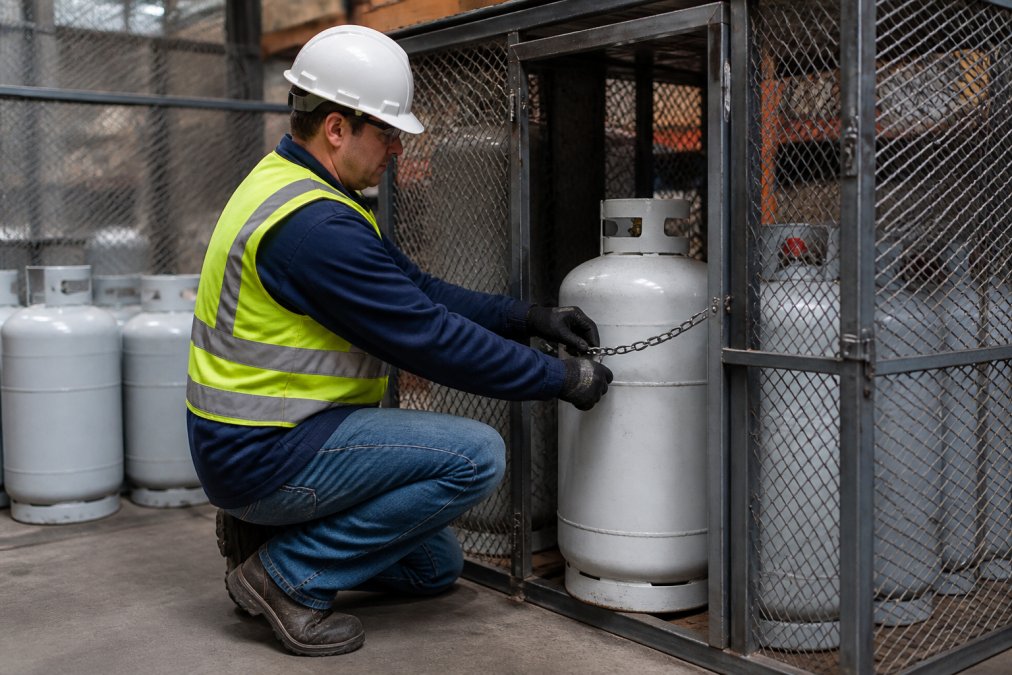
- Secure every cylinder. Use chains, straps, or rack brackets so a cylinder cannot tip.
- Check separation distances. Confirm 20 feet of clearance from combustibles and ignition sources.
- Confirm ventilation. For any indoor storage, verify low-level airflow is working.
- Log the cylinder. Record the receipt, location, and inspection result.
Upright Positioning, Securement, and Foot Ring Stability
Upright positioning is non-negotiable. A cylinder on its side can roll, stress the valve assembly, and let liquid propane reach the relief valve instead of vapor. The foot ring keeps a cylinder stable, so a damaged or missing one takes that cylinder out of service. warehouse racking load capacity.
Securement is the second half of the same control. Chains and straps should hold the cylinder against a fixed rack or wall so it cannot move during forklift traffic, and the cage itself should be anchored to the pad.
Warehouse Fire Suppression and Emergency Response Protocols
Fire suppression around propane storage is about containment, not extinguishing a fully involved cylinder. Once a relief valve is venting and the escaping vapor is burning, evacuate, isolate, and let it burn under control rather than knock the flame down, which can let unburned gas accumulate and re-ignite. This is the most counterintuitive point for crews trained on ordinary Class A fires.
How Propane Storage Fits Your Building’s Fire Protection Systems
In a warehouse, propane storage has to be reconciled with the building’s fire protection design, usually built around NFPA 13 sprinkler coverage and NFPA 30 flammable and combustible liquids rules. Key points:
- Sprinklers protect the structure, not the cylinder. NFPA 13 coverage controls a building fire and protects the roof and racking. It does not cool a propane cylinder enough to prevent a relief valve from venting, and it does not make indoor propane storage acceptable on its own.
- Keep the storage cage out of sprinkler shadow. If the cage sits under a mezzanine, a deep rack bay, or a high-piled storage area, sprinkler water may never reach a fire in or around it. Place the cage fully within sprinkler coverage or, preferably, outdoors.
- Respect the flammable liquids boundary. NFPA 30 governs how flammable and combustible liquids are stored and separated. Propane is a flammable gas, not a liquid, but the same separation logic applies: keep the cylinder cage out of any flammable liquid storage area and out of its drainage path.
- Review the cage location with your fire protection contractor. A short walkthrough with the contractor who services your sprinkler and alarm systems is the cheapest way to confirm the cage does not sit in a coverage gap or block an alarm device.
Emergency Response Protocols for Warehouse Staff
Post a written protocol at the storage cage and cover it in shift briefings. A workable sequence for a suspected leak or fire:
- Do not approach a leaking cylinder to close the valve if vapor is already visible or audible. Move upwind and uphill of the release.
- Trigger the building alarm and call 911. State that propane is involved and give the cage location.
- Evacuate to the designated assembly point, upwind of the cage. Propane vapor is heavier than air and travels along the ground, so an assembly point downhill or downwind is the wrong choice.
- Shut down nearby ignition sources remotely if it is safe to do so, forklift charging, welding bays, and any open flame equipment in the area.
- Account for personnel. Use your normal roll-call method and report anyone unaccounted for to the fire department.
- Do not re-enter until the fire department clears the area. A cylinder that has vented can re-pressurize and vent again as it warms.
For a small, incipient fire that has not reached a cylinder, a trash fire next to the cage, for example, a Class B extinguisher is appropriate. For anything involving a cylinder itself, evacuate.
Pre-Incident Planning That Pays Off
- Give the fire department a pre-plan that shows the cage location, cylinder quantities, and the nearest hydrant.
- Keep a call list at the cage that includes the fire department, your propane supplier, and the facility emergency contact.
- Inspect every cylinder in and around the cage after any incident, even a minor one, before returning the area to service.
A propane cylinder fire is not a “knock it down and clean up” event. If a cylinder is venting and burning, the correct action is evacuation and containment, not extinguishment.
Fire Suppression and Emergency Response Checklist
| Item | What to Confirm |
|---|---|
| Sprinkler coverage | Cage is within NFPA 13 coverage, not in a shadow |
| Flammable liquid separation | Cage is outside NFPA 30 storage areas and drainage paths |
| Extinguishers | Class B units within reach, inspected and tagged |
| Alarm and call list | Posted at the cage, current |
| Pre-plan | On file with the fire department |
| Evacuation route | Upwind and uphill of the cage |
| Post-incident inspection | Every cylinder in the area checked before reuse |
Inventory Management and Segregation from Incompatible Materials
Inventory management is the gap most warehouses leave open. Cylinders that sit for months without rotation hide corrosion and leaks, and full cylinders mixed with empty ones create confusion during an emergency. A home user stores two cylinders; a warehouse may store two hundred, and the difference is a system, not a shelf.
Why FIFO Matters for Propane Cylinders
First-In, First-Out is standard for perishable goods, and propane cylinders belong on the same list for a mechanical reason. Every cylinder’s valve assembly and relief valve rely on elastomeric seals and seats that degrade from propane exposure, temperature cycling, and UV. A cylinder untouched for a year is more likely to have a stiff or weeping seal than one in regular service.
A practical rotation rule:
- First in, first out. Ship or use the oldest full cylinders first, regardless of where they sit in the cage.
- Date every cylinder on receipt. A paint marker or a durable tag on the collar is enough.
- Inspect on rotation, not on a calendar. Every time a cylinder moves, check the valve, collar, foot ring, and body for corrosion or damage.
- Quarantine anything questionable. A tagged quarantine zone keeps a suspect cylinder out of the rotation until it is inspected or returned.
Segregation from Incompatible Materials
Propane must be kept away from incompatible materials, and in a warehouse that list is longer than most crews realize. Key separations:
- Oxidizers. Oxygen cylinders, nitrous oxide, and pool or janitorial chemicals containing hypochlorite or peroxides accelerate combustion. Store them in a separate area, ideally a separate cage, with a clear distance between the two.
- Flammable liquids. Gasoline, solvents, and paint thinners belong in their own flammable liquid cabinet or room, not next to the propane cage.
- Corrosives. Acids and caustics can attack cylinder valves and collars if a container leaks nearby.
- Combustible materials. Cardboard, pallets, and shrink wrap stacked against the cage are fuel. Keep a clear zone around the cage.
- Ignition sources. Battery charging stations, welding bays, and any open flame equipment belong well away from the cage.
Full, Empty, and Damaged Cylinder Zones
A three-zone layout removes most of the confusion during an emergency and during normal operations:
| Cylinder Status | Storage Zone | Rotation Rule |
|---|---|---|
| Full | Outdoor cage, labeled zone | First in, first out |
| Empty | Separate labeled area | Return on next delivery |
| Damaged | Quarantine, tagged | Inspect before reuse |
Label each zone with signage identifying it as flammable gas storage and stating the rotation rule. A simple paper or digital log is enough: record each cylinder’s arrival date, location, and condition, and review it weekly. The log is also your evidence of due diligence if an inspector or insurance carrier asks how cylinders are managed.
Tie the cylinder log to your delivery schedule. When full and empty cylinders move on a predictable cadence, FIFO happens on its own and the cage never becomes a dead-storage area where corrosion and leaks go unnoticed.
When you need cylinders delivered on a schedule that fits your operation, Discount Propane offers online ordering and delivery scheduling so you can see pricing upfront and plan refills without a phone call.
Frequently Asked Questions
What are the OSHA regulations for storing propane tanks?
OSHA 29 CFR 1910.110 governs propane storage and requires cylinders to be stored upright, away from heat sources, and in areas with proper ventilation. Cylinders must be secured to prevent tipping, and storage areas must be separated from incompatible materials. OSHA also requires that storage locations be clearly marked with no smoking signs and that employees receive proper training on handling and emergency procedures.
Can propane tanks be stored indoors at a warehouse?
Indoor propane cylinder storage is allowed under specific conditions. NFPA 58 limits indoor storage to cylinders with a water capacity of 2.5 pounds or less in most occupancies, but larger cylinders may be stored in dedicated rooms with proper ventilation, fire-rated construction, and no ignition sources. Your local fire code and building occupancy classification determine the exact limits. Always verify with your authority having jurisdiction before storing propane indoors.
How far should propane tanks be kept from ignition sources?
NFPA 58 requires a minimum separation of 10 feet between propane cylinders and open flames, ignition sources, or combustible materials. For larger storage quantities, separation distances increase. Cylinders should also be kept at least 20 feet from oxygen cylinders and other oxidizing gases. These distances help prevent fire hazards and allow safe gas dispersion if a leak occurs.
How do you properly secure propane tanks to prevent tipping?
Secure propane cylinders in an upright position using chains, straps, or a storage rack designed for cylinder containment. The foot ring or base ring must sit flat on a level surface. Never lay cylinders on their side. For warehouse settings, use a storage cage or rack system that keeps cylinders vertical and prevents them from falling during transport or accidental contact with forklifts.