
Table of Contents
- 1. Install a Smart Thermostat to Cut Propane Consumption
- 2. Smart Propane Tank Monitor Benefits: Real-Time Fuel Tracking
- 3. How to Optimize Propane Furnace Efficiency With Smart Diagnostics
- 4. Seal Air Leaks and Insulate for a Tighter Thermal Envelope
- 5. Is Propane Cheaper Than Heating Oil? Smart Tech Tips to Compare
- 6. Use Smart Plugs and Zoned Heating for Supplemental Warmth
- 7. Automate Budget Billing and Fuel Deliveries With Smart Alerts
- Conclusion: Smart Tech That Pays for Itself
- Frequently Asked Questions
Last Updated: October 1, 2026
1. Install a Smart Thermostat to Cut Propane Consumption
A smart thermostat is a Wi-Fi-connected device that adjusts your home’s heating schedule automatically based on occupancy, time of day, and your habits. For propane users, that automation directly reduces burner runtime, which is where most of your propane costs go.
Most homeowners set one temperature and forget it. A smart thermostat fixes that by lowering the heat when rooms are empty and restoring it before you walk in the door. The result is fewer hours of furnace operation and a smaller heating bill.
Check for a C-wire before buying. Many older propane furnaces and boilers don’t have one, and without it your thermostat may need a power adapter kit or a professional install.
How Automated Scheduling Reduces Burner Runtime
Automated scheduling works by grouping your week into blocks: home, away, and sleep. During away and sleep blocks, the thermostat drops the setpoint a few degrees, and the furnace simply runs less.
Temperature setpoints matter more than most people realize. Every degree you lower the setpoint during an 8-hour away block reduces runtime proportionally. Stack that across a full heating season and the savings add up without any comfort loss. Applying this same logic of incremental adjustments to your air conditioning system provides a reliable method to lower cooling bills while maintaining a consistent indoor climate throughout the warmer months.
Popular options include the ENERGY STAR smart thermostat program, which lists certified models and their efficiency claims. The Ecobee Smart Thermostat Premium and Google Nest Learning Thermostat both handle scheduling well, and the Emerson Sensi Touch 2 is a strong pick if you want simple setup over advanced learning.
| Thermostat | Starting Price | Best For | Standout Feature |
|---|---|---|---|
| Ecobee Smart Thermostat Premium | $229.99 | Room-by-room control | SmartSensor occupancy detection |
| Google Nest Learning Thermostat | $279.00 | Set-and-forget users | Auto-Schedule learning |
| Emerson Sensi Touch 2 | $179.99 | DIY installers | Easy setup, 7-day scheduling |
| Honeywell Home T9 | $169.99 | Uneven heating | Smart Room Sensors |
| Wyze Thermostat | $79.99 | Tight budgets | Low cost, basic scheduling |
2. Smart Propane Tank Monitor Benefits: Real-Time Fuel Tracking
Smart propane tank monitoring is a cellular or Wi-Fi sensor that attaches to your tank gauge and reports fuel levels to a mobile app in real time. The main benefit is simple: you stop guessing how much propane is left and start ordering based on actual data.
Running out mid-winter is the most expensive mistake a propane household can make. Emergency deliveries carry premium charges, and a cold house can mean frozen pipes. A monitor removes that risk entirely.
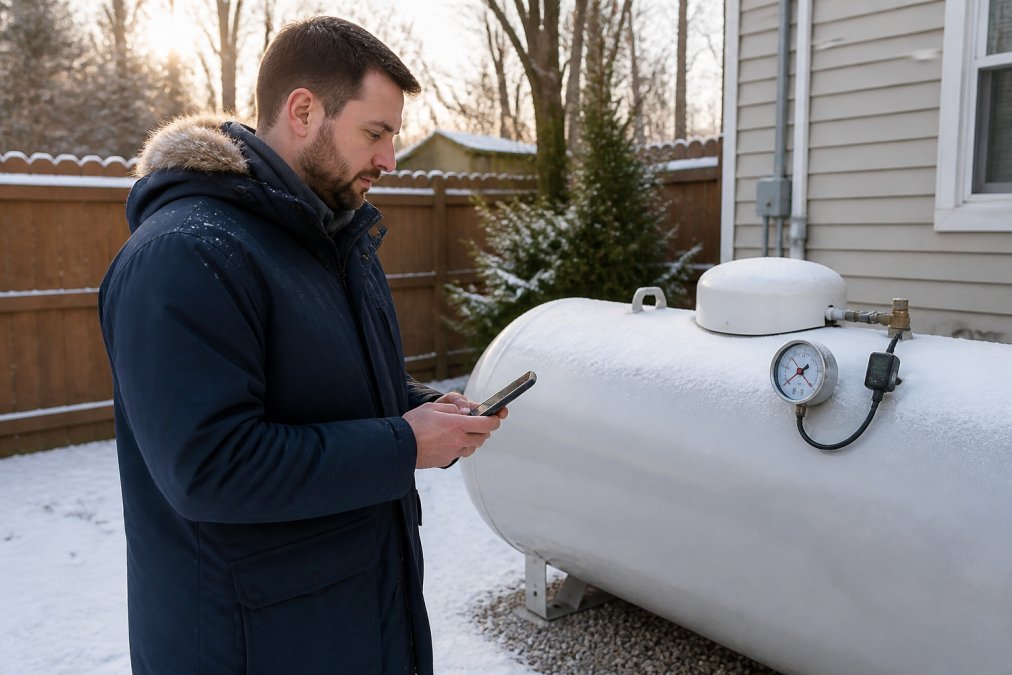
The Tank Utility Propane Monitor is the most established option here. It tracks usage history, which helps you spot consumption patterns, like a furnace that’s suddenly working harder than it should.
Avoid Emergency Delivery Fees and Run-Outs
A low-fuel alert fires when your tank hits a threshold you set, giving you days of lead time instead of hours. That window is what lets you schedule a normal delivery rather than pay for an emergency run.
Fuel level sensors also help you verify delivery amounts. If a fill doesn’t match what you were billed for, the usage history shows it. That kind of transparency is worth having when you’re comparing suppliers.
Monitors need a cellular signal at the tank. If your tank sits in a dead zone, check coverage before buying, or choose a model that supports an external antenna.
3. How to Optimize Propane Furnace Efficiency With Smart Diagnostics
Smart diagnostics are monitoring tools that track your furnace’s performance continuously and flag efficiency drops before they turn into breakdowns. A furnace running below peak BTU efficiency burns more propane for the same heat.
The Emerson Sensi Predict is built for exactly this. It watches furnace health in real time and sends predictive maintenance alerts, so a failing igniter or a dirty burner gets caught early instead of mid-January.
If you’d rather skip the subscription, a simple annual tune-up still matters. A technician checks burner adjustment, airflow, and combustion, all of which drift over time. Pair that with a diagnostic tool and you’re covering both the mechanical and the monitoring side.
4. Seal Air Leaks and Insulate for a Tighter Thermal Envelope
Your thermal envelope is the boundary between conditioned indoor air and the outdoors: walls, attic, basement, windows, and doors. Every gap in it leaks heat your propane paid for.
Air sealing is the cheapest efficiency upgrade in most homes. Weather stripping around doors, caulk along window frames, and foam around pipe penetrations cost little and cut heat loss immediately.
Insulation upgrades go further. Attic insulation in particular tends to be thin in older homes. The DOE home energy audit guidance recommends a professional energy audit to find where your home loses heat before you spend on fixes.
One practical note: seal first, insulate second. Adding insulation over an unsealed attic floor traps air leaks underneath it and wastes the investment.
5. Is Propane Cheaper Than Heating Oil? Smart Tech Tips to Compare
Propane is often cheaper than heating oil per BTU, but the gap shifts with the market, so the honest answer is that it depends on current prices in your area. What smart tech changes is how precisely you can compare the two.
The trick is to compare cost per BTU, not cost per gallon. Propane delivers roughly 91,500 BTUs per gallon, while heating oil delivers about 138,500 BTUs per gallon, according to EIA heating fuel comparison data. Divide your price per gallon by the BTU content, then compare furnace efficiency on top of that.
Smart thermostats and usage reports make comparing propane costs easier because they show actual consumption, not estimates. If you’re weighing a conversion from oil to propane, real usage data from a monitored home gives you a far better projection than a rule-of-thumb calculator.
6. Use Smart Plugs and Zoned Heating for Supplemental Warmth
Supplemental heating means warming only the rooms you actually use, instead of heating the whole house to one temperature. Smart plugs and zoned controls make that practical.
A smart plug can schedule a space heater in a home office for work hours only. The Mysa Smart Thermostat handles high-voltage electric baseboard heat with the same scheduling logic, which is useful if you run electric heat in one or two rooms alongside a propane furnace.
The Shelly Plus 1 Smart Relay is the budget pick for tinkerers. It’s a small Wi-Fi relay that can automate a non-smart heating zone or circulator pump, and it supports an open API for custom home automation setups.
The goal isn’t to replace your propane heat. It’s to stop paying propane prices to heat rooms nobody’s sitting in.
7. Automate Budget Billing and Fuel Deliveries With Smart Alerts
Budget billing spreads your annual fuel cost across even monthly payments, which smooths out winter spikes. Smart alerts pair with it by triggering a reorder before you hit a low threshold, so you’re never buying fuel in a panic.
Automated scheduling is where this gets genuinely useful. Set a low-fuel alert, link it to your supplier’s ordering system, and your delivery happens on your schedule, not the week you run out.
The strongest setup combines a tank monitor, a low-fuel alert, and a supplier that lets you order online in minutes. That combination eliminates both emergency fees and the phone call.
This is where Discount Propane fits naturally. You can check real-time propane prices online before ordering, schedule delivery without a commitment, and manage everything from your phone or PC. Payment options include PCI-compliant credit card processing, cash on delivery, or Zelle, so you’re not locked into one billing method.
Conclusion: Smart Tech That Pays for Itself
The hard part isn’t buying the hardware. It’s building a system where your thermostat, tank monitor, and delivery schedule all talk to each other, and that takes a supplier who makes ordering simple.
Discount Propane was built for exactly that. Upfront online pricing lets you see costs before you commit, flexible scheduling means you order when your monitor says it’s time, and secure account management keeps everything in one place. Get started with Discount Propane and take the guesswork out of your next fill.
Frequently Asked Questions
Can smart thermostats be used with propane heating systems?
Yes. Smart thermostats like the Ecobee Smart Thermostat Premium, Nest Learning Thermostat, and Emerson Sensi Touch 2 are compatible with most propane furnaces. They work by controlling the low-voltage signal to your furnace, just like a standard thermostat. The main requirement is a C-wire for constant power, though some models include adapters. Once installed, you can set schedules, use geofencing, and monitor runtime to reduce propane consumption.
How does a remote tank monitor help save money on propane?
A remote tank monitor like the Tank Utility Propane Monitor tracks your fuel level in real time and sends low-fuel alerts. This prevents you from running out during peak winter months, which often triggers emergency delivery surcharges. It also helps you verify delivery amounts and spot unusual consumption patterns that may indicate a leak or inefficient furnace. By ordering on your schedule rather than guessing, you avoid premium fill-up prices.
Is propane cheaper than heating oil in 2026?
Propane and heating oil prices vary by region and season, but propane typically costs less per BTU than heating oil in many parts of the country. Propane also burns cleaner, which can reduce maintenance costs and extend furnace life. Smart tech like tank monitors and programmable thermostats helps you track usage and buy propane when prices are lower, stretching your budget further. Check current rates on your supplier’s website for the most accurate comparison.
What runs up a propane bill the most?
The biggest culprits are heat loss through air leaks and poor insulation, an inefficient or poorly maintained furnace, and heating empty rooms. Smart thermostats with occupancy sensors, like the Honeywell Home T9 or Ecobee, can stop heating unused spaces. Sealing drafts and insulating ducts also reduce runtime. Finally, scheduling annual furnace tune-ups keeps BTU efficiency high, so you burn less fuel for the same warmth.